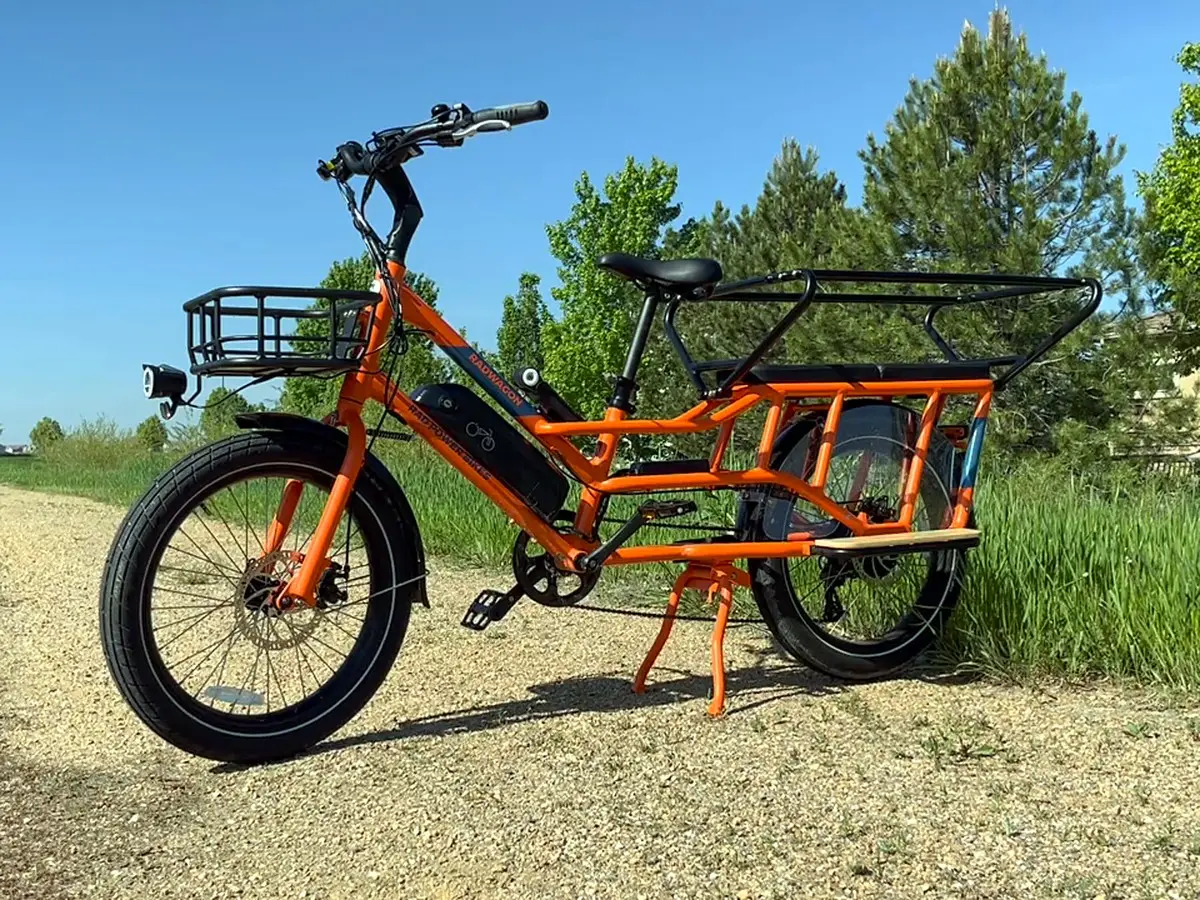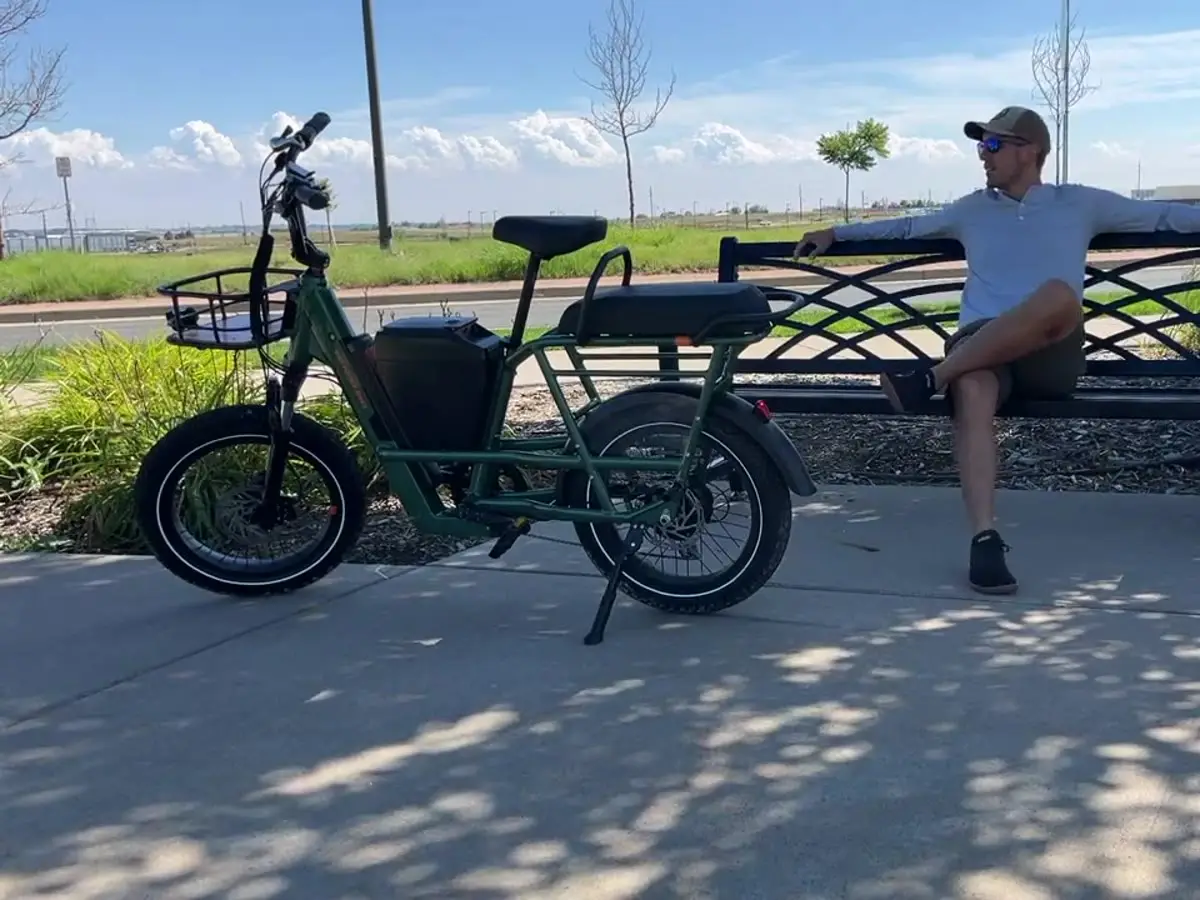
I tested the RadRunner 3 Plus for several weeks with the passenger package, and it carried my kids, hauled backpacks and handled mud and gravel well. I also had a list of things I’d change: a saddle that was too flat, a battery that was only “semi-integrated” and a cadence sensor at that price. The plain Rad RadRunner is Rad’s simplest take on the same idea, a small-wheeled utility bike with one gear, a padded seat and a big rack. I haven’t ridden it. Everything below comes from Rad Power Bikes’ official RadRunner page, checked on Oct 28, 2026 and linked at the bottom.
Simple on purpose
The RadRunner has a single speed: a 52T chainring and a 16T rear cog. There’s no shifter and no derailleur, so you can’t pick an easier gear for a steep climb; the motor and throttle have to cover that. The fork is rigid steel, so the 20 x 3.3 in tires are your only suspension. When I rode the 3 Plus, it had a 7-speed and a 60mm fork, so this is a much more basic bike.
Some of what I’d change on the 3 Plus is addressed here. The saddle is a moped-style seat with extra padding, not a flat one, and the battery is an external pack, which is easy to see and easy to remove.
Motor and controls
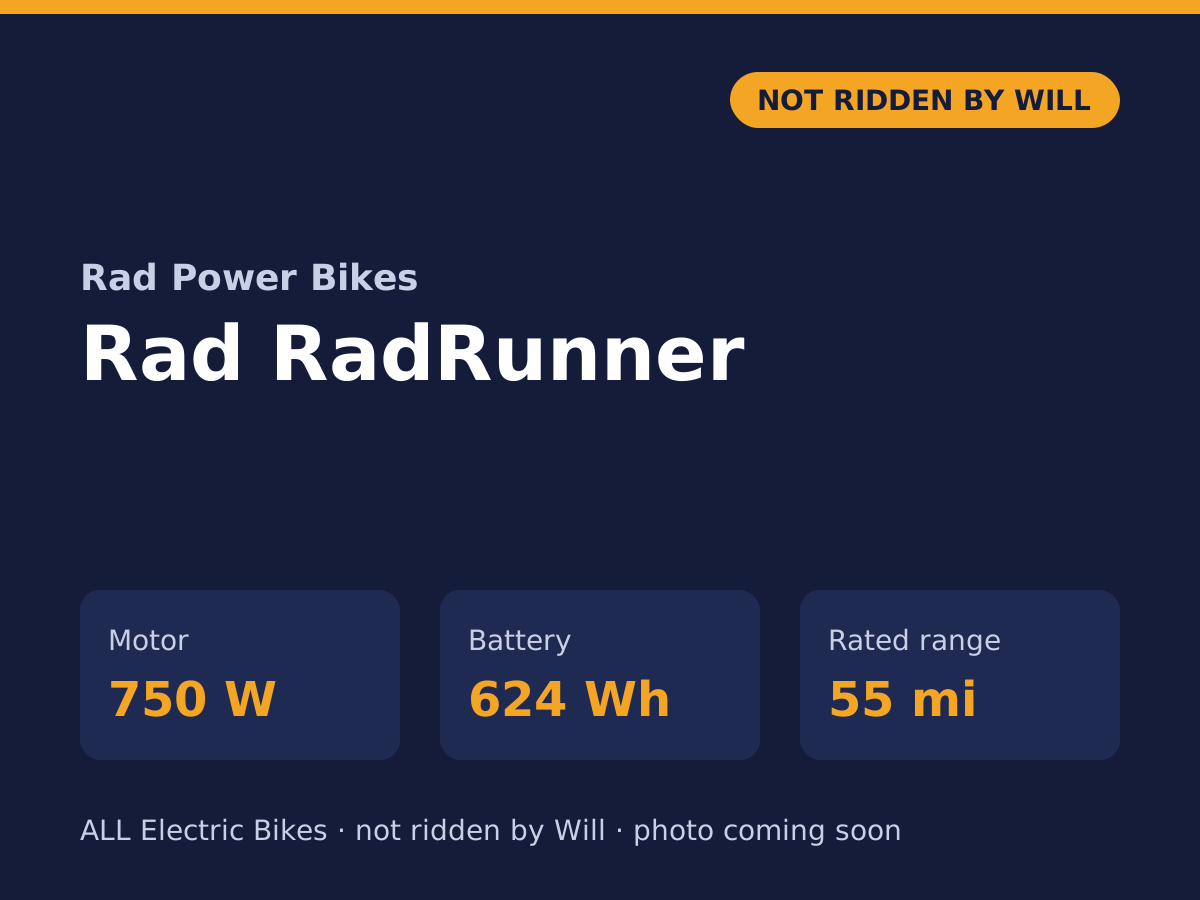
The motor is a 750W rear hub. Rad’s page doesn’t agree with itself on torque: the spec table says 60 Nm, but the marketing copy says 65 Nm twice. I’d go with the spec table until Rad clarifies it. Pedal assist uses a cadence sensor, with five levels plus a zero assist option, and there’s a half-twist grip throttle. It’s a Class 2 bike with a 20 mph top speed. Check your local rules in our e-bike laws hub.
The color display has passcode protection, maintenance reminders and a USB-C port for your phone. The headlight is a 40 lux, 100 lumen LED that turns on when it senses it’s getting dark.
Battery and range
The battery is Rad’s Safe Shield external pack, 48V 13Ah, 624Wh, UL certified, with what Rad calls thermal-resistant tech. Rad estimates 17 to 55+ miles per charge, a wide range that tells you how much cargo, hills and throttle use matter on a bike like this. The charger is a 48V, 2 amp unit. Rad notes the battery key is a universal key, not unique to your bike, which is worth knowing if you park it in public. Rad lists UL 2849 and UL 2271 certification for the bike and an IPX6 weather rating.
Brakes and tires
Gemma GA-950E hydraulic disc brakes with 180mm rotors handle stopping. The tires are Rad’s own 20 x 3.3 in design with puncture protection, a multi-surface tread and a reflective stripe.
Hauling and fit
The integrated rear rack holds 120 lb, and total payload is 320 lb with a 275 lb max rider. The bike weighs 65 lb, or 55 lb with the battery out, which is about 10 lb lighter than the 75.5 lb Rad listed for the 3 Plus. A dual-leg steel kickstand comes standard. Fenders are sold separately.
There’s one size, for riders 4’11” to 6’2”, with a 16.5 in standover and a 45 in wheelbase. The seat height runs from 31.5 to 42.5 in from the ground.
RadRunner, RadRunner Plus or RadRunner Max?
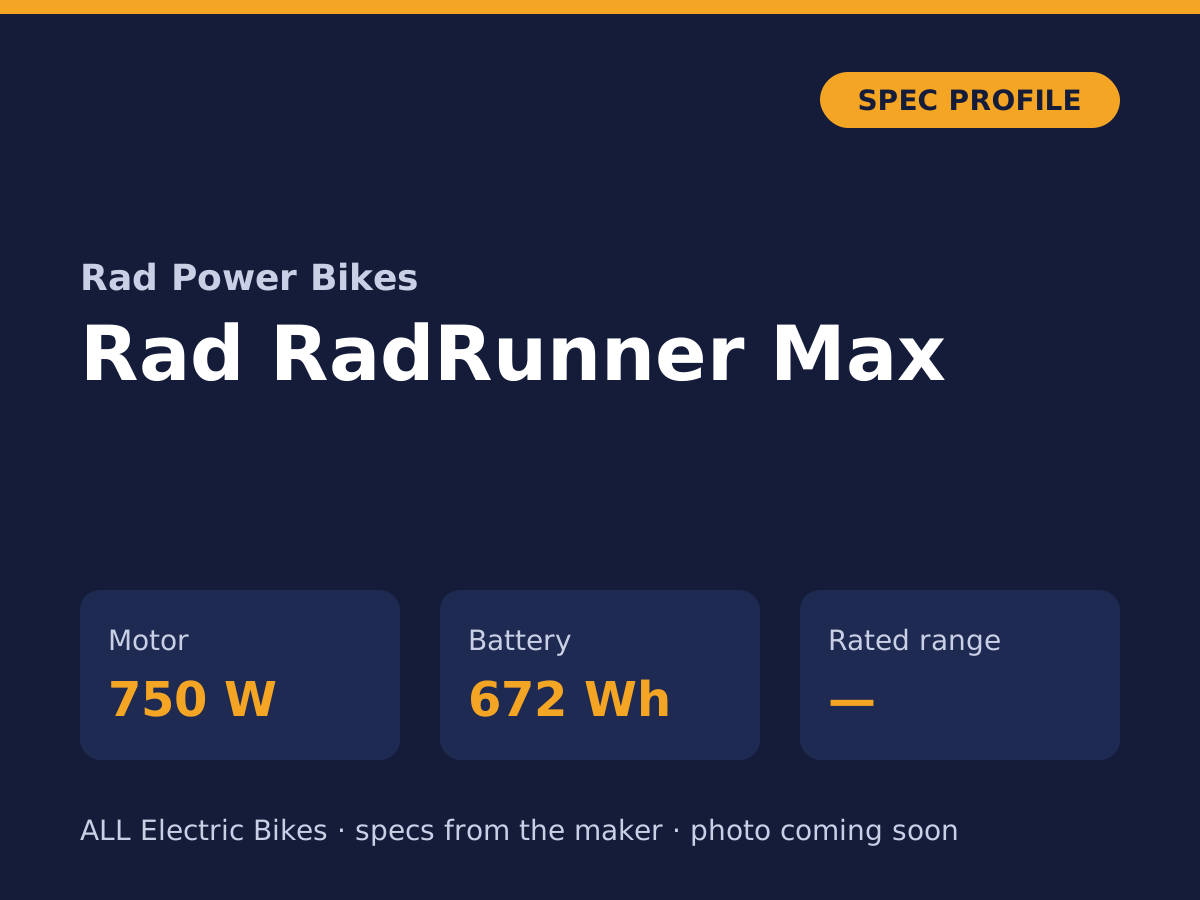
The RadRunner Plus is $1,799 as of Oct 28, 2026. Based on our Plus page, the extra $300 gets you a Shimano 7-speed and a 65mm suspension fork, with the same 624Wh battery, the same brakes and a 120 lb rack, at 75 lb. The RadRunner Max is Rad’s bigger model, covered on its own page. If your rides are flat and mostly in town, the base RadRunner covers it. If you have hills, the gears on the Plus are the reason to spend more.
How it fits with the bikes I’ve reviewed
The RadRunner 3 Plus is the closest bike I’ve ridden. Compared with it, the base RadRunner is lighter and simpler, with a padded saddle and an easy-to-remove battery, but it gives up the gears, the front suspension and some of the 3 Plus’s 350 lb payload. Both use a cadence sensor. The RadWagon 4 is the bigger cargo bike I filmed from Rad, which I used for school drop-offs and groceries with two kids on the back. If carrying two kids is the main job, start there. My best cargo e-bike guide has more options.
FAQ
Have I ridden the RadRunner?
No. I haven’t ridden it. I rode and filmed the RadRunner 3 Plus and the RadWagon 4, and this page compares the RadRunner with them using Rad’s published specs.
How much torque does it have?
Rad’s spec table says 60 Nm. The marketing text on the same page says 65 Nm. Until Rad clarifies, I’d use 60 Nm.
Does it have gears?
No. It’s a single speed with a 52T chainring and a 16T cog. The RadRunner Plus adds a 7-speed.
Does it come with fenders?
No. Rad lists fenders as sold separately.
Will it fit me?
Rad lists one size for riders 4’11” to 6’2”, with a 16.5 in standover and seat heights from 31.5 to 42.5 in.
Pros and cons (from the specs and sources)
Pros: hydraulic brakes with 180mm rotors; padded moped-style saddle; 120 lb rack and 320 lb payload; 65 lb, lighter than the RadRunner Plus; low 16.5 in standover for riders from 4’11”; passcode display with USB-C; light-sensing headlight.
Cons: single speed; rigid fork; cadence sensor; fenders cost extra; Rad’s page lists two torque figures; showed “Back Order” on Oct 28, 2026; battery key is universal, not unique.
Who it’s for
On paper, the RadRunner fits riders who want a simple, low, sturdy utility bike for errands around town, especially on flat ground, and families who want one bike that riders of different heights can share. If you have real hills or a long commute, the RadRunner Plus adds gears and a suspension fork for $300 more. If hauling kids is the main job, look at a bigger cargo bike like the RadWagon 4.
Price
As of Oct 28, 2026, the Rad RadRunner was $1,499 in Classic Blue and Forest Green, and the page showed it as “Back Order”. A banner on the same page advertised it for $1,399 as a limited-time offer, but the price shown with the buy button was $1,499, so check the final price at checkout.
“For each will have to bear his own load.” Galatians 6:5 (ESV)