Should you buy one?
Start with the battery. On Nov 24, 2025, the CPSC told owners to stop using the battery models the RadWagon 4 shipped with (RP-1304, RAD-S1304Y and HL-RP-S1304). Rad didn’t recall them, and the bike isn’t sold new anymore. So the only way to buy a RadWagon 4 is used, and I’d only do it in one of two cases:
- The battery label shows a model number that isn’t on the CPSC list, such as one of Rad’s newer Safe Shield packs, or
- You budget for a new battery on top of the price of the bike. As of Oct 24, 2026, Rad lists two Safe Shield external batteries that it says fit the RadWagon 4: a 15Ah pack at $599 (out of stock) and a 13Ah pack at $549. Both need Rad’s updated charger, sold separately. Details are in the battery section below.
If neither works for you, skip it. Don’t ride on a flagged pack.
If the battery checks out, the bike itself did the family jobs I bought it for. I used mine for pool runs, trips around town and grocery stops. The throttle gets a loaded bike moving from a stop, the dual-leg kickstand is sturdy, and I had no tire problems on mine.
Skip it even with a good battery if you want a torque sensor, built-in turn signals or a polished drivetrain. The shifter on mine felt cheap, and I had to adjust the gears out of the box.
Price and availability: Rad’s archived RadWagon 4 page (Wayback snapshot, May 31, 2026) showed $1,299, down from $1,799, and marked it out of stock. Rad’s live page for it now returns “not found.”
About the link below: it’s the affiliate link from my video description, and it now goes to the RadWagon 5. I haven’t reviewed the RadWagon 5, so nothing in this review tells you how it rides.
See the RadWagon 5 at Rad Power Bikes (not an affiliate link; goes to the RadWagon 5, not the bike reviewed here)
Who it’s for
- Parents carrying one or two kids to school, the pool or the park.
- Riders who want a throttle that works from zero. With two kids on the back, that first push off a stop is the hardest part.
- Families with riders of different sizes. Rad lists rider heights from 5’1” to 6’4”, and the stem and seatpost adjust.
- Shoppers buying used, or catching a leftover RadWagon 4 deal.
Who should look elsewhere
- If you want a smoother assist that responds to how hard you pedal, the Aventon Abound has a torque sensor. The RadWagon 4 uses a cadence sensor.
- If your passenger would rather ride next to you than behind, look at the MOD Easy Sidecar.
- If you want new and in stock today, you’re shopping for the RadWagon 5, not this bike.
RadWagon 4 vs Aventon Abound vs Abound LR
RadWagon 4 figures are from Rad’s archived product page (May 31, 2026). Abound figures are from my Abound review, which uses Aventon’s archived Abound page (June 2024), except the 440 lb payload, which comes from my Abound video. Abound LR figures are from my Abound LR review, which uses Aventon’s current page (checked Oct 22, 2026).
| Rad RadWagon 4 | Aventon Abound | Aventon Abound LR | |
|---|---|---|---|
| Sustained motor power (W) | 750 | 750 | 750 |
| Torque (Nm) | 65 | Not listed | 80 |
| Torque sensor | No (cadence) | Yes | Yes |
| Pedal assist levels | 5 | 4 | 3 |
| Top speed (mph) | 20 | 20 | Not listed (Class 2) |
| Battery (Wh) | 672 | 720 | 733 |
| Rated range (mi) | 45 | 50 | 60 |
| Charge time (hours) | 7.5 | Not listed | 5 |
| Total payload (lbs) | 350 | 440 | 440 |
| Rear rack rating (lbs) | 120 | 143 | 143 |
| Bike weight (lbs) | 76.7 | 81 | 88 |
| Wheel size (in) | 22 | 20 | 20 |
| Rear gears | 7 | 7 | 8 |
| Suspension fork | No, rigid steel | Yes, up to 50mm | Yes, 51mm |
| Dropper seatpost | No (telescoping post) | Yes | Not listed |
| Turn signals | Not listed | Yes | Yes |
| Throttle | Yes | Yes | Yes |
| Price (USD) | $1,299, out of stock (May 31, 2026 snapshot) | $1,999 (Aug 3, 2023 snapshot) | $1,999 (Oct 22, 2026) |
On price, the RadWagon 4 was only cheaper while it was on sale. Its regular price was $1,799, against $1,999 for the Abound in Aventon’s Aug 2023 snapshot. The $1,299 sale price never came with stock in the snapshot I found, so you can’t buy it new for that today. For more detail, read Aventon Abound vs Rad RadWagon 4.
Setting it up
My bike arrived with the bell bent in shipping (1:58 in the video). It took some twisting to straighten it, and I don’t think that’s typical. The gears were a bigger problem. They didn’t line up and wouldn’t shift through the whole range, so I had to adjust them before the bike rode right. It could have been my unit, but plan on a basic tune before your first loaded ride, or have a shop do it. Rad’s own page rates the build difficulty as hard.
The cockpit
The grips are elongated, which is comfortable on longer rides. The front brake is on the left. The display shows pedal assist from 1 to 5 and a battery fuel gauge, so you know when to head home. On the right, a twist throttle works from zero, which makes it easy to get going with two kids loaded.
The shifter is the weak spot. The 7-speed setup felt cheap in my hand, and while it did the job once I’d adjusted it, it’s the one part of the cockpit that feels built to a price.
How it handles a load
Right behind the front wheel there’s a spring that I hadn’t seen on another e-bike (2:49). Rad’s RadWagon 4 owner’s manual calls it the “deflopilator.” It runs from the fork to the down tube, and Rad says it keeps the front wheel from flopping left or right too easily and improves steering. In the video I said it keeps the handlebars and front tire pointing straight, and that I think it’s just added safety.
Rad lists a 350 lb total payload and a 120 lb rear rack. In the video I read Rad’s claims that the long frame and low center of gravity keep it stable with a full load. I didn’t load it to 350 lb, so treat that as Rad’s claim.
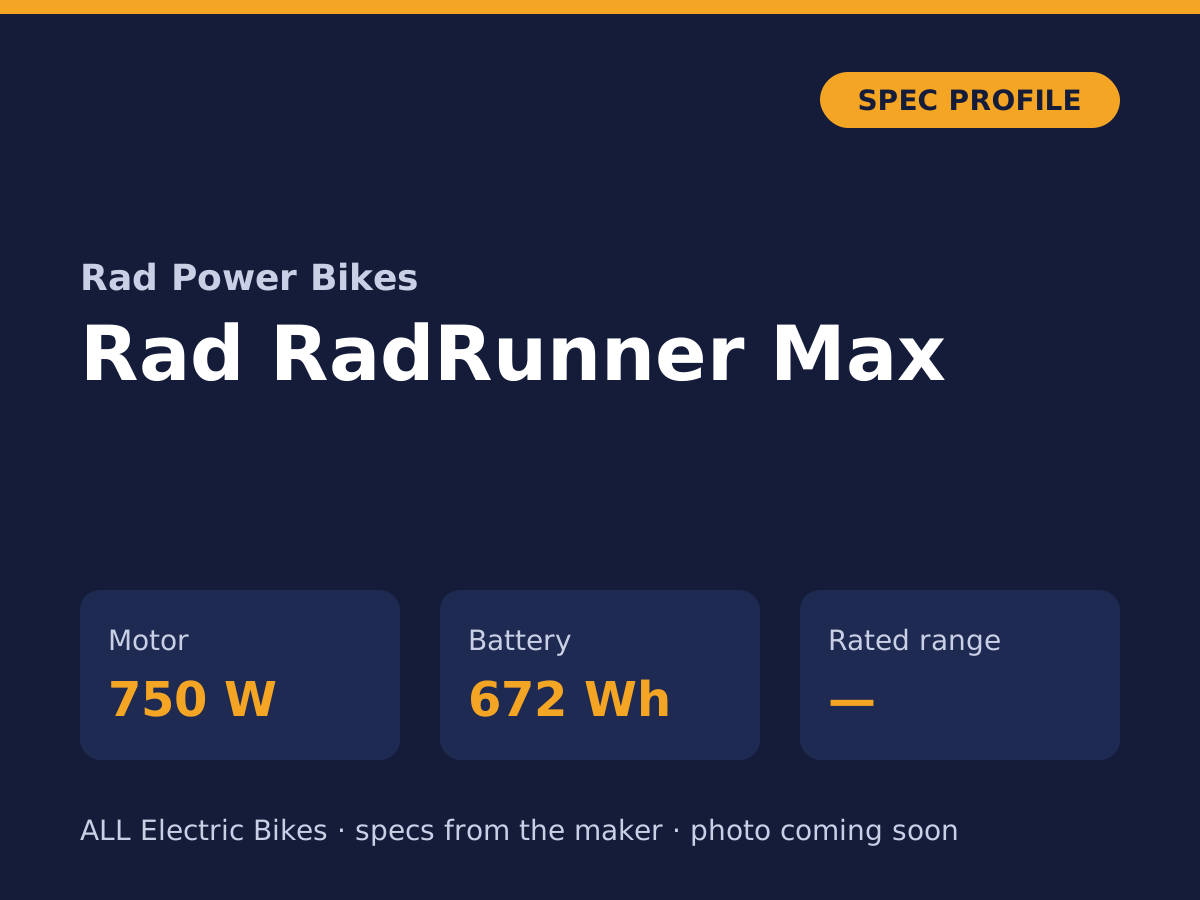
The motor is a 750W rear hub, which Rad rates at 65 Nm. In the video I said it has the power to tackle hills and zip across intersections, but that was me reading the spec. I didn’t film or time a climb.
What the specs mean on the road
Cadence sensor. The motor turns on when the pedals turn, at a set level for each of the 5 assist settings. It doesn’t measure how hard you push.
Rigid steel fork. There’s no front suspension. The 3 inch tires are what soften the ride.
Mechanical disc brakes, 180mm rotors. These are cable brakes, not hydraulic.
672Wh external battery, 25 to 45+ miles. With two kids and groceries, expect the low end.
350 lb payload, 120 lb rack. The payload includes you. Two kids on the rack count against both numbers.
USB port. Rad lists one 5V 1A port.
20 mph, Class 2. Rad’s page lists a 20 mph top speed and Class 2. Both the throttle and the pedal assist stop helping at 20 mph, so it fits where Class 2 bikes are allowed. See my e-bike classes guide.
48V 2A charger, 7.5 hours from empty. Rad’s manual gives an estimated charge time by how much of the battery you used: about 3.75 hours after using half, 6 hours after 80%, and 7.5 hours from empty. Charging in the cold takes longer. The manual says to stop using a battery that still won’t show full after charging at least an hour longer than those times.
My tires
What actually happened, first: the 2022 RadWagon 4 was recalled in Nov 2022 over its 22 x 3 inch tires made by VEE Tire Co. and misaligned rim strips (full details in the tire recall section below). In the video I said Rad brought the tire design in-house after a supplier issue, and that the RadWagon 3 was pulled over its tires. The second part was wrong; it was the RadWagon 4. I rode mine on pavement and the dirt path in the footage with zero tire issues, but on a used bike, check the sidewalls.
Carrying kids
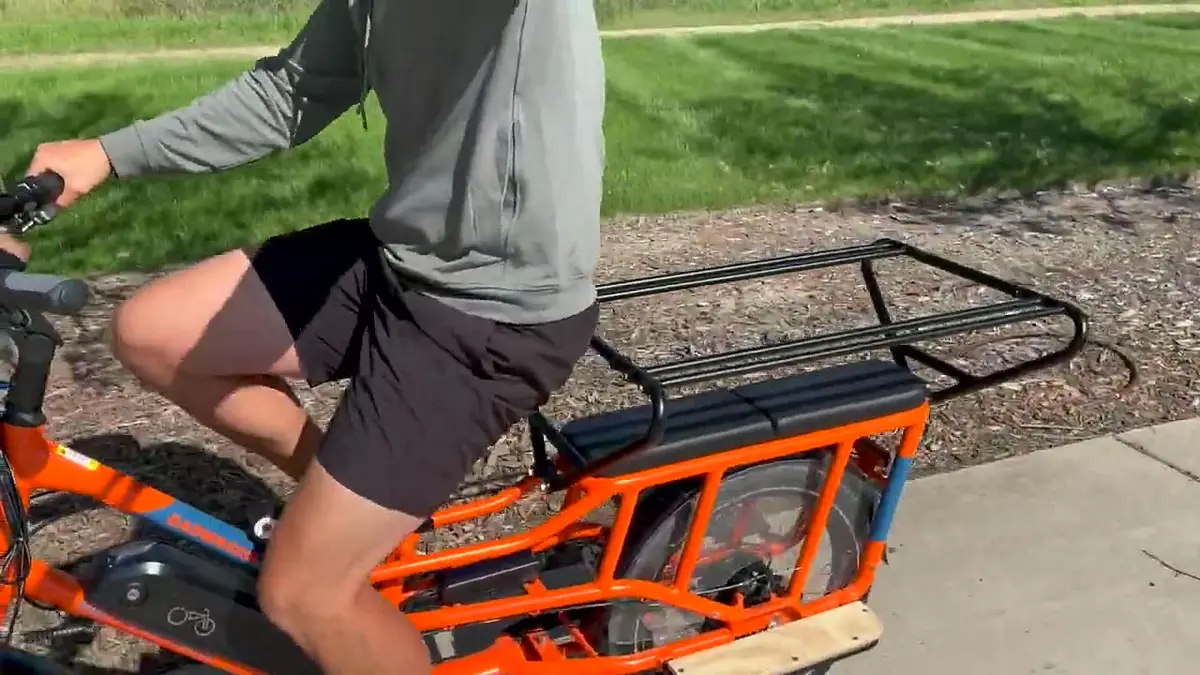
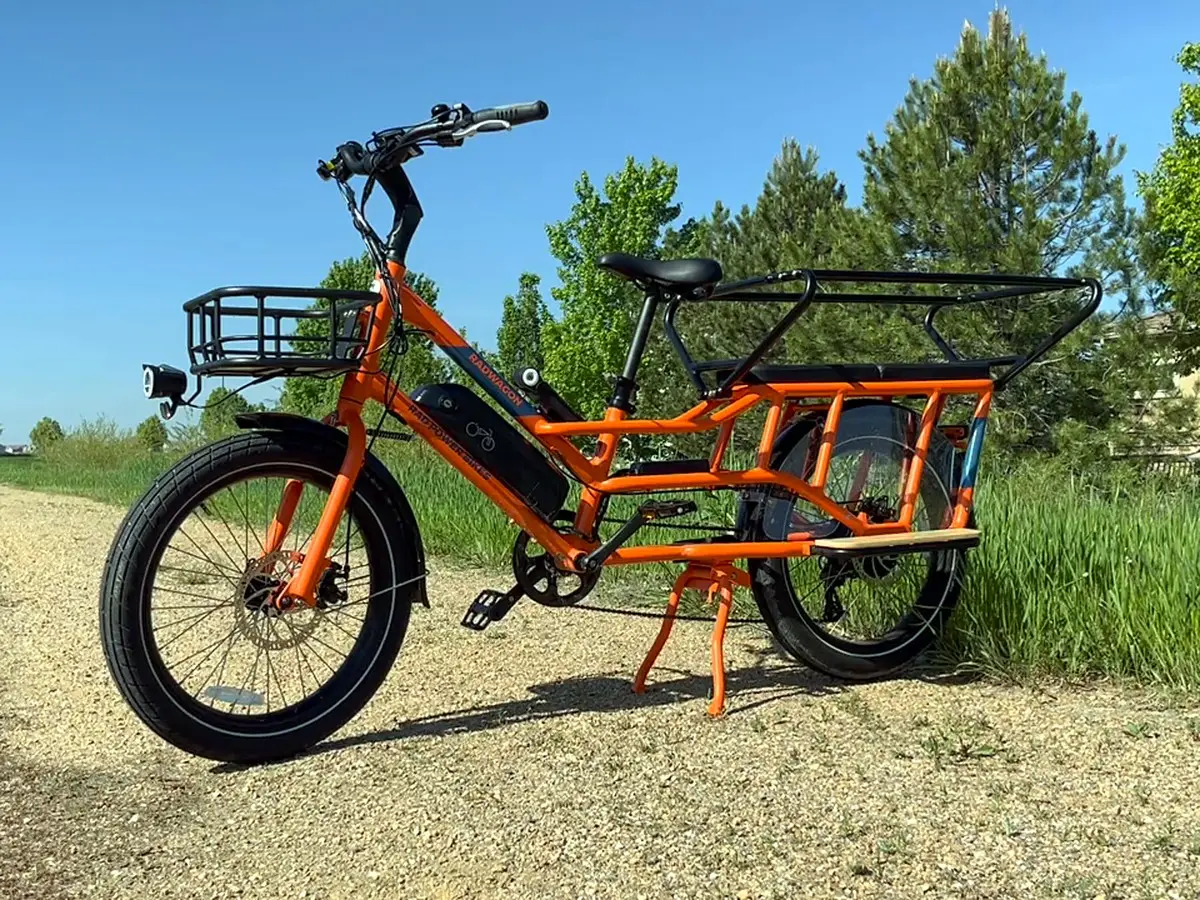
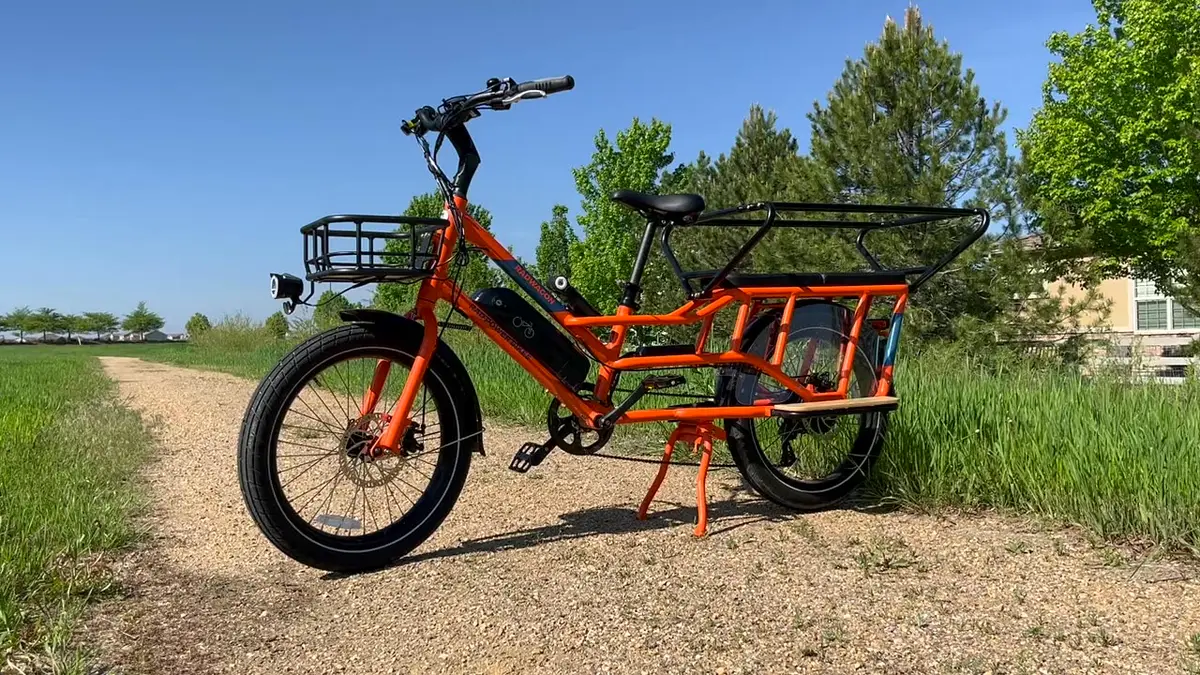
The “monkey bars” around the rear seats adjust. For smaller kids you can tighten them, which reduces the chance of a child sliding out. The caboose and running boards give kids somewhere to hold on and put their feet.
One ordering tip: the seat cushions are sold one at a time. With one child, buy one. With two, order two, or one kid ends up sitting on the bare rack.
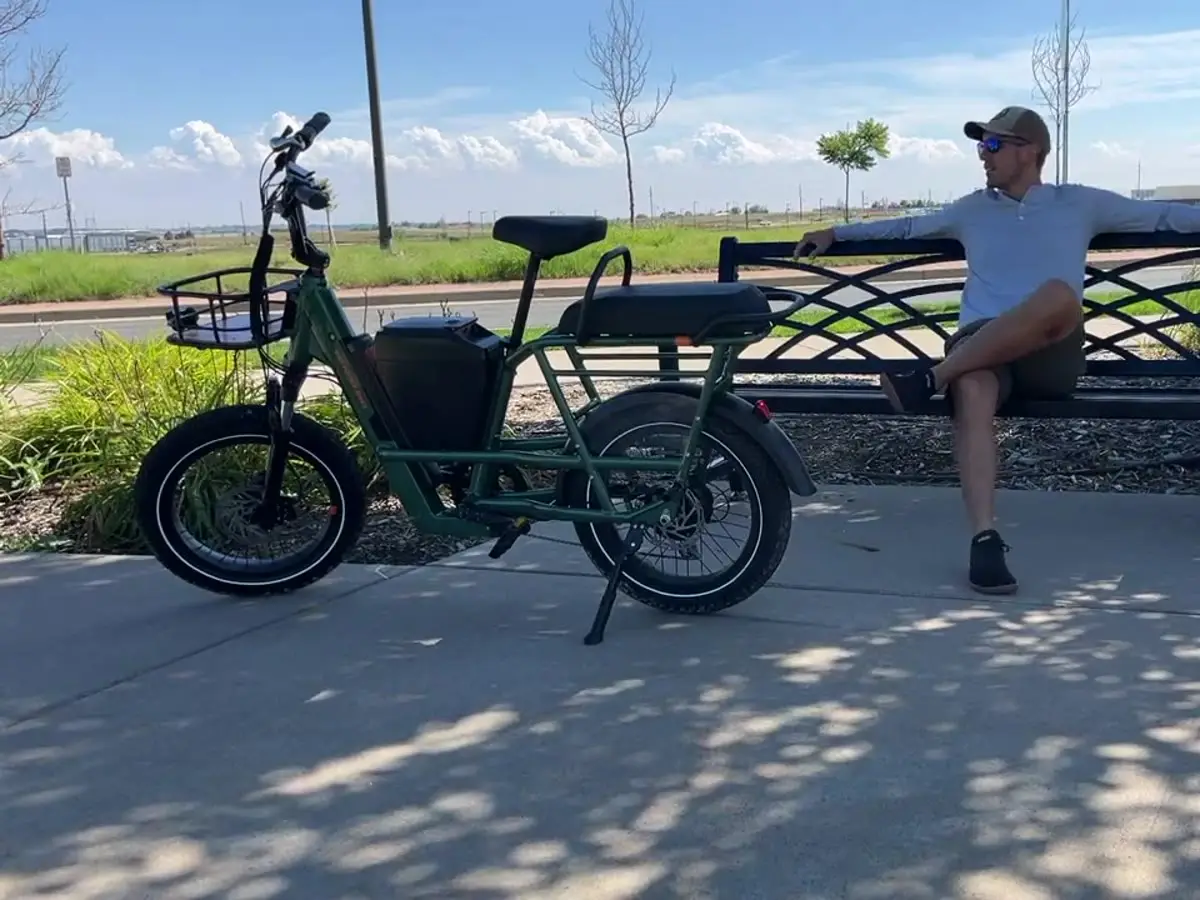
The dual-leg kickstand is sturdy; Rad lists it as spring loaded and steel. Hold on to the bike while kids are getting on and off, which I said in the video too (6:19).
For visibility, there’s reflective striping on the tire walls, an LED headlight, and an integrated tail light that doubles as a brake light. The bright orange paint helps too. If you have the front basket, the headlight mounts to the front of it. I really like that design. It also means a backpack has somewhere to go: on a school run, when one of the kids was whining about wearing theirs, we just threw it in the basket.
Rad’s rules for carrying passengers
My video shows the monkey bars and cushions but doesn’t go through Rad’s passenger rules, so here they are from the RadWagon 4 owner’s manual and Rad’s family e-bike page:
- Helmets for everyone. Rad says the rider and every passenger should wear a properly fitted, approved helmet.
- Under 4, or can’t ride a bike yet: only in a properly fitted, approved child seat. Rad says the rack can take two Thule Yepp Maxi seats.
- Age 4 and up: Rad requires running boards (or passenger pegs), rear wheel skirts, and a handle accessory such as the Caboose or Deckhand. The pegs are rated at 30 lb each, and the child has to be tall enough to rest their feet on them.
- Always seat a passenger on a Deckpad. Rad says it isn’t safe to sit directly on the bare rack.
- Seating position. Passengers sit over or in front of the rear wheel, facing forward, never sideways or backward, and no one stands or kneels on the rack. Rad caps the rear third of the rack at 40 lb.
- When to switch from a child seat: Rad says there’s no set age; switch once your child can reach the foot supports and hold the bars comfortably.
- Never leave a child on the parked bike. The manual calls that a very high risk.
The “monkey bars” in my video are the Caboose. As of Oct 24, 2026, Rad lists the RadWagon Caboose at $199, the RadWagon Deckhand at $69 and the RadWagon Deckpad at $89 each. I didn’t check running board or wheel skirt prices.
Daily life with it
My routine was simple: kids to the pool, kids around town, a run to the grocery store. Parking was easy, since a bike can pull up close almost everywhere. Rad rates the range at up to 45 miles. I didn’t run a formal range test.
The mid-step frame makes getting on easier than a full top tube, and the adjustable handlebars and seatpost make it easy to share between riders.
Pros and cons
Pros
- Throttle from zero makes loaded starts easy
- Deflopilator spring keeps the front wheel from flopping
- Adjustable monkey bars, caboose and running boards for kids
- Sturdy dual-leg kickstand
- Reflective tires, headlight, and tail light with brake light
- 22 x 3 tires gave me no trouble on pavement or dirt
Cons
- Shifter felt cheap, and the gears needed adjusting out of the box
- The bell arrived bent on my unit
- Cadence sensor, not torque sensor
- Seat cushions sold individually
- Not sold new anymore; Rad’s link now goes to the RadWagon 5
- CPSC battery fire warning (Nov 2025) covers the battery models it shipped with
- No factory support for bikes bought before Rad’s Dec 2025 bankruptcy
Battery fire warning: check before you buy or ride
This matters more than anything else in this review if you own a RadWagon 4 or are looking at a used one.
On Nov 24, 2025, the CPSC warned people to stop using Rad Power Bikes batteries with model numbers RP-1304, RAD-S1304Y and HL-RP-S1304 right away. The RadWagon 4 is on the list of bikes those batteries shipped with. The CPSC says the packs can ignite, especially after the battery or harness has been exposed to water and debris, and it counted 31 fire reports, including 12 with property damage of about $734,500. Some of those fires happened when the battery wasn’t charging or in use.
What the CPSC tells owners to do:
- Find the model number on the label on the back or rear of the battery.
- If it’s one of the three numbers above, take the battery off the bike and stop using it.
- Don’t throw it in the trash or a store battery bin. Call your local household hazardous waste site first and ask if it takes lithium-ion e-bike batteries.
- Don’t sell or give the battery away.
Rad didn’t agree to a recall. The CPSC says Rad told it that, given its finances, it couldn’t offer replacements or refunds to everyone. Rad’s statement at the time said it disagreed with the CPSC and that its newer Safe Shield batteries aren’t covered by the warning.
Some owners have reported two labels on the same RadWagon 4 battery, a RAD-S1304Y sticker on top and an RP-1304 sticker on the back. Both numbers are in the CPSC warning.
Replacing a flagged battery
As of Oct 24, 2026, Rad’s Battery Upgrade Program page lists these Safe Shield packs, and each product page lists the RadWagon 4 as compatible:
| Battery | Price (Oct 24, 2026) | Stock |
|---|---|---|
| Safe Shield Advanced External, 15Ah | $599 | Out of stock |
| Safe Shield Advanced External, 13Ah | $549 | In stock |
Rad’s fine print: eligible owners get a 50% discount code by email, battery shipping costs extra, battery sales are final, and Safe Shield packs only work with Rad’s updated charger, which is sold separately. Rad says not to use older Rad chargers or third-party chargers with them. The 13Ah pack is smaller than the original 14Ah battery, so expect slightly less range.
I filmed this review in 2023, before the warning. My video doesn’t cover battery safety, and nothing I said about the battery or range should be read as a safety endorsement of these packs.
Warranty and support after Rad’s bankruptcy
Rad Power Bikes filed for Chapter 11 on Dec 15, 2025, and the brand has been under new ownership (Rad Life Mobility) since Feb 27, 2026, according to Rad’s warranty page. The same page says the new owner has no obligation to provide warranty or service for products bought before Dec 15, 2025. Claims on those bikes go through the bankruptcy case (Case No. 25-02183) by filing a Proof of Claim.
What that means for a RadWagon 4, which was sold before the bankruptcy:
- Don’t count on a factory warranty, whether you bought new or used.
- Bicycle Retailer reported in March 2026 that the buyer planned a 50% discount program to replace the flagged batteries. An owner later posted a support email on Reddit saying the company wasn’t offering replacements for batteries in the notice and offered $100 off a Safe Shield battery instead. Those two accounts don’t match, so ask Rad directly before you buy a replacement.
- For the bikes it sells now, Rad’s page lists a 2-year warranty on the frame and listed components, and a battery warranty of 300 charge cycles or 2 years, whichever comes first.
The tire recall
In the video I said the RadWagon 3 was pulled over its tires and that this was the first RadWagon after those problems. That’s not quite right, and the graphic I put on screen at that moment shows it: it’s labeled “RadWagon 4 (2022 model with ribbed tires)” and shows a Bicycle Retailer headline about stop-ride notices on some RadWagon 4 bikes, with a smooth sidewall marked OK and a ribbed sidewall marked with a warning.
The CPSC recall from Nov 3, 2022 covers about 29,300 RadWagon 4 bikes and spare 22 x 3 inch Rad tires made by VEE Tire Co. The recall notice says the rim strip could be misaligned and pop the tube, and the ribbed-sidewall tires could go flat without warning. Rad had 137 reports of blowouts, deflation and sidewall separation, and eight injuries, including a broken wrist and a broken arm. The fix was a free replacement of both tires and rim strips.
So the tire problem was the 2022 RadWagon 4 itself, not the RadWagon 3. If you’re buying a used one, look at the tire sidewalls. Ribbed sidewalls mean the recall work may not have been done.
What the ride footage shows
I went back through my riding clips to see what I actually rode on, since that’s what my impressions are based on:
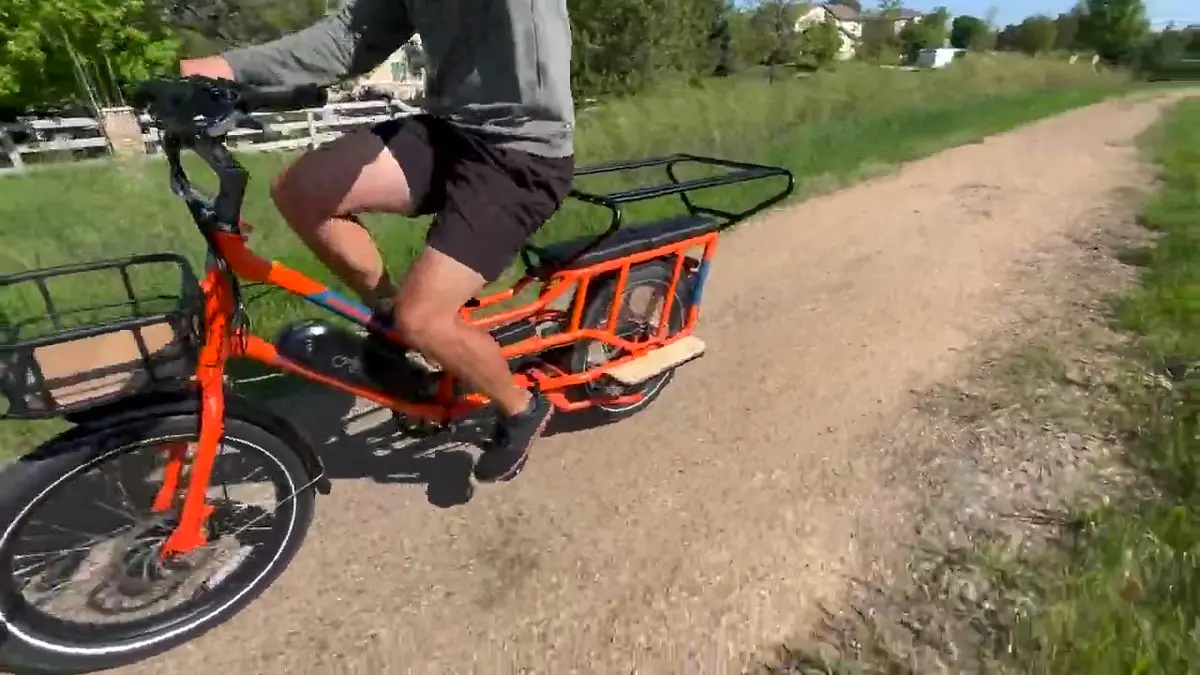
- Surfaces. Concrete bike paths, sidewalks, a wide gravel and dirt path through open grass, and a paved path past a park bench. That dirt path is the “off-road” in my video. There’s no rocky trail.
- Weather. Sunny, dry and green, so late spring. No wet riding on camera.
- Load. A helmeted kid rides on the back in several clips, and there’s a loading sequence at the kickstand with a child climbing on.
- Terrain. The paths look close to flat. No steep climb is filmed.
- Fit. The seat is set low for me in the footage. A viewer pointed that out, and in my reply I said it was set for my wife when we filmed.
What I didn’t test
- Hills. I said the 750W motor has the power to tackle hills, but I didn’t film or time a climb, loaded or empty.
- Braking. I didn’t run a stopping test on this bike, and nothing in the wet.
- Range. I didn’t run the battery down. The 25 to 45+ mile figures are Rad’s.
- Top speed. Not measured.
- Load limits. I carried kids and groceries, but I didn’t weigh a full load against the 350 lb payload or 120 lb rack rating.
What an owner says
These are commenters’ experiences, not mine.
One owner who’d had a RadWagon 4 for almost a year said they use it for a short daily commute, groceries, carrying a roommate and occasional camping trips. They called out the wide kickstand as worth mentioning, which matches what I saw. Their downsides:
- Ride comfort depends on tire pressure. At higher pressure for efficiency it was bumpy; at low pressure it was very smooth. With a rigid steel fork, the tires are your only suspension up front, so this tracks.
- Brakes. They called the stock brakes cheap, not the smoothest, and said they squeal when wet. They said cable-actuated hydraulic calipers were a big upgrade. The same commenter pointed out you can hear the brakes making noise around 4:20 in my video.
- Headlight. Bright, but a narrow spot of light. Fine for being seen, not great for lighting a dark road.
- Storage tip. They fit a small soft cooler bag in the gap between the seat post and the rack, after moving the controller under its plate.
Another commenter, at 5’4”, asked for tips on getting on and off because swinging a leg over the mid-step bar felt risky. I didn’t answer that one. Rad lists rider heights from 5’1”, but the mid-step frame still has a bar to clear, so shorter riders should try one before buying. Another viewer’s worry was fixing a flat on the rear wheel, which carries the hub motor; I didn’t have a flat during testing, so I can’t speak to how hard it is.
FAQ
RadWagon 4 vs Aventon Abound: which is better?
The Abound adds a torque sensor, turn signals, a dropper post, a suspension fork and a higher payload (440 lb against 350). The RadWagon 4 is the simpler bike, with a steering spring and kid-focused rear accessories. It cost less only while it was on sale ($1,299 against a regular $1,799). A used RadWagon 4 is only the value pick if its battery isn’t on the CPSC list, or if you count a $549 to $599 replacement battery plus a new charger in the price. The comparison page covers it in full.
What’s the RadWagon 4’s range?
Rad estimates 25 to 45+ miles per charge from the 672Wh battery. Kids, cargo and hills push you toward the low end.
Is the RadWagon 4 good for carrying kids?
That’s what I used it for. The adjustable monkey bars, the running boards and the stable kickstand are designed for it. Hold the bike while kids get on and off.
Are kids safe in the rear bars?
Follow Rad’s rules: everyone wears a fitted helmet; kids under 4 ride only in an approved child seat; kids 4 and up need running boards or pegs, wheel skirts, a Caboose or Deckhand and a Deckpad; and nobody sits sideways, stands on the rack or stays on a parked bike. In my video I also tightened the monkey bars for smaller kids to reduce the chance of them falling out.
Did Rad fix the tire problem?
The 2022 RadWagon 4 was recalled in Nov 2022 for its ribbed-sidewall tires, with free replacement tires and rim strips as the fix. I had no tire problems on mine. On a used bike, check for ribbed sidewalls.
Is it the best cargo e-bike under $1,500?
Only used, and only after the battery check. At Rad’s $1,299 sale price (May 31, 2026 snapshot) it fit the budget, but it was out of stock. A used one with a flagged battery needs a $549 to $599 Safe Shield pack and a new charger, so add that to the asking price before comparing.
Is the RadWagon 4 battery safe?
The CPSC warned in Nov 2025 to stop using Rad batteries labeled RP-1304, RAD-S1304Y or HL-RP-S1304, and the RadWagon 4 shipped with them. Check the label on the back of the battery before riding or buying.
Does Rad still honor the RadWagon 4 warranty?
Rad’s warranty page says the new owner has no obligation to service bikes bought before Dec 15, 2025. Claims on older bikes go through the bankruptcy case.
Is a used RadWagon 4 worth buying?
A commenter on my video, posted around November 2025 (YouTube showed “11 months ago” when I pulled comments in October 2026), said a bike shop had one for sale for $800, though they weren’t sure which RadWagon version it was. At that price it can make sense, but only after you’ve checked the battery model number and the tire sidewalls, and budgeted for a new battery if it’s one of the flagged packs.
Price
Rad’s archived RadWagon 4 page (Wayback snapshot, May 31, 2026) showed $1,299, down from $1,799, and out of stock. The live page now returns “not found.” Rad’s current page for the RadWagon 5 starts at $1,999 as of Oct 22, 2026, with some versions listed at $2,399.
Check RadWagon 5 pricing at Rad Power Bikes (not an affiliate link; it goes to the RadWagon 5, which I haven’t reviewed).
Related reviews and guides
- Aventon Abound review
- Aventon Abound vs Rad RadWagon 4
- MOD Easy Sidecar review
- E-bike guide for parents
- Types of e-bikes
- Compare e-bikes
“Train up a child in the way he should go; even when he is old he will not depart from it.” Proverbs 22:6 (ESV)