
In this guide (7 sections)
When I tested the Romatlink Dolphin, it became our family’s daily school run bike for the kids (Dolphin video, 5:55 to 6:01), so this question isn’t theoretical for me. Lots of parents now ask me whether to buy their own kid an e-bike, and my answer always comes back to three things: what your state allows, which class of bike you choose, and whether your kid is ready for something heavier and faster than anything they’ve ridden before.
I’m not a lawyer. The laws below come from the statutes I checked on October 22, 2026, and each one links to its source. Rules change, and cities can add their own, so check your state’s statute and your local rules before you buy.
Start with your state’s law
Most age limits in the US apply to Class 3, the bikes that assist up to 28 mph. A few states go further. Here’s what I confirmed in the statutes themselves:
| State | Age rule I confirmed | Helmet rule I confirmed | Source |
|---|---|---|---|
| Minnesota | No one under 15 may operate any e-bike | Not confirmed | 169.222 |
| Ohio | Under 16 can’t operate Class 3; may ride as a passenger | Class 3: all operators and passengers | 4511.522 |
| Colorado | Under 16 can’t ride Class 3 unless as a passenger | Class 3: riders under 18 | 42-4-1412 |
| Maryland | Under 16 can’t operate Class 3 on highways | Not confirmed | 21-1205.2 |
| Washington | Under 16 can’t operate Class 3 | Not confirmed | 46.20.500 |
| Texas | Under 15 can’t operate Class 3 (the statute lists exceptions) | Not confirmed | Ch. 551 |
| Virginia | No statewide minimum in the sections I read | Class 3: all riders; localities may require helmets for 14 and under | 46.2-906.1 |
| Florida | No statewide minimum in 316.20655 | Under 16 (via 316.2065(3)(d)) | 316.20655 |
“Not confirmed” means the e-bike sections I read didn’t settle the question, not that there’s no rule. Some states put youth helmet rules in their general bicycle laws, and many cities and counties add their own.
Minnesota stands out as the strict one: no one under 15 can ride any class of e-bike, not even Class 1. Everywhere else in the table, age 15 or 16 is the usual line, and it applies to Class 3. A younger teen on a Class 1 or Class 2 bike is generally legal in these states, while a younger teen on a Class 3 bike usually isn’t.
That last point has a catch parents miss. Many bikes can be switched to a higher speed in the app, and Florida, Virginia, Ohio, Nevada, Oklahoma and Minnesota all have rules against changing a bike’s speed unless the class label is updated. My classes explained guide has the details. If your 13-year-old unlocks 28 mph, the law sees a Class 3 bike.
The class I’d start a young rider on
For most kids and younger teens, I’d start with Class 1 or Class 2, capped at 20 mph. Class 1 only helps while they pedal, so it rides the most like the bike they already know. Class 2 adds a throttle, which is a real help on hills, but it also means the bike can take off without a pedal stroke. If your kid is the type to grab a handful of throttle, Class 1 is the calmer choice. I’d save Class 3 for older teens who have already shown good road sense, and only where your state allows it. If the bike lets you set a lower top speed in the app or display, do it before the first ride and lock it if you can.
Two bikes I’ve filmed show what that looks like in practice.
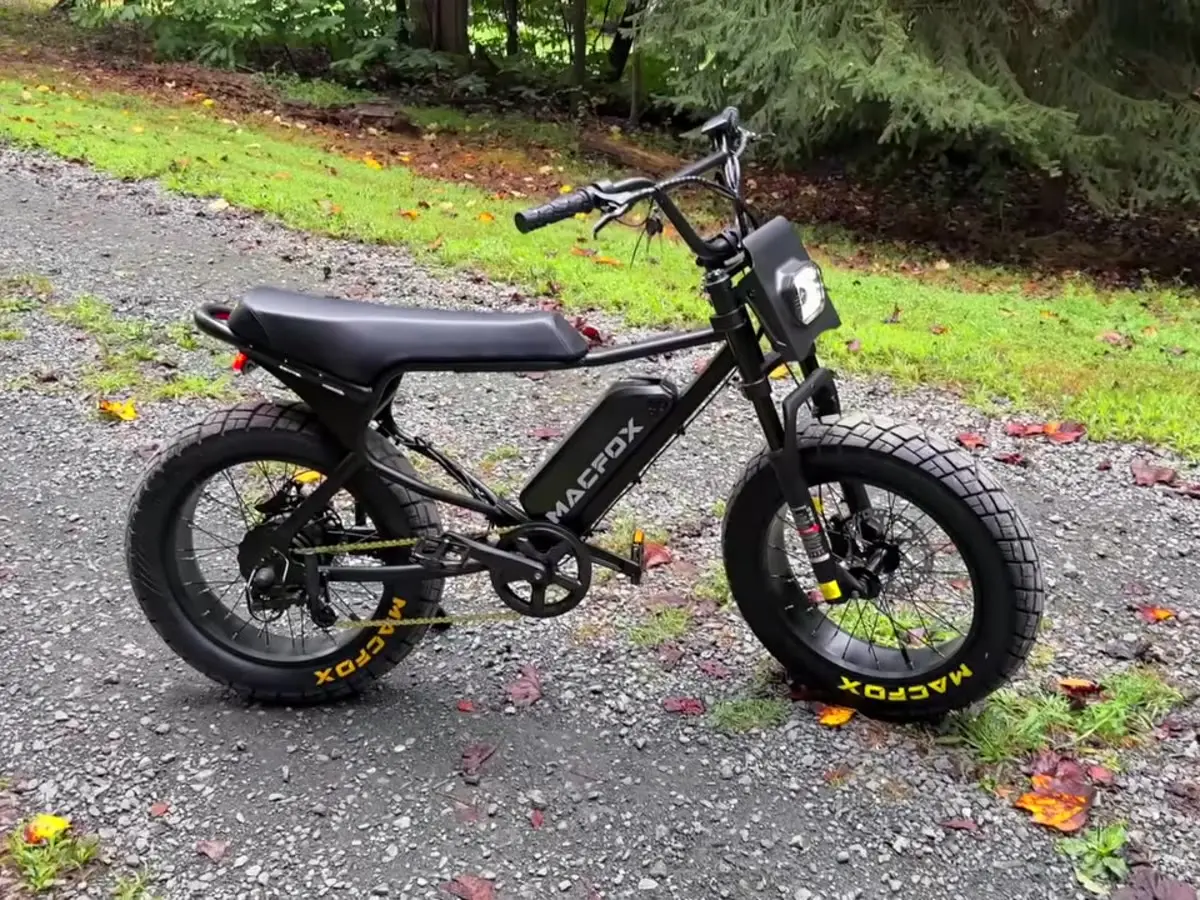
The MACFOX X7 left me wanting more power as a 200 lb adult, but I said in my video that it’s ideal for the teenager who isn’t driving yet, because parents don’t have to worry about too much speed (X7 video, 9:11 to 9:29). MACFOX lists it as Class 2 at 20 mph, and it was $1,599 at MACFOX on Oct 27, 2026. It’s heavy at 87 lb, though, so it suits an older, bigger teen. For a smaller rider, I called the little ONEBOT S7 folder a great e-bike for a kid with a two or three mile ride to school (ONEBOT video, 5:13 to 5:26), and said its 250W motor should be plenty on hills for a rider under 100 lb (6:48 to 6:58). ONEBOT’s own page for it no longer loads, so I can’t give you a current official price.
Fit matters more than features
Fit checks aren’t legal requirements, but they decide whether a kid can control the bike. Start with standover: with both feet flat on the ground, your kid should have clear space between the top tube and their body, and a step-through frame makes that much easier. Then have them sit on the saddle at its lowest setting. They should be able to put at least the balls of both feet down, or one foot flat. E-bikes are heavy, and a rider who can’t reach the ground at a stop will tip over.
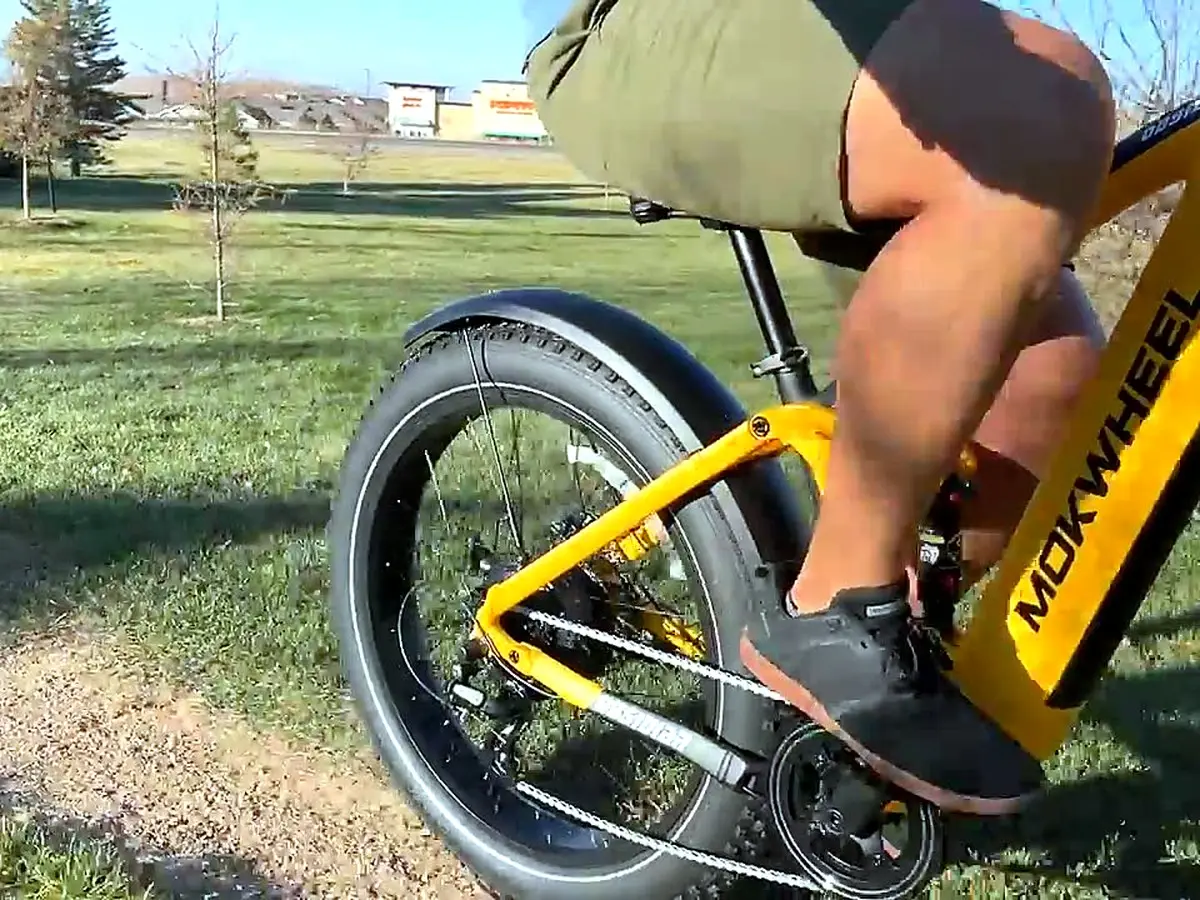
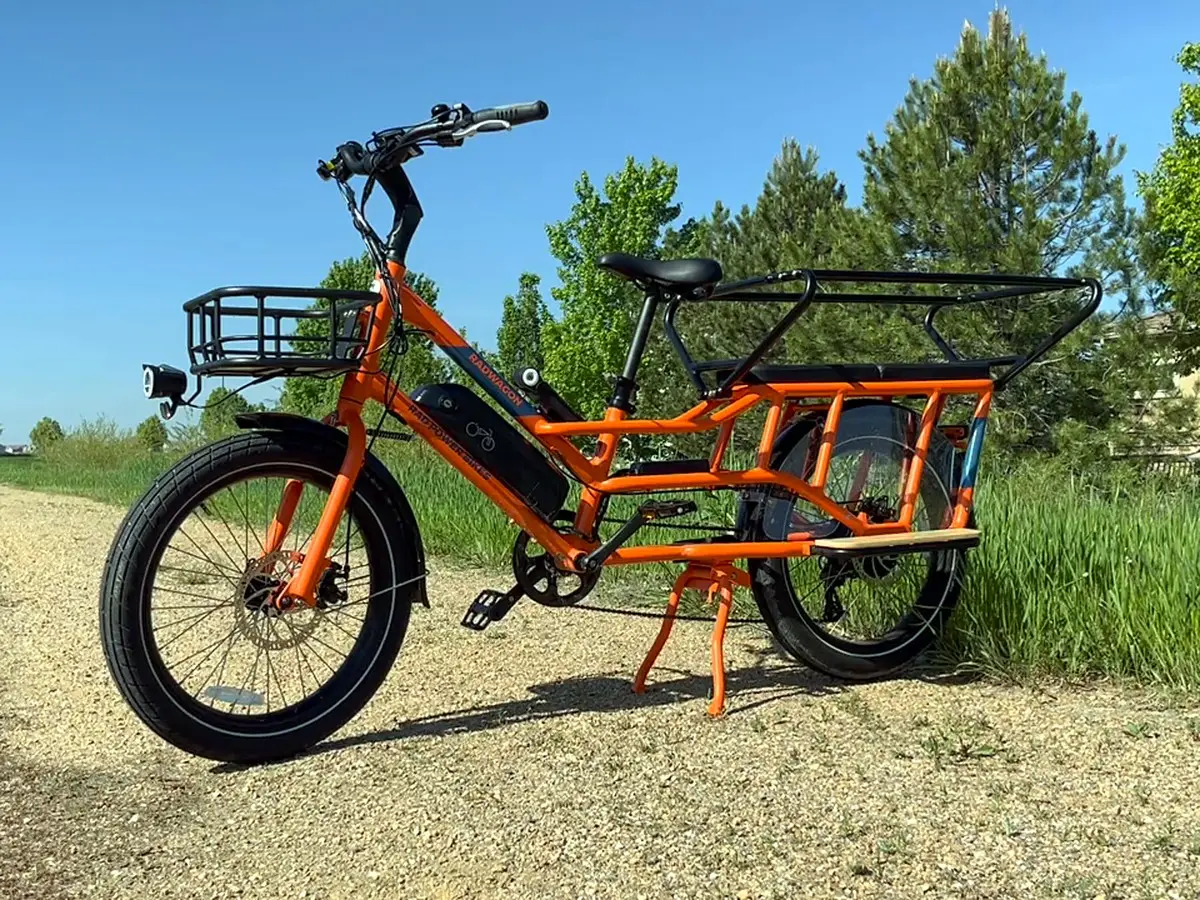
Weight is the check most parents skip. The bikes I’ve reviewed that list a weight run from 54 lb (Aventon’s listed weight for the Ramblas ADV, successor to the Ramblas) to about 77 lb for the RadWagon 4 and Mokwheel Obsidian. Have your kid walk the bike, turn it around, and pick it up after laying it down. If they can’t lift it, they can’t recover from a tip-over in the road. That’s why fat tire bikes in the 70s are usually too much bike for a smaller teen, and the types guide compares the weights.
Finish with reach and brakes. With hands on the grips, their arms should be slightly bent, not locked straight; if they’re stretched out, look for a smaller frame or a shorter stem. And make sure they can squeeze both brake levers hard with their hand size. Many levers adjust closer to the bar.
The helmet, and how it should fit
Bicycle helmets sold in the US must meet the CPSC standard, so look for the certification label inside (NHTSA). That’s also the standard Ohio, Colorado and Virginia name in their e-bike helmet rules. For a teen who rides at Class 3 speeds, consider a helmet certified to NTA 8776, a Dutch standard written for speed pedelecs that assist up to 45 km/h. It tests at higher impact speeds and covers more of the temples and the back of the head (NEN). No US state I checked requires it.
Fit is where most helmets fail. Following NHTSA’s steps, the helmet should sit level and low, one or two finger widths above the eyebrows, with the side straps forming a V under and slightly in front of each ear. The chin strap should be snug enough that only one or two fingers fit under it, and when your kid yawns wide, the helmet should pull down on their head. It shouldn’t rock more than about an inch in any direction. Buy one that fits now, not one to grow into, and replace it after any crash, even if you can’t see damage.
Beyond the helmet, I’d add lights front and rear even for daytime rides, closed-toe shoes because e-bike pedals hurt bare feet, gloves for a fall, and a good lock, because e-bikes get stolen.
Practice before the road
Before the first real ride, head to an empty parking lot and start on the lowest assist level. Practice hard stops with both brakes, since an e-bike carries more momentum than a regular bike, and practice starting from a stop, because the assist can surge as the pedal goes down. On a Class 2, teach them to keep their hand off the throttle until both feet are on the pedals.
Then ride the route together once. Point out the driveways, blind corners and places where they’ll need to walk the bike, and agree on where they’re allowed to ride. Sidewalk and path rules vary a lot. Oregon makes it an offense to ride an e-bike on a sidewalk (ORS 814.410), and Arizona, Ohio, Colorado and Washington keep Class 3 off most bike paths. Many cities have their own sidewalk rules, so check your state’s statute in the table above and your city’s code.
Last, talk about the rules of the road. The laws I read for Arizona, Florida, Virginia, Oklahoma, Washington and Oregon treat e-bikes as bicycles rather than motor vehicles, so the usual bike rules apply: stop at stop signs, ride with traffic, and signal turns. A faster bike doesn’t change who has the right of way.
Quick checklist
| Check | Done? |
|---|---|
| State age and helmet rules checked (table above) | ☐ |
| Class 1 or 2, with speed capped if possible | ☐ |
| Feet reach the ground at a stop, with standover clearance | ☐ |
| Rider can lift the bike after a tip-over | ☐ |
| CPSC-certified helmet, fitted with NHTSA’s steps | ☐ |
| Lights, bell and lock | ☐ |
| Parking-lot practice done | ☐ |
| Route ridden together once | ☐ |
Sources
Statutes are linked in the table above, checked Oct 22, 2026. MACFOX X7 price and class: macfoxbike.com, checked Oct 27, 2026. Helmet guidance: NHTSA and NEN. My videos: Romatlink Dolphin, MACFOX X7, ONEBOT S7.
“Behold, children are a heritage from the LORD, the fruit of the womb a reward.” Psalm 127:3 (ESV)
Check prices for the bikes in this guide
Prices change often, so these links go to the current listing. I only show a price where it's in my review data.
- Romatlink Dolphin · $599
- MACFOX X7 · $1,599
- Rad Power Bikes RadWagon 4 · $1,299
- Mokwheel Obsidian · $1,799.99
Some of these are affiliate links: I may earn a commission at no extra cost to you. Disclosure