Picture the school run: kids with backpacks, a bag of groceries on the way home, and a road where cars come up fast behind you. That’s the job the Rad Power Bikes RadRunner Max is built for. I haven’t ridden it. Everything here comes from Rad’s official RadRunner Max page, rechecked on Oct 27, 2026, Rad’s accessory and warranty pages, and what I learned riding the Rad and cargo bikes I have tested.
Should you buy one?
On paper, this is the heavy hauler in Rad’s utility lineup, at $2,299 (as of Oct 27, 2026). The headline number is a 420 lb payload, with up to 120 lb on the integrated rear rack. Rad caps the rider at 275 lb, so a 200 lb parent has about 220 lb left for kids and cargo. That’s my math from Rad’s figures, and it’s the number I’d check first before buying.
The other thing that stood out to me is the radar. Rad calls the Max its first bike with built-in rear radar. It watches for cars and cyclists up to 100 meters behind you, shows their speed and distance on the color display, and flashes the taillight to warn them, even with your lights off. On a bike carrying kids in traffic, that is the feature I’d want most.
Before you order, know who you’re buying from. Rad Power Bikes filed for Chapter 11 in December 2025, and Life EV bought the brand and its assets for $13.2 million, closing in March 2026, according to TechCrunch and GeekWire. Rad bikes are now sold by Rad Life Mobility, and its current warranty is better than a lot of direct-to-consumer brands: two years on the frame and main components, and two years or 300 charge cycles on the battery, whichever comes first. The catch is that it only covers bikes bought new from Rad or an authorized Rad retailer. If you’re looking at a used Max bought before Dec. 15, 2025, the new owner says it has no obligation to cover it.
The spec sheet, translated
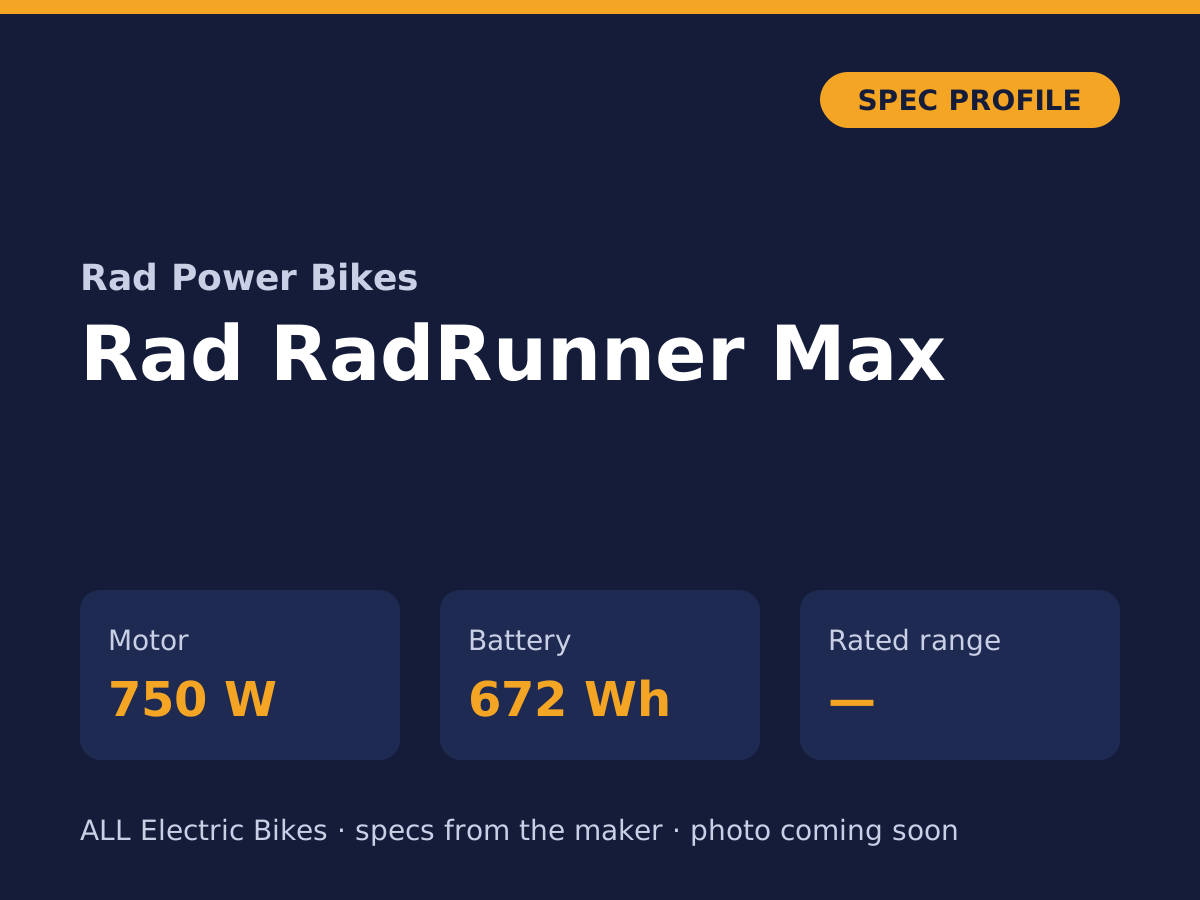
Rad pairs a 750W rear hub with 90 Nm of torque and a torque sensor it calls RideLogic. In plain terms, the assist should build with how hard you push the pedals rather than lurch on the moment the cranks turn. That’s the upgrade I asked for on the RadRunner 3 Plus. I liked that bike for hauling my kids, but it uses a cadence sensor, and at its price I wanted a torque sensor. With a loaded rack, a smooth pull from a stop matters more than a fast one.
You can set the Max as Class 1, Class 2, a limited Class 3 at 25 mph, or full Class 3 at 28 mph pedaling. The display also lets you set a guest passcode and lock in speed settings for someone else who rides it. That’s a useful touch if a teenager or a partner shares the bike.
Gemma hydraulic brakes on 180mm rotors handle the stopping, and the 20 x 3.5 in tires keep the load low. Small, wide wheels are the usual choice on utility bikes for that reason. Rad also lists an 80mm suspension fork, full fenders, a 28 in wide handlebar and a dual leg center stand.
Range, and what the Range Extender changes
Range is where I’d temper expectations. The 672Wh battery is rated for 19 to 61+ miles. That’s the same capacity as the RadRunner 3 Plus, and a bit smaller than the 720Wh pack on the Radster Trail and Radster Road. Hauling kids and running at 28 mph will push you toward the low end of that range.
Rad’s fix is the RadRunner Range Extender, $249 as of Oct 27, 2026, with the second battery sold separately. It mounts a second Rad battery and makes the bike dual-battery. Rad estimates 121 to 130 miles on a Max with both batteries. You charge the two packs separately unless you buy a second charger, and the bike still runs on one battery if the other is empty. For most school runs you won’t need it. It makes sense for long weekend rides or if you can’t charge at work.
Loading kids and gear
The passenger setup is where a bike like this earns its price. Rad’s RadRunner 3/RadRunner Max Passenger Package is $139 as of Oct 27, 2026. It includes a padded seat, retractable foot pegs and a clear wheel skirt to keep feet out of the spokes. Rad notes it doesn’t work with panniers or other rear storage, so plan on a front basket if you carry a passenger and groceries at once. The Range Extender, on the other hand, is listed as compatible with Rad’s passenger seats, pannier bags and Thule Yepp Maxi child seats.
The dual leg center stand holds the Max upright while kids climb on. That matters more than it sounds. On the RadRunner 3 Plus I tested, the side kickstand couldn’t be trusted with a passenger climbing on, and I told viewers to hold the bike while a kid gets on. It’s also the same reason I used the handlebar parking brake every day on the Bunch Bike Original 3.0 my family rode.
Weight, fit and storage
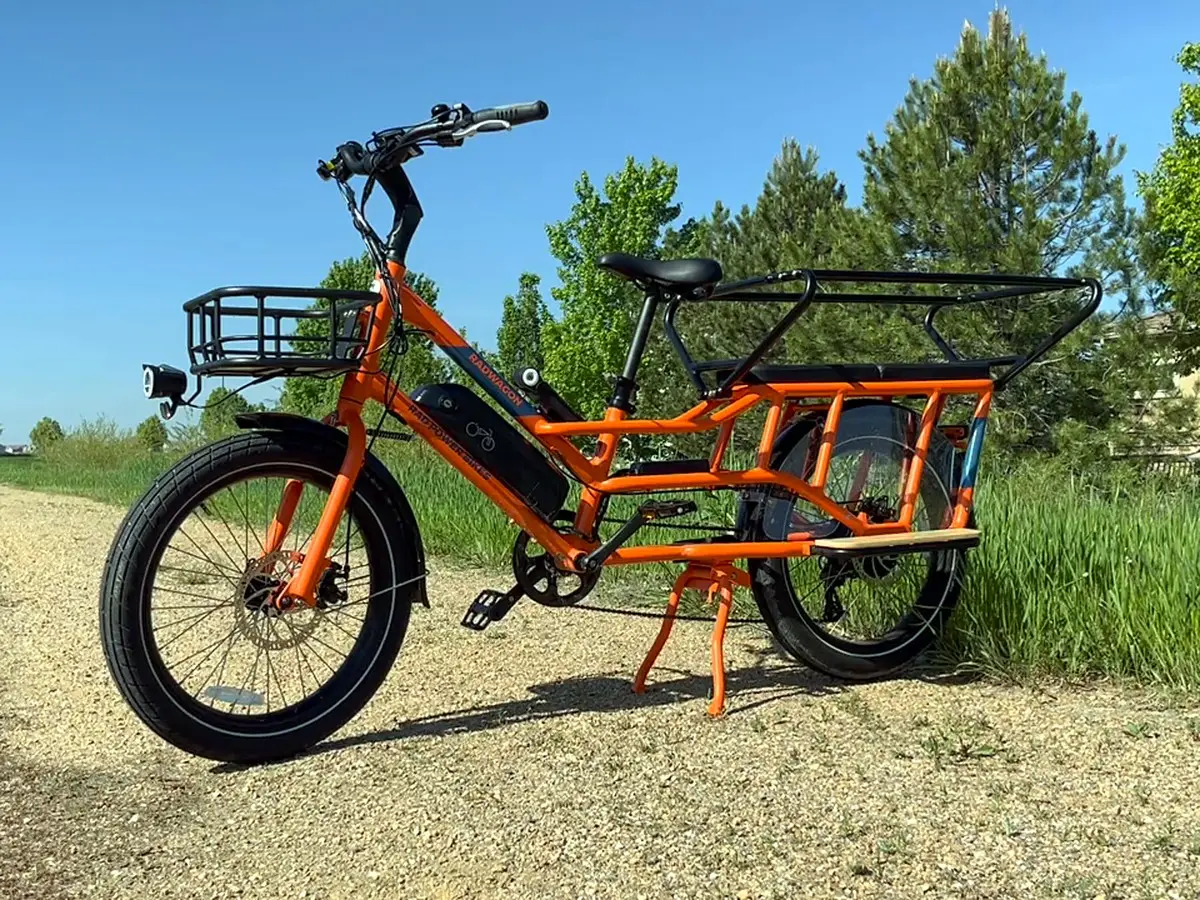
At 82 lb, or 72 lb with the battery out, this is not a bike you carry up stairs. You’ll want ground-level storage: a garage, a shed or a ground-floor entry. Rad lists the bike at 72.5 in long, including the fender, with a 46.8 in wheelbase. That’s shorter than a longtail like the RadWagon 4 I reviewed, so it should fit in more garages and on more bike paths.
The 17 in standover and 4’11” to 6’2” height range mean most adults in a family can share it. Rad puts the build difficulty at medium and offers assembly at checkout. Tight bolts and adjusted brakes matter on a bike that carries kids, so if you aren’t comfortable with a torque wrench, that’s money well spent.
Two security features round it out: a display passcode, and Apple Find My, so you can locate it from an iPhone. Rad also notes that the battery key is a universal key that may open other Rad battery locks, so take the battery inside when you park in public.
Owner feedback worth reading
Rad’s page showed 4.3 out of 5 from 35 owner reviews on Oct 27, 2026. Most are happy, but a few complaints are worth knowing about. One owner said the bike feels bouncy on rough roads, and another said leaving the battery on the bike outside during a hot summer stopped it from working until the weather cooled. These are single owner reports, not my testing, but both match the advice I’d give for any e-bike: store the battery somewhere cool, and expect a smaller wheel to feel bumps more.
Pros and cons (from the specs)
Pros: 420 lb payload and a 120 lb rack; radar alerts for traffic up to 100 meters back; 90 Nm torque sensor; hydraulic brakes, turn signals and a high beam; a center stand for loading; Apple Find My; a two-year warranty when bought new.
Cons: 82 lb; a 672Wh battery, smaller than the Radsters’ 720Wh; the passenger package rules out panniers; a brand that just came out of bankruptcy under new owners.
How it fits with the bikes I’ve reviewed
If you want a Rad with a passenger seat and can live with a cadence sensor, the RadRunner 3 Plus is the one I’ve actually ridden, though Rad’s page for it wasn’t live when I last checked. If you need a true longtail, I reviewed the RadWagon 4. And if the goal is replacing car trips with little kids, the Bunch Bike’s front box is the setup my family lived with. For more options, see my best cargo e-bikes guide.
Who it’s for
The RadRunner Max makes sense for parents hauling one kid on the back, and for riders carrying heavy cargo, within Rad’s 4’11” to 6’2” height range. The radar makes the most sense if you share roads with fast traffic. Look elsewhere if you don’t have ground-level storage, need more than 275 lb of rider capacity, or plan to carry more than one passenger, which is what longtails and box bikes are built for.
Price
$2,299 on Rad’s site as of Oct 27, 2026. The Range Extender ($249) and Passenger Package ($139) are extra.