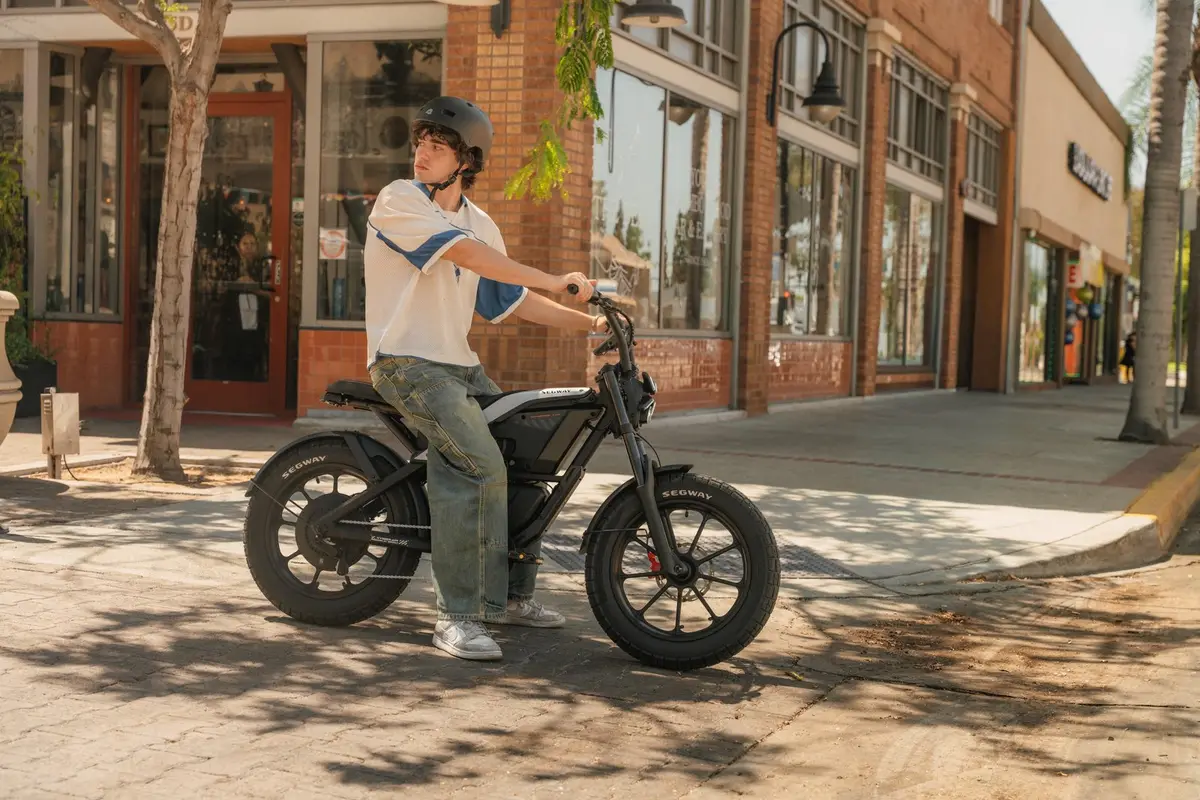
The Segway Xyber Air is the street-legal little brother of the Segway Xyber. The original Xyber is an off-road-only bike with a $3,299.99 regular price on Segway’s store. The Air keeps the moto look, brings the price to $1,999.99, and lets you set it to Class 1, 2 or 3. I rode it mostly on gravel, up two steep, bumpy climbs and back down. I’m about 6’1” and 200 lbs, and I came away with one big surprise: I didn’t expect it to be this much fun to ride.
This is my full review. Everything I say about how it rides comes from my own test video. The specs come from Segway’s press release and press kit one sheet.
The short verdict
Buy the Xyber Air if you want a moto-style e-bike with a lot of power, a front fork and 20 x 4 inch tires, and you’ll ride a mix of gravel, trails and pavement. It pulled me up steep gravel climbs on the throttle alone, the brakes gave me real control on loose rock going down, and you can switch between Class 1, 2, 3 and Hybrid in the settings where your state allows it. The AirLock walk-away lock and Apple Find My make it a good pick for a teenager’s bike, too.
Skip it if you’ll ride mostly on pavement. I said it plainly in my video: there are plenty of other options for that, and on smooth roads you’re paying for a fork and fat tires you don’t need. Skip it too if you want to pedal a lot, need gears, or need a real cargo rack. The seat is fixed, it’s single speed, and Segway’s optional rack is rated for only 22 lbs.
See the Xyber Air at Segway (affiliate link; $1,999.99 MSRP as of Oct 27, 2026)
Pros and cons
Pros
- Plenty of pull on steep gravel climbs at full throttle with me at about 200 lbs. It held 12 to 14 mph on the steepest parts in Class 2.
- Strong, controllable brakes: two-piston hydraulic discs with 180 mm rotors, plus electronic braking from the rear motor
- Comfortable on gravel, thanks to the 20 x 4 tires, the 80 mm front fork and a plush but firm seat
- The kickstand is better than on most e-bikes I’ve tested. It held the bike on a slope with no lean at all.
- A briefcase-style removable battery, plus a charge port on the bike so you don’t have to remove it
- An optional lockable bag ($99.99 add-on) that fits under the battery and has a three-digit combination lock
- Class 1, 2, 3 or Hybrid, selectable on the display
- AirLock auto-lock and unlock, and Apple Find My
- Daytime running light that’s always on, plus a 600-lumen automatic headlight
- 84 lbs, which I called about half the weight of the original Xyber (Segway lists the original at 146.4 lbs)
Cons
- The fixed seat makes pedaling uncomfortable
- Single speed, so the motor does the work
- You need the app to start the bike
- The optional rear rack is rated for only 22 lbs
- Some smart features need a subscription after the first year, and Segway hasn’t published that price
- Not the best value if you’ll only ride on pavement
- I haven’t done a range test or a long-term durability test yet
Why the Xyber Air exists
The original Xyber was never street legal. Segway’s store page says it’s designed for off-road use only. The Xyber Air is Segway’s answer for people who loved that look but want to ride it on streets and bike paths. Segway’s press release calls it the original’s design “in a lighter, more responsive package,” and it can be set up as a Class 1, 2 or 3 e-bike.
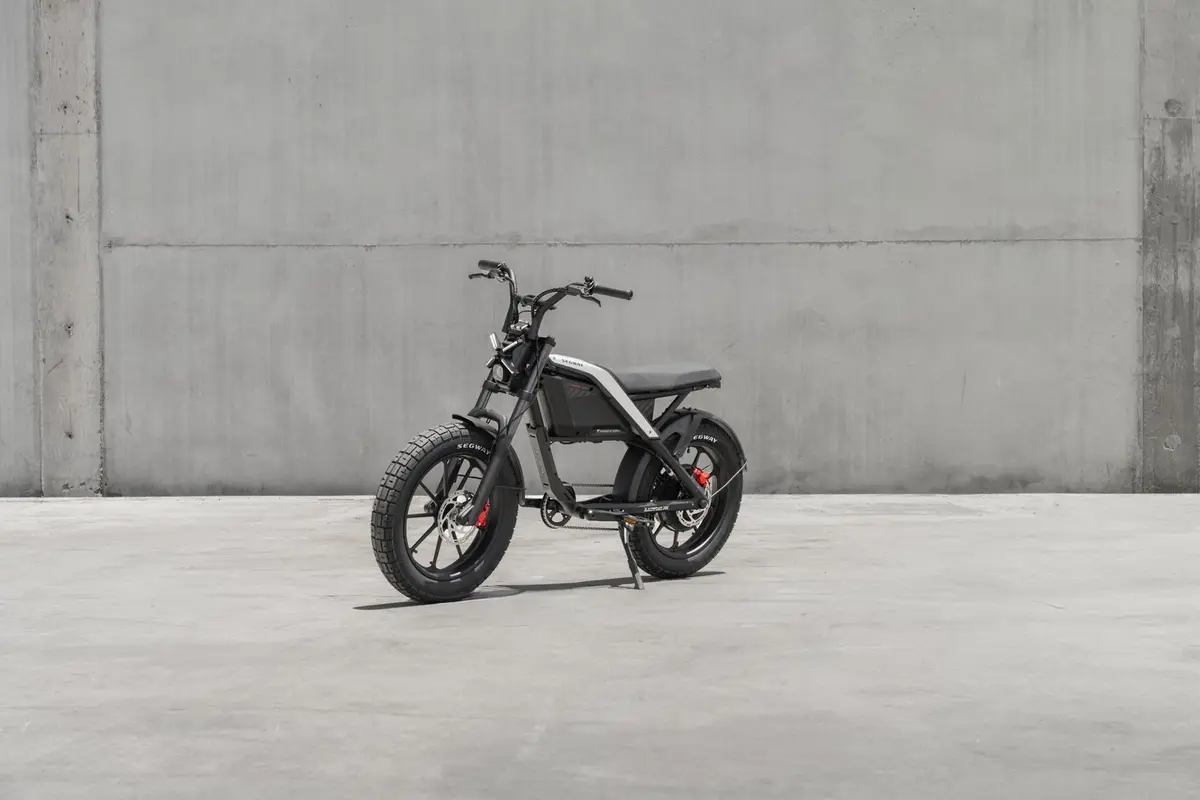
That’s the bargain you’re making. The Air has far less power on paper (Segway lists 750W for the Air and 3,000W for the original with one battery), but it’s legal where e-bikes are allowed, it weighs 84 lbs to the original’s 146.4 lbs, and it’s $1,300 less than the original’s $3,299.99 regular price. I haven’t ridden the original Xyber. I compare the two on Segway’s numbers in my Xyber vs Xyber Air guide.
Who it fits
Segway lists a rider height range of 4’8” to 6’. I’m about 6’1” and 200 lbs, just over the top of that range, and it fit me.
The fit caveat isn’t your height. It’s the seat. Like every other bike I’ve tested with a fixed seat, pedaling isn’t great on the Xyber Air. You can’t move the seat to get the leg extension you’d want for real pedaling. In the ride test you can see how awkward it is for me to pedal. But this bike has a twist throttle that works from a stop, and that’s how I rode it almost the whole time. If I’m pedaling this bike, I’m doing something wrong.
If you plan to ride on the throttle, the fixed seat won’t bother you. If you want to pedal for exercise, look elsewhere.
Controls, display and app
On the left bar you have the front brake lever and the controls for the center display. On the right is the rear brake lever and a twist throttle that works from zero.
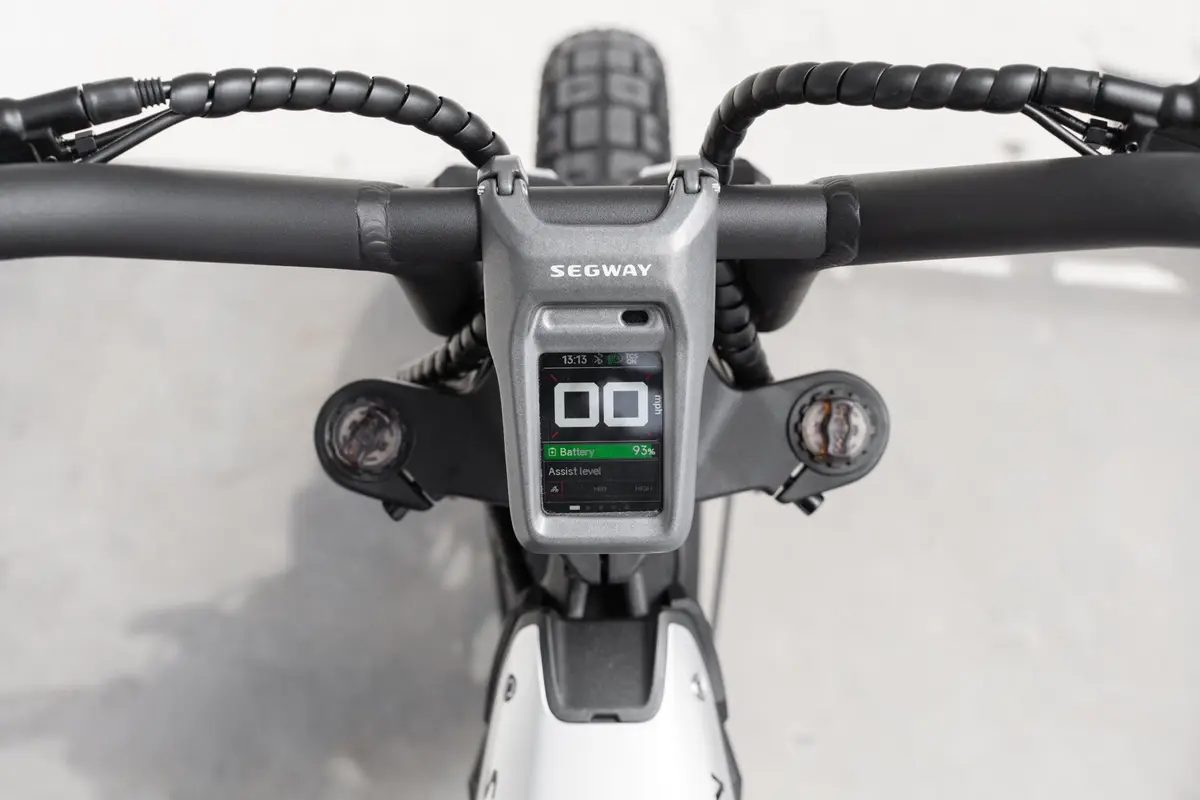
The display works like the other Segways I’ve tested. It connects over Bluetooth, and the bike unlocks automatically when your phone comes near it, a lot like a Tesla. A small joystick moves you through the menus. There’s a speaker built into the bike, and if your phone is playing music you can control it from the display. I don’t see much use for that. I’d just control music on my phone.
You can also put in navigation through the app and see it on the display. If you commute or ride long distances, that could make sense. For me, on a screen that small, it’s a little gimmicky. You also get ride stats like average speed, and then you can go back to the main speed screen.
The settings menu is where the useful stuff is. You can change the speed mode (more on that below), screen brightness, the horn sound and the volume. There’s a horn button on the bars too.
One thing I didn’t like with my first Segway was needing to download an app just to start the bike. I still don’t love that, but Segway does a very good job with locking and unlocking. And a small note: my bike had some sticky protective film on the controls that I had to peel off.
Speed modes: Class 1, 2, 3 or Hybrid
Under the speed mode setting, you can pick Class 1, Class 2, Class 3 or Hybrid, and you can change it whenever you want. Segway lists these speeds:
- Class 1: pedal assist to 20 mph
- Class 2: pedal assist or throttle to 20 mph
- Class 3: pedal assist to 28 mph
- Hybrid: throttle to 20 mph, and pedal assist takes over up to 28 mph, with no mode switching
Segway’s one sheet notes that Hybrid isn’t allowed in California, New York and certain other states with extra restrictions. Its footnote says class function and top speed depend on federal, state and local laws. Check your state before you use Class 3 or Hybrid. My e-bike laws by state pages, my Class 2 vs Class 3 guide and my Xyber Air class modes guide cover the rules.
For my whole test I rode in Class 2, so everything about speed and climbing below is at the 20 mph limit. I didn’t test top speed in Class 3. You can check today's price at Segway.
Assist levels and the throttle
The plus and minus buttons step the pedal assist from low to high, and all the way down to none. Here’s something I didn’t expect. On the “none” setting, the throttle still works. Keep that in mind if you hand this bike to a new rider and think turning assist off makes it tamer. It doesn’t. I kept assist on high almost the whole time.
Battery, range and charging
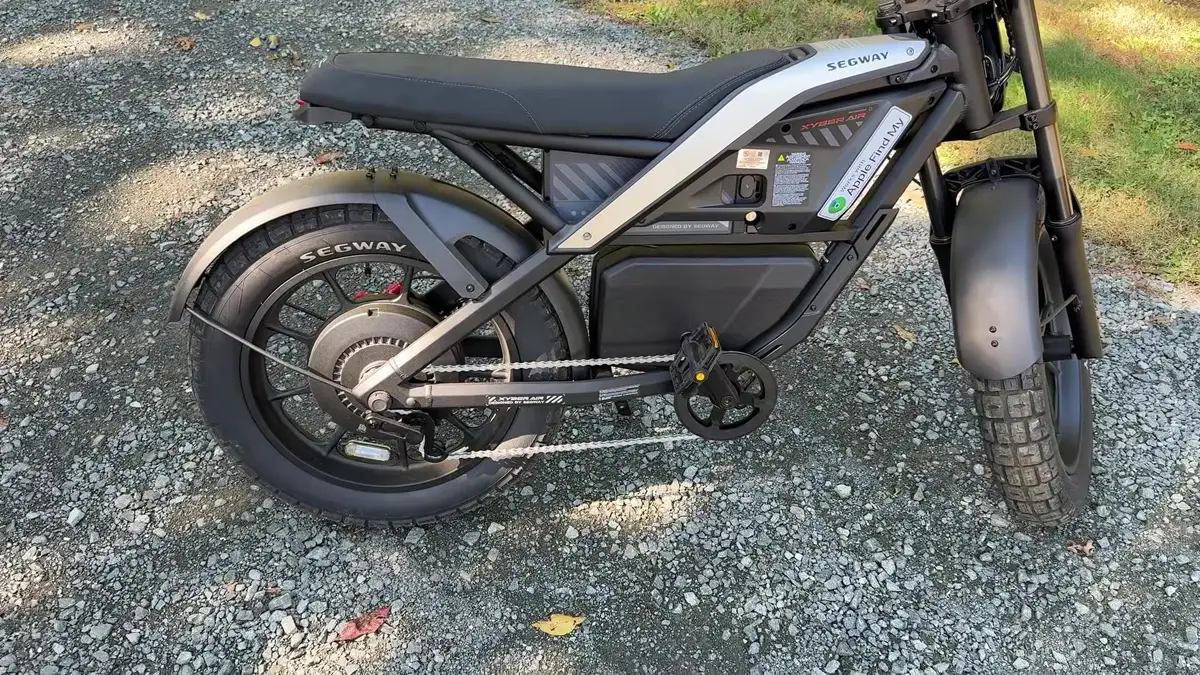
The battery is 48V and 717 Wh, the same capacity as the Muxi and Muxi Pro. Segway rates it for up to 58 miles. I haven’t done a range test, but in the real world I think 50 miles is about the most you’ll get, especially if you’re a heavier rider. That’s my estimate, not a measured number.
What I measured on camera: 12 to 14 mph up steep gravel inclines on full throttle in the Class 2 setting, at about 200 lb (video, 10:43).
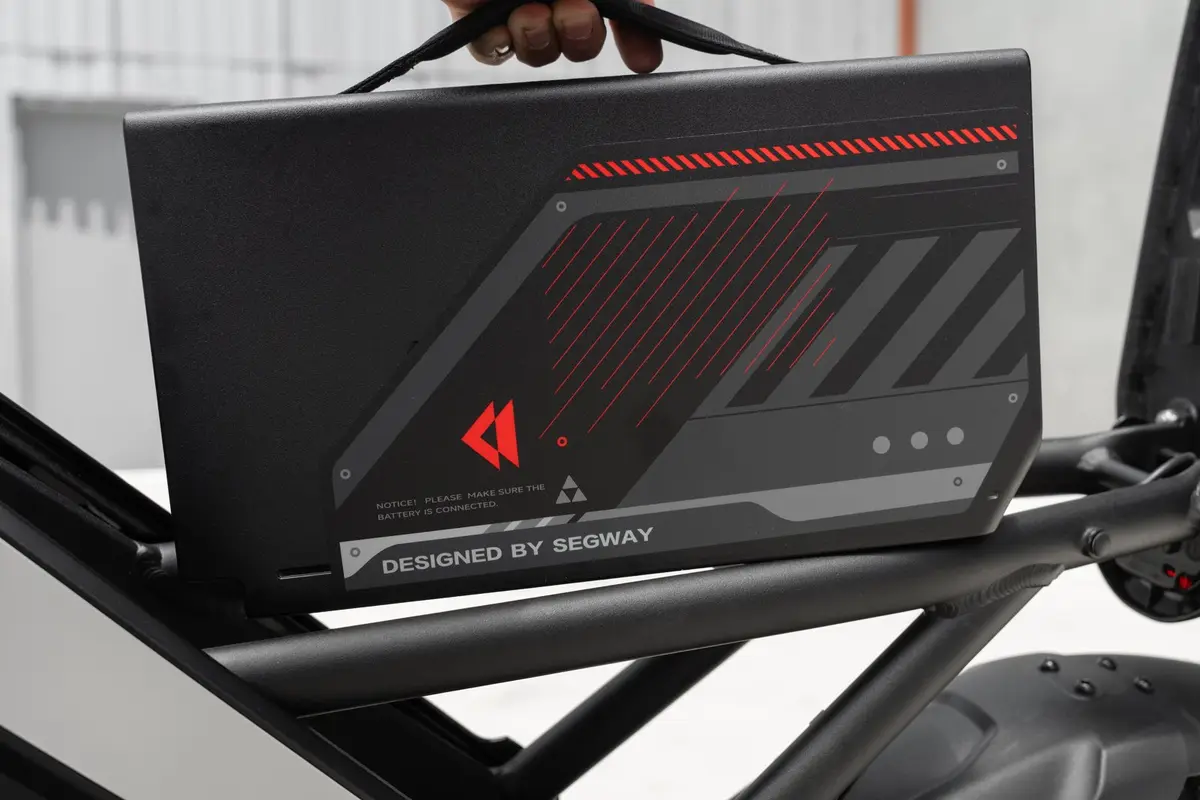
Charging takes about seven hours on the included 1.3A charger. If you ride all day and plug it in overnight, it should be fine.
I like how Segway handles the battery. Lift the seat and the battery comes out like a briefcase, the same design as every Segway e-bike I’ve tested. You can carry it inside to charge, so the bike doesn’t have to come in. The battery locks in with the provided key, and the locking mechanism feels very secure. If you don’t want to take it out, there’s a flap on the side where you can charge it on the bike.
Storage, fenders and the rack
There’s a lockable storage bag right under the battery area, with a three-digit combination lock. It came on my review bike, but you’ll pay extra for it on yours.
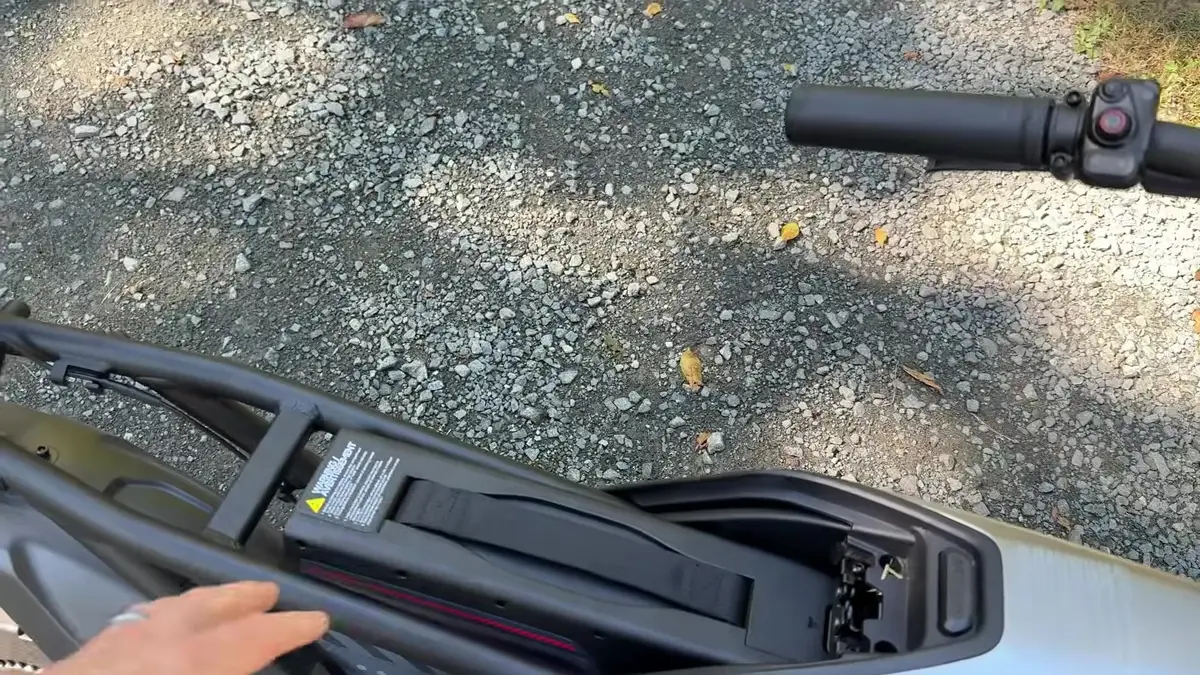
My review bike came with front and rear fenders and that lockable bag, but a bike you buy won’t. Segway’s store lists both as add-ons as of Oct 27, 2026: the fender set at $79.99 and the lockable middle bag at $99.99. The box comes with the bike, charger, pedals, two keys, reflectors and the manual. The fenders did a great job on my ride. I could hear gravel and rocks being kicked up, and none of it hit me.
The optional rear rack is $79.99 and rated for 22 lbs. That’s fine for a small bag, but it’s not a cargo bike. The Muxi and Muxi Pro racks are rated for 121 lbs.
The kickstand
This might not sound like a big deal, but I use a lot of kickstands reviewing all these e-bikes. The kickstand on the Xyber Air is better than on most e-bikes I’ve tested. I parked it at a slight angle, with the bike leaning downhill so most of the weight was on the kickstand. It had no problem at all. It didn’t lean or slide down the hill.
Lights
The X-shaped front light is a daytime running light, and it’s always on. At first I thought that was the headlight. The 600-lumen headlight sits underneath it. The headlight runs on auto by default, with a light sensor that turns it on when it gets dark. When I covered the sensor with my finger, it switched on, and it’s very bright.
The power button controls it:
- One tap turns off auto mode and turns the headlight off.
- Another single tap turns it on or off manually.
- A double tap puts it back on auto.
Even out in daylight, the daytime running light and tail light stay on. I appreciate that for rider safety. In back you get a tail light and a brake light, and no turn signals. You know I don’t like those silly turn signals, so I count that as a plus.
Security: AirLock and Apple Find My
Like the Muxi Pro, the Xyber Air has Segway’s AirLock. The bike locks itself when you walk away with your phone and unlocks when you come back. That’s a really nice feature if you leave it in a public place. It also works with Apple Find My, so if you use Apple devices you can add it to the Find My app and track it.
Segway also lists GPS tracking, a motion alarm and a Lost Mode that disables the bike remotely. It notes that certain features need a subscription after the first year. Segway hasn’t published the subscription price, so I can’t tell you what it costs. I only tested AirLock in my video.
The security matters most if you’re buying this for a teenager. You don’t want a $2,000 e-bike disappearing overnight.
The ride test
I sat on it with my feet on the ground to start, then put them up on the pedals to rest. Throttle almost the whole time, pedal assist on high, Class 2.
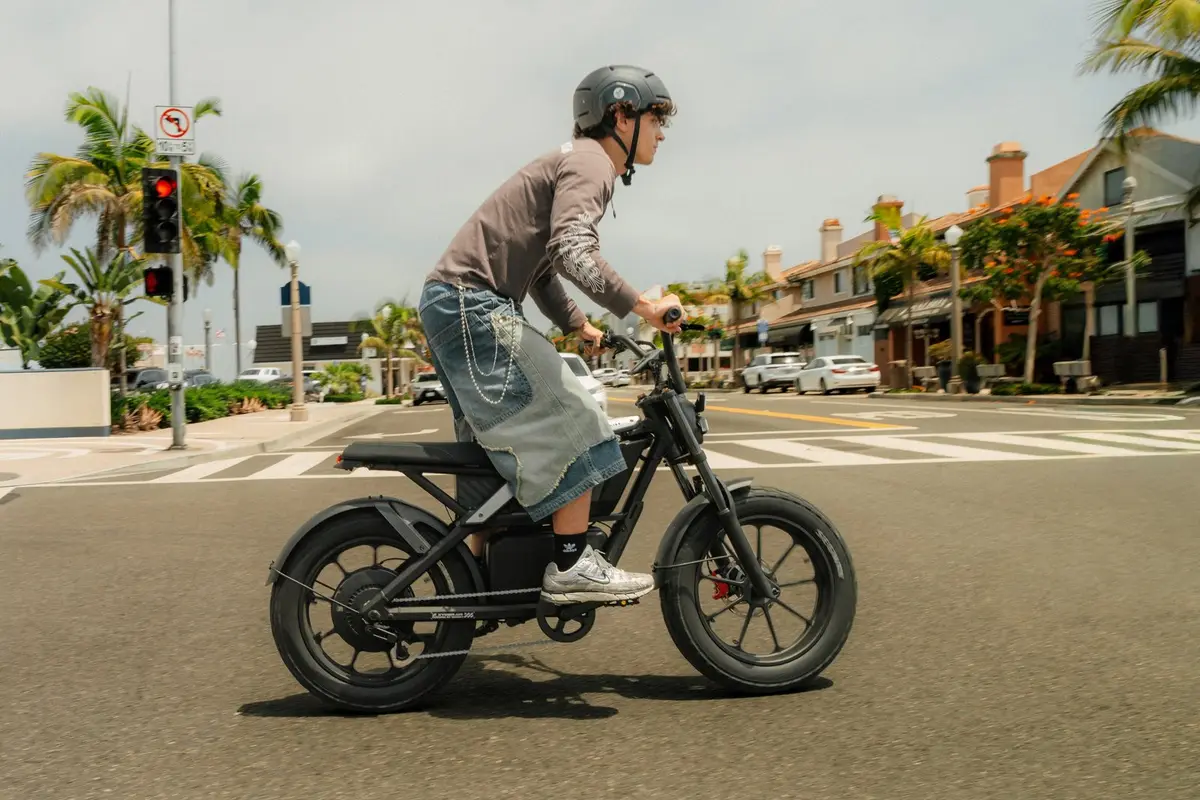
Downhill first. I started on a short downhill at full throttle and let off, and I had a lot of control. The brakes are very powerful and easy to control, even on gravel.
The first climb. Still at full throttle, I went up a steep, bumpy incline and the motor kept pulling. On the steepest part I dropped to about 13 mph, but I could feel the rear tire pulling the whole way. That’s the 750W rear hub motor and 80 Nm doing the work. There are no gears to shift, so the motor has to carry you.
The second climb. On another steep climb I dropped to 14 mph, then 12 near the top, still at full throttle in Class 2. It got me to the top at 200 lbs, and the motor did an excellent job.
The descent. Going back down, the control and stopping power were incredible. I was squeezing the brakes hard to keep from sliding out on the gravel. The hydraulic discs use 180 mm rotors front and rear, and they’re sized well for this bike. Segway also lists hill descent control with regen, plus traction control and hill start assist. I didn’t test those on their own.
Electronic braking. When I squeezed the brake levers just a hair, I could feel the motor’s electronic braking kick in at the rear. It’s very smooth and gives you a lot more control. Segway did an excellent job with it.
Comfort. On gravel, the bike feels really good. The wide tires and front fork help. I think the seat helps the most, because it’s plush but also firm. Segway doesn’t list rear suspension. I haven’t done a long, multi-hour ride yet.
Acceleration. In my video I quoted Segway at about six seconds from 0 to 20 mph, but Segway’s press release and one sheet say nine seconds. On gravel I got roughly seven to seven and a half seconds. That wasn’t a scientific test, and gravel is slower than pavement, so treat it as a rough check.
The fun factor. What I really didn’t expect was how much fun this bike is to ride. It has plenty of speed, and plenty of power when you need it most, going up a hill.
Weight
Segway lists the Xyber Air at 84 lbs and the original Xyber at 146.4 lbs, so in my video I called the Air about half the weight and really light by comparison. But 84 lbs is still heavy for an e-bike. It’s heavier than the Muxi Pro, at 82.2 lbs. Plan to roll it into a garage, not carry it up stairs. Pulling the battery out helps if you ever need to lift it.
How it compares
| Segway Xyber Air | Segway Muxi Pro | Segway Muxi | Aventon Abound SR | |
|---|---|---|---|---|
| Price | $1,999.99 MSRP | $1,999.99 | $1,699.99 | $1,899 |
| Motor | 750W (1,600W peak) | 750W | 750W | 750W |
| Torque | 80 Nm | 80 Nm | 80 Nm | 80 Nm |
| Battery | 717 Wh | 717 Wh | 717 Wh | 733 Wh |
| Rated range | 58 mi | 73 mi | 80 mi | 60 mi |
| Class 3 top speed | 28 mph | 28 mph | 23 mph | not listed |
| Gears | 1 | 9, auto | 1 | 8 |
| Front suspension | 80 mm fork | 70 mm fork | none | 50 mm fork |
| Tires | 20 x 4 in | 20 x 3.0 in | 20 x 3.0 in | not listed |
| Rear rack rating | 22 lbs (optional rack) | 121 lbs | 121 lbs | 143 lbs |
| Max payload | 330 lbs | 418 lbs | not listed | not listed |
| Weight | 84 lbs | 82.2 lbs | 72.75 lbs | 80 lbs |
| Range tested by me | not tested | not tested | not tested | not tested |
Sources: Segway’s Xyber Air press release (Oct 13, 2026) and press kit one sheet (checked Oct 26, 2026); Segway’s Muxi Pro vs Muxi page and store (Oct 23, 2026); Aventon’s page via my Aventon Abound SR review (Oct 22, 2026). Prices as of those dates. “Not listed” means the source doesn’t give it.
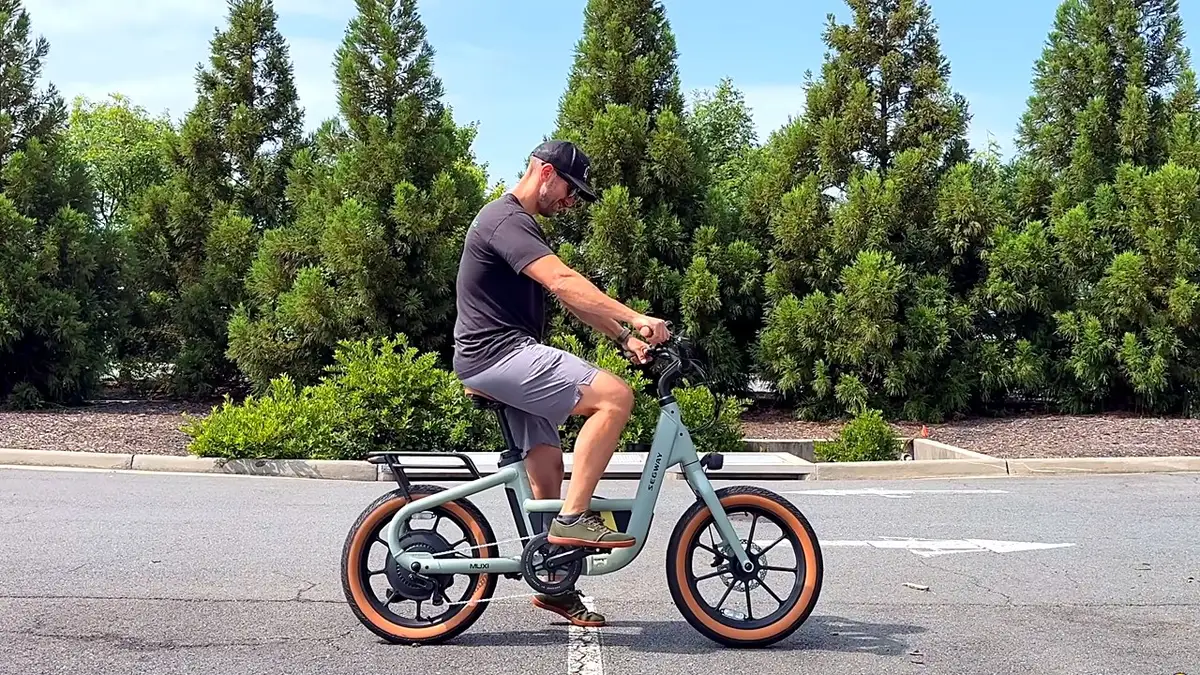
Xyber Air vs Muxi Pro. They cost the same, and they share the battery, motor rating and Segway’s app and AirLock. The Muxi Pro is the practical choice, with nine automatic gears, a 121 lb rack and more rated range. The Xyber Air is the one to buy for moto styling, wider tires, a longer-travel fork and the feel on gravel. My Xyber Air vs Muxi vs Muxi Pro guide goes deeper.
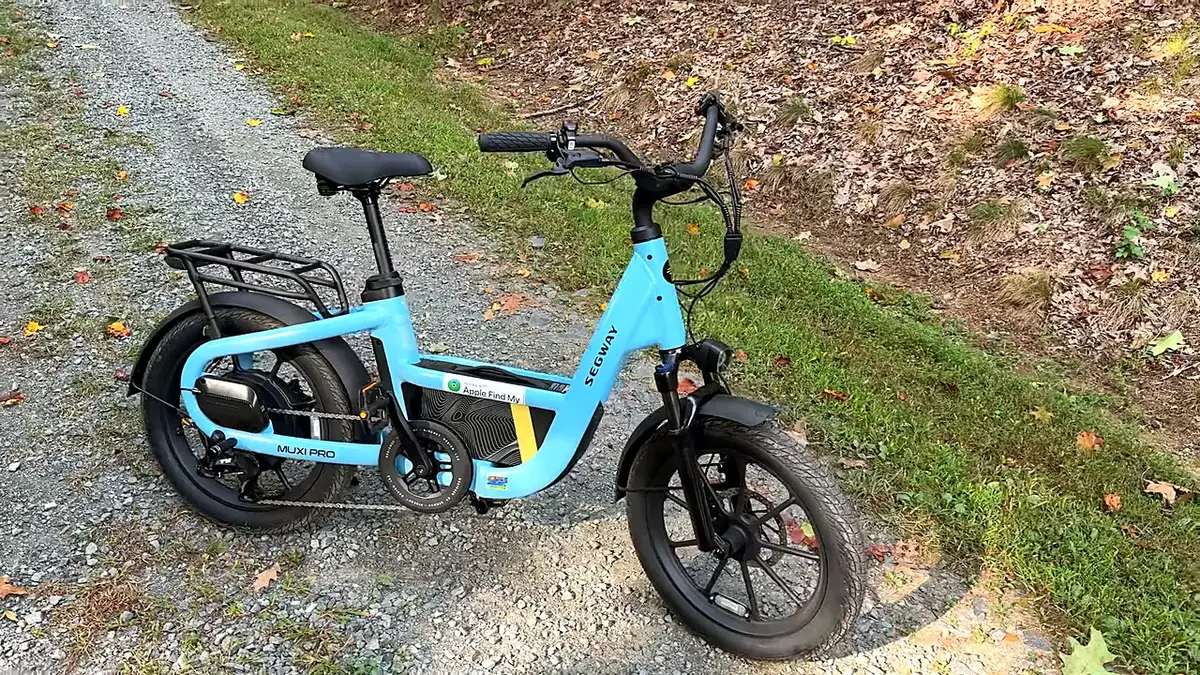
Xyber Air vs Muxi. The Muxi is $300 less and lighter, with the same 121 lb rack rating. But it has no front suspension and tops out at 23 mph in Class 3. If you’ll ride mostly on pavement and want to carry things, it makes more sense.
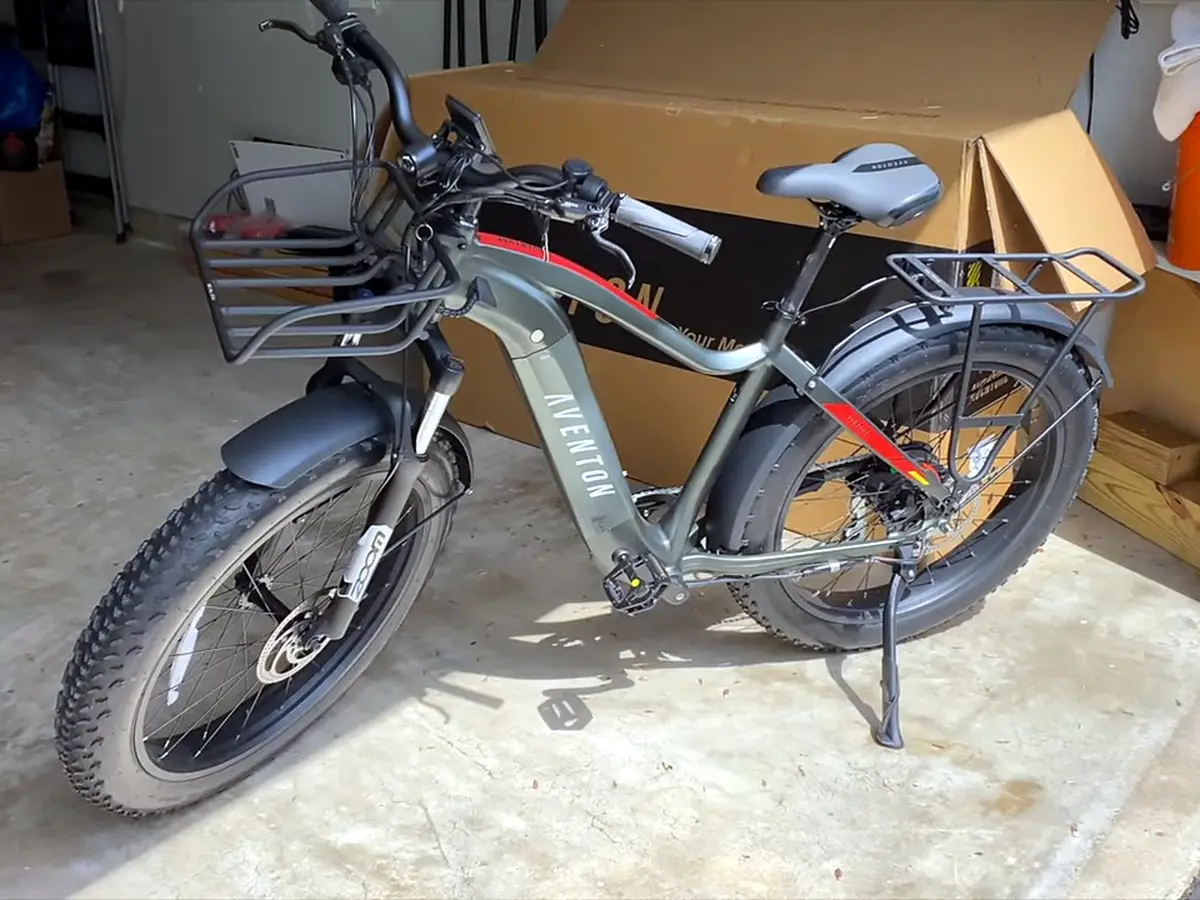
Xyber Air vs Aventon Abound SR. The Abound SR is a cargo bike with eight gears and a 143 lb rack. If hauling is the job, pick the Abound. If you want fun on dirt and gravel, pick the Xyber Air.
For more options, see my Xyber Air alternatives guide.
Who it’s for
- Riders who use the throttle. If you want to twist and go, the fixed seat and single speed don’t matter much, and the motor and brakes do.
- Mixed-surface riders. Gravel, trails and pavement all work. In my video I called it a hybrid design because of the knobbier tires: great for pavement but also good off it.
- Parents buying for a teenager, where local laws allow it. You get the 4’8” minimum rider height, AirLock and Apple Find My, and you can set it to a lower class. Check your state’s age rules first, and remember the throttle still works with assist set to none.
- People who want the Xyber look without the off-road-only limit or the original’s price.
It’s not for pavement-only commuters, riders who want to pedal for exercise, or anyone who needs a cargo rack. The Muxi or Muxi Pro, or a cargo bike like the Abound SR, makes more sense for those jobs.
Price and what you pay
Segway lists the Xyber Air at $1,999.99 MSRP as of Oct 27, 2026, at store.segway.com, Segway dealers and SCHEELS. Fenders, the lockable bag and the rack don’t come with it. Segway sells them as add-ons at $79.99, $99.99 and $79.99, so the bike with fenders and the bag is $2,179.97, or $2,259.96 with the rack too. Some smart features need a subscription after the first year, and Segway hasn’t published the price. For the full cost breakdown, see my Xyber Air specs, range and price guide and is the Xyber Air worth it?
For a power-focused bike with a dual-crown fork, hydraulic brakes, a 717 Wh removable battery and Segway’s security features, I think it’s a very competitive price at the $2,000 mark.
See the Xyber Air at Segway (affiliate link)
What I haven’t tested yet
- Real-world range. My 50-mile figure is an estimate.
- Class 3 and Hybrid riding. I stayed in Class 2.
- Rain. Segway rates the battery and display IPX7 and the body IPX5. I didn’t ride it in the rain.
- Long-term durability. I’m keeping this bike for a while, and I plan to do six-month and one-year follow-ups. If there’s something you want me to test, let me know in the comments on my video.
FAQ
Is the Segway Xyber Air street legal?
Yes. Unlike the off-road-only original Xyber, the Air is designed to be a street-legal Class 1, 2 or 3 e-bike. Which class you can ride depends on your state. See Is the Segway Xyber street legal?
Is the Segway Xyber Air a Class 3 e-bike?
It can be. You pick Class 1, 2, 3 or Hybrid in the settings. Segway lists 28 mph with pedal assist in Class 3, where your local law allows it. I tested it in Class 2.
How far does the Xyber Air go on a charge?
Segway rates it up to 58 miles on its 717 Wh battery. I haven’t done a range test, but I think about 50 miles is the realistic most, especially for heavier riders.
How long does it take to charge?
About seven hours on the included 1.3A charger. You can charge the battery on the bike or take it inside.
How much does the Xyber Air weigh?
Segway lists it at 84 lbs. The original Xyber is 146.4 lbs on Segway’s page.
Can a 200 lb rider climb hills on it?
In my test, yes. At about 200 lbs and full throttle in Class 2, it climbed two steep, bumpy gravel hills and dropped only to 12 to 14 mph on the steepest parts. Segway lists a max payload of 330 lbs.
Does the throttle work without pedal assist?
Yes. The throttle works from a stop, and it still works with assist set all the way down to none.
Is it good for a teenager?
For a teen who fits the 4’8” to 6’ rider range and lives where the law allows it, it can be. AirLock and Apple Find My help with theft, and you can set a lower class. Check your state’s age limits first.
How is it different from the original Xyber?
The Air is street legal, has a 750W motor instead of the original’s 3,000W (one battery), weighs 84 lbs instead of 146.4 lbs, and lists at $1,999.99 instead of $3,299.99 regular. I haven’t ridden the original. See Xyber vs Xyber Air.
Final thoughts
I really like the design of the Xyber Air, and I love how much power it has. It pulled me up steep gravel hills, it stopped with real control on loose rock, and it was more fun to ride than I expected. Add the security features and a price just under $2,000, and it’s a great overall package. Just know what it is: a throttle-first, moto-style e-bike for mixed surfaces. If you’ll mostly ride on pavement or want to pedal, there are better choices.
Related reviews and guides
- Segway Muxi Pro review
- Segway Muxi review
- Is the Segway Xyber Air worth it?
- Segway Xyber Air alternatives
- Segway Xyber Air specs, range and price
- Is the Segway Xyber street legal?
- Segway Xyber Air classes: switching 1, 2, 3 and Hybrid
- Aventon Abound SR review
- Best e-bike for heavy riders
- Class 2 vs Class 3 e-bikes
- E-bike laws by state
“He gives power to the faint, and to him who has no might he increases strength.” Isaiah 40:29 (ESV)