I haven’t ridden the Ride1Up Prodigy V2 ECO, or any version of the Prodigy V2. This page is a research profile, not a review. The numbers come from Ride1Up’s product page, manual and policies, the CPSC, and independent reviews that I summarize in my own words and link at the bottom. Prices and stock are as of Oct 27, 2026.
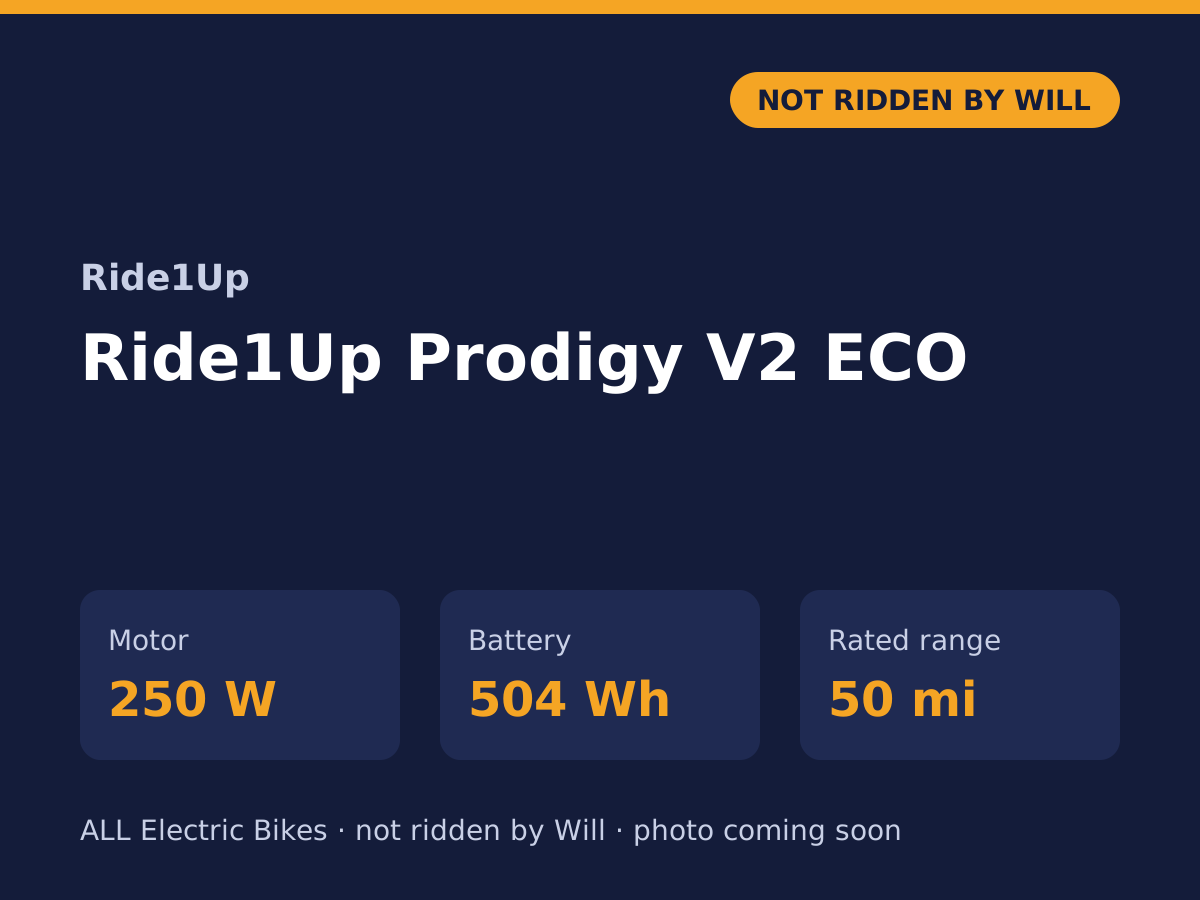
Here’s the short version. For $1,295 shipped, Ride1Up puts a Brose mid-drive with 90 Nm of torque and a torque sensor into a commuter with a suspension fork, hydraulic brakes, a rack, fenders and lights. Both frames, the step-through ST and the high-step XR, showed in stock on ride1up.com on Oct 27, 2026. The catch is what a low price usually leaves out: a 1-year warranty, home assembly, a modest 504Wh battery and no throttle.
Which Prodigy this is
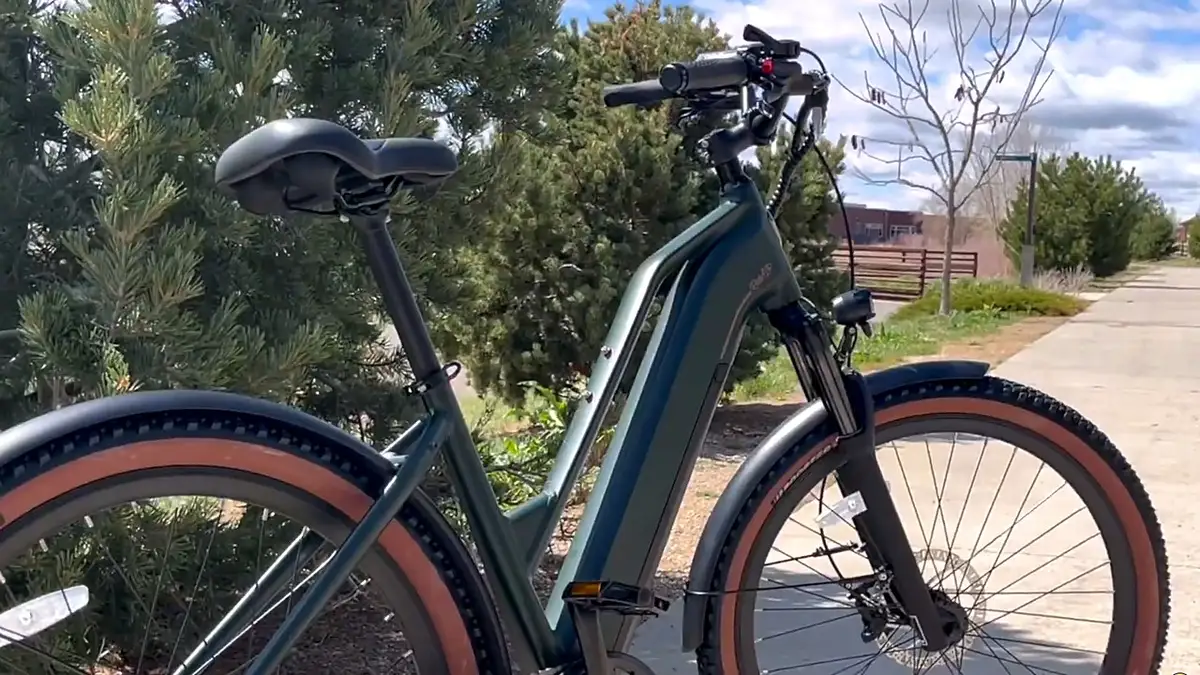
The Prodigy V2 has been sold in a few versions, including LX models with a Gates belt and an Enviolo CVT hub. Ride1Up’s old Prodigy V2 link now redirects to one current model, the chain drive Prodigy V2 ECO, so that’s the bike this page covers. Electrek reported launch prices of $2,395 for the chain version and $2,695 for the belt drive LX in January 2024.
Most of the well known independent reviews tested the LX. It uses the same Brose motor and the same 504Wh battery, but its belt and CVT hub aren’t on the ECO, so I’ll say when a finding comes from the LX.
The Brose motor and the torque sensor
The motor is the Brose TF Sprinter, rated at 250W and 90 Nm. It’s a mid-drive, so it sits at the cranks and drives the chain through the bike’s gears. On a steep hill you shift down and the motor gets the same leverage your legs do. That’s why a 250W mid-drive can climb well against hub motors with much bigger watt ratings.
It’s also torque sensing. The sensor measures how hard you push and adds power in proportion, so a light push gets a little help and a hard push gets a lot. That usually feels like a strong regular bike. Ride1Up’s own hub motor commuters, the Ride1Up Turris and the Ride1Up Cafe Cruiser I filmed, use Ride1Up’s current based cadence sensor instead, which turns the motor on when the cranks spin without measuring how hard you push.
Independent testers liked the motor on the LX. Electric Bike Report called the LX the best Prodigy Ride1Up had made and described the power as smooth and consistent. ElectricBikeReview.com called the motor smooth, silent and powerful, with natural feeling assist. Electrek said a quality mid-drive at Ride1Up’s price is probably the most affordable way to get one.
The recurring critique is top speed. A verified LX owner on Ride1Up’s page wrote that the bike won’t hold 28 mph without an effort he couldn’t sustain, and that normal effort gets him to roughly 22 to 24 mph. That fits how a 250W torque sensing motor works. It multiplies your effort rather than replacing it.
No throttle
The Prodigy V2 ECO is pedal assist only, with four levels on a 1.5 inch Brose color display. If you need a throttle to get rolling at a stoplight on a hill, rest your legs, or ease sore knees, this isn’t your bike.
The upside is a simpler legal picture. Ride1Up lists it as Class 3, with pedal assist to 28 mph. Class 3 bikes come with more rules in many states, such as minimum ages, helmets and bans on some paths, so check yours on my e-bike laws hub.
If you’ve never ridden a torque sensing mid-drive, try one at a shop before ordering online.
Battery, range and charging
Ride1Up lists a 36V 14Ah Phylion pack with Samsung cells, which is 504Wh. It sits in the down tube and comes out for charging. Ride1Up rates the range at 30 to 50 miles, depending on rider weight, terrain and assist level, and ships a 36V 2A charger with auto shut-off. It doesn’t list a charge time.
Independent range tests on the LX, with the same 504Wh battery, ran from 31 miles in the top mode to 65.3 miles in Tour at Electric Bike Report, and from 32 to 73 miles at ElectricBikeReview.com. OutdoorGearLab got 19.34 miles in Boost and scored the LX 4.9 out of 10 for range. The LX owner quoted above said he used about half his charge on 10 flat miles in Boost.
That spread shows how much range depends on mode and speed. On paper, planning for 20 to 30 miles in the top mode and 40 or more in the middle modes is a fair reading of the evidence.
Gears, brakes, fork and tires
Ride1Up lists a MicroShift Advent 9-speed derailleur and trigger shifter with a Shimano 11-34T cassette and a 48T chainring. A mid-drive puts more force through the chain and cassette than a hub motor does, so expect to replace the chain more often, and ease off the pedals for a moment when you shift.
The brakes are 180mm hydraulic discs. Ride1Up doesn’t name the brand on the page. The fork has 100mm of travel with a lockout, the same travel Ride1Up lists on the Turris.
The tires differ by frame. The ST lists a 27.5 by 2.10 inch tire, and the XR lists a WTB Ranger at 27.5 by 2.25 inches. Neither is a fat tire. The stock seat post is a rigid Zoom 350mm by 28.6mm, and Ride1Up sells an accessory bundle that includes a suspension seat post.
Fit, weight and cargo
The ST fits riders from 5’0” to 6’0”, and the XR fits 5’5” to 6’1”. Ride1Up’s size chart lists 30.7 inches of stand over and a 38.2 inch maximum seat height for the XR. OutdoorGearLab felt the LX fit best for riders around 5’5” to 5’10”, and the 6’1” LX owner said it just fits him.
Ride1Up lists 58 lb, a 300 lb weight capacity and a 40 lb rear rack. Electric Bike Report weighed its LX test bike at 62.3 lb.
Shipping, warranty and returns
Ride1Up ships free to the 48 contiguous states. The bike arrives in a box, mostly assembled, and you attach parts like the handlebars, front wheel and pedals using the manual. Ride1Up asks you to report shipping damage or a defective part within 3 working days of delivery, so photograph it as you unbox it.
The warranty is 1 year against manufacturing defects, for the original owner only, who must be 18 or older. In the first 30 days Ride1Up covers parts and labor if you contact them before the work is done. After that, Ride1Up ships replacement parts free in the US, and labor is on you.
Ride1Up’s return policy page, which I read on Oct 26, 2026, offers 30-day returns on its e-bikes, with the odometer under 20 miles, photos sent to support first, and $250 to $350 deducted from your refund for return shipping. One thing to confirm: on Oct 27, 2026, the support strip on the Prodigy V2 ECO page listed a 1-year warranty and free shipping but didn’t mention 30-day returns, while the 700 Series page did. Ask Ride1Up before you order if a return matters to you.
I searched the CPSC recall database for Ride1Up on Oct 26, 2026, and found no recalls.
How it compares with bikes I’ve filmed
None of these are ride comparisons. I haven’t ridden the Prodigy, so this is the Prodigy’s published numbers next to bikes I have filmed, with those bikes’ specs from their brands.
The Ride1Up Turris is the closest Ride1Up I’ve filmed. Ride1Up lists a 750W sustained geared rear hub with 90 Nm, a cadence sensor, a throttle, a 100mm fork, 180mm hydraulic brakes and 54 lb. It was $1,395 on Oct 27, 2026, and out of stock in every option. So on paper, the Turris adds a throttle and a bigger hub motor, and the Prodigy adds the mid-drive, the torque sensor and an extra gear.
The Ride1Up Cafe Cruiser is a 750W Bafang hub cruiser with 60 Nm, a 720Wh battery, 26 by 3 inch tires and 65 lb, per Ride1Up. It’s a relaxed, upright bike with a throttle, not a sporty commuter.
The Velotric Discover 2 lists a 750W rear hub with a 75 Nm torque sensor, a throttle, a 705.6Wh battery, an 80mm fork and 63 lb, at $1,499 as of Oct 27, 2026, with only the Large Cherry Crimson frame showing in stock. On paper it’s the pick if you want a torque sensor and a throttle and more battery, and the Prodigy is lighter with the mid-drive.
The Velotric T1 ST is the lightweight end, with a 350W hub, 45 Nm, a torque sensor, no throttle, a 352.8Wh battery and 36 lb. Velotric now sells it as the T1 ST Plus, at $1,399 as of Oct 22, 2026.
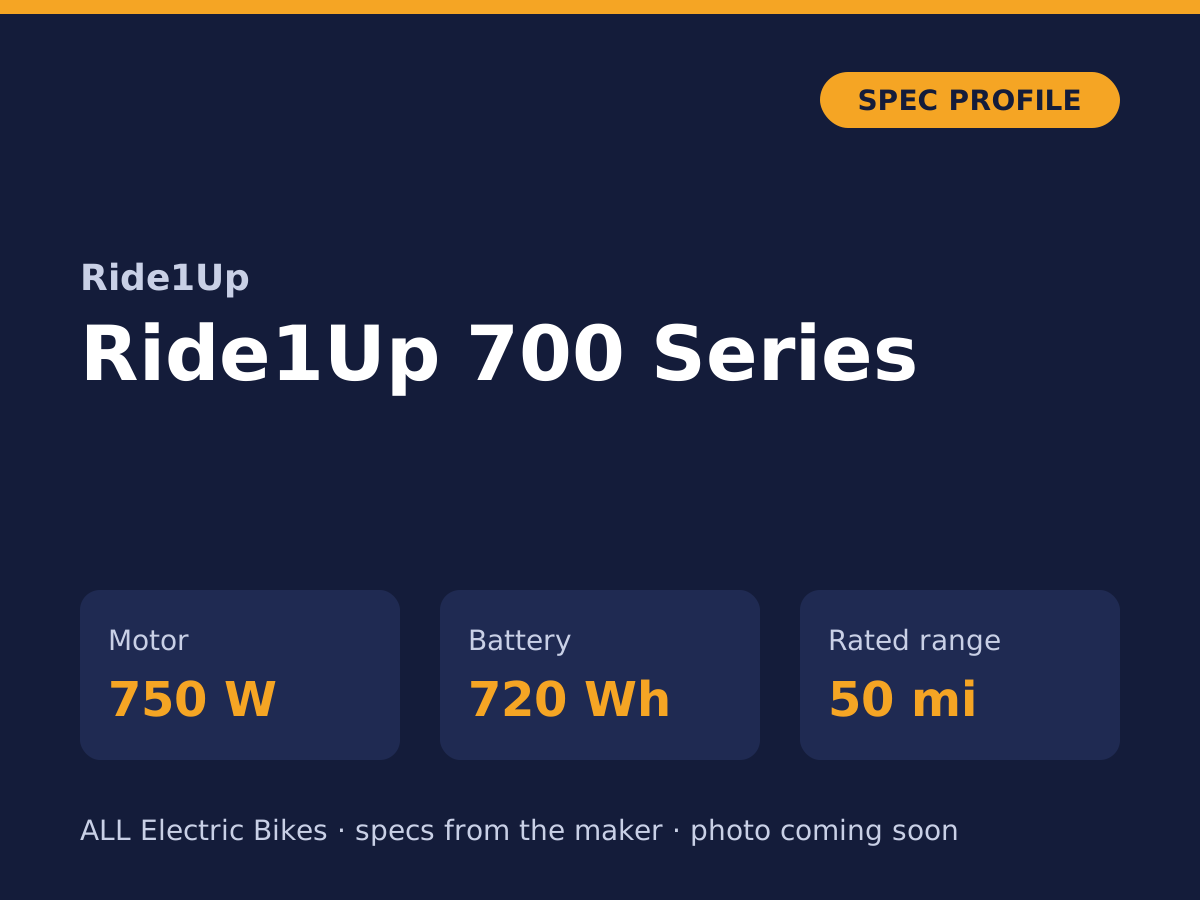
If you’re also looking at the Ride1Up 700 Series, note that it’s out of stock in every option as of Oct 27, 2026, and I haven’t ridden that one either.
Who it fits, on paper
The Prodigy V2 ECO fits budget commuters who want a mid-drive and torque sensor without paying bike shop prices, riders in hilly cities who’ll use the gears and 90 Nm, and riders between 5’0” and 6’1” who can handle assembly and basic upkeep.
It’s not a good fit if you want a throttle, need more than 300 lb of capacity, ride long distances in the top mode, or want a long warranty and a local dealer.
FAQ
Has Will ridden the Prodigy V2?
No. I haven’t ridden any version, and this page is built from the sources below.
Does it have a throttle?
No. It’s pedal assist only, with four levels.
How fast does it go?
Ride1Up lists pedal assist to 28 mph. An LX owner says normal effort gets him into the low to mid 20s.
How far does it go?
Ride1Up says 30 to 50 miles. Independent tests of the LX, with the same battery, ranged from about 19 miles in the top mode to 73 miles in Tour.
Sources
Accessed Oct 26 and Oct 27, 2026.
- Ride1Up Prodigy V2 ECO product page (price, stock, specs, sizing, owner reviews)
- Ride1Up Prodigy V2 user manual (PDF)
- Ride1Up warranty
- Ride1Up return and pre-order policy
- Ride1Up shipping
- Electric Bike Report, Prodigy V2 LX review
- ElectricBikeReview.com, Prodigy V2 review
- Electrek, Prodigy V2 review (launch prices)
- OutdoorGearLab, Ride1Up Prodigy V2 LX review
- CPSC recall search
“Better is a little with the fear of the LORD than great treasure and trouble with it.” Proverbs 15:16 (ESV)