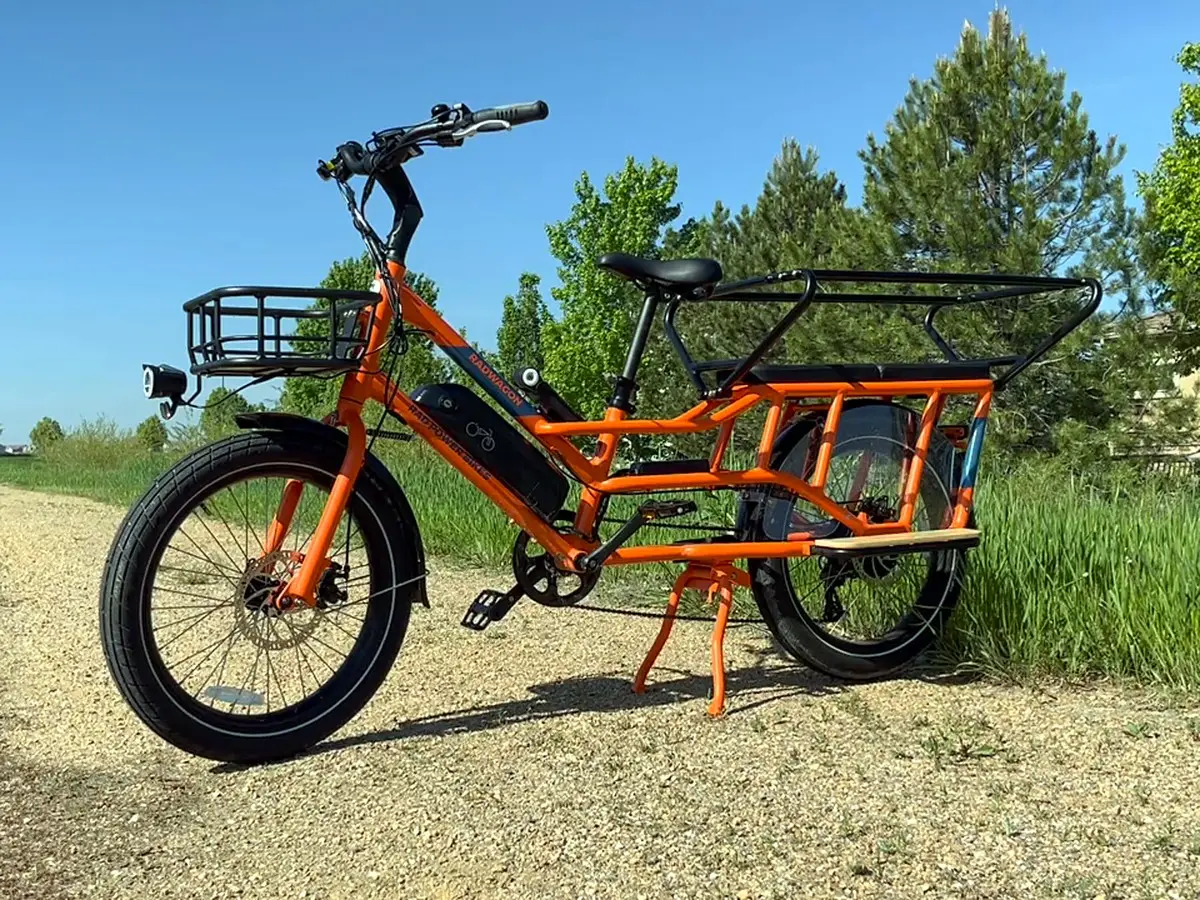
The hardest part of carrying kids on a bike isn’t the riding. It’s the moment you stop: a child climbing onto the deck, a bike that wants to tip, and a hill waiting at the end of the street. My family used the Rad RadWagon 4 for pool runs, trips around town and grocery stops, and the things I’d change on it were a cadence sensor, mechanical brakes, a cheap-feeling shifter and no turn signals. The Rad Power Bikes RadWagon 5 is its successor, and on paper it fixes most of that list. I haven’t ridden it. Everything here comes from Rad’s official RadWagon 5 page, Rad’s warranty and refund policies, the CPSC, news coverage of Rad’s sale, and independent reviews I summarize in my own words, all linked in the sources. When I mention riding notes, they’re about the RadWagon 4.
Should you buy one?
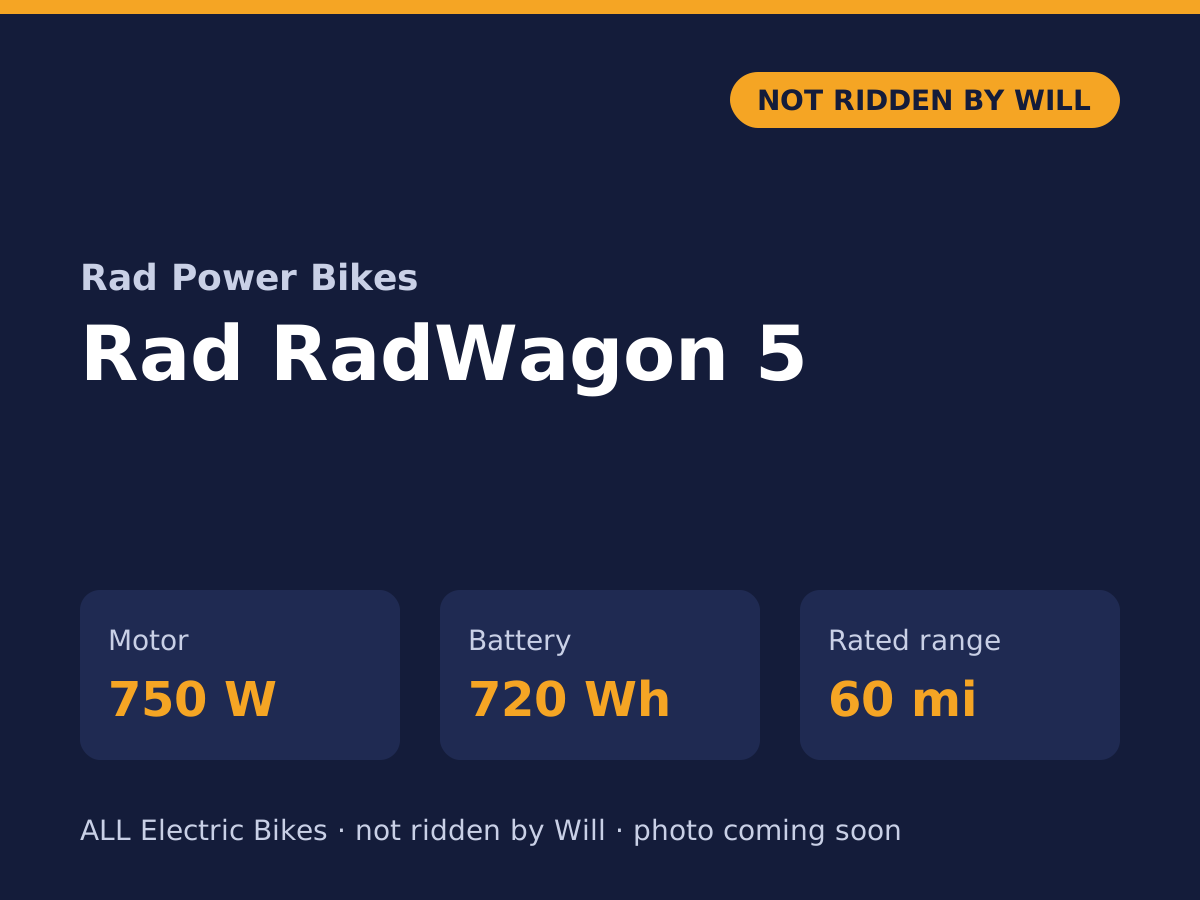
At $2,399 (as of Oct 27, 2026), the RadWagon 5 is a complete family longtail. Rad lists a 750W motor with 90 Nm of torque and a torque sensor, a 720Wh battery, Tektro hydraulic disc brakes, a 45mm suspension fork, turn signals, a two-leg center stand and a 120 lb rear rack. It ships as a Class 2 bike and can be switched to Class 1 or Class 3. Rad lists it as shipping within two business days.
There are real trade-offs. It weighs 86 lb with the battery. Rad caps the rider at 265 lb inside a 375 lb total payload. The stock charger is 2A, and Electric Bike Report estimated about 7.5 hours from empty. Returns cost money: $149 shipping on an unridden bike, plus a 30% restocking fee if it’s been ridden, and only under 20 miles.
And there’s the company. Rad Power Bikes filed for Chapter 11 on Dec 15, 2025. Life EV bought Rad’s assets for $13.2 million, and TechCrunch reported on Mar 6, 2026 that Life EV officially owned the brand. GeekWire and Engadget covered the sale too. Bikes are now sold under Rad Life Mobility, and the warranty comes from that company.
One more thing to check: Rad also sells a cheaper entry RadWagon for $1,799 (as of Oct 26, 2026) with a 65 Nm motor, a 350 lb payload and a 275 lb rider limit. It’s a different bike, so make sure the listing says RadWagon 5.
The motor, and why the sensor matters
Rad lists a 750W rear hub with 90 Nm of torque, up from 65 Nm on the RadWagon 4, and pairs it with a torque sensor. On my RadWagon 4, the cadence sensor turned the motor on at a set level as soon as the pedals turned. It didn’t measure how hard I pushed. A torque sensor adds power in proportion to your effort, which should feel smoother pulling away from a stop with kids on the back.
Electric Bike Report timed the RadWagon 5 up a one-third mile hill at a 12% grade. On throttle alone it took 1:26, averaging 12.6 mph, against that site’s 1:33 average. Pedaling in the top assist level, it took 1:17 at 14.1 mph, against an average of 1:23.
Class settings and the throttle
The RadWagon 5 ships as Class 2, with throttle and pedal assist up to 20 mph. Class 1 keeps pedal assist at 20 mph and, per Rad, only lets the throttle work while you pedal. Class 3 Limited raises pedal assist to 25 mph, and Class 3 raises it to 28 mph. GearJunkie reports that the throttle stays capped at 20 mph in Class 3. Rad doesn’t state the throttle limit for either Class 3 setting, so check the display after you switch. ElectricBikeReview reported that in Class 3 the bike reached 28 mph and averaged 26.8 mph at the highest assist level.
Class 3 bikes are often barred from multi-use paths and may have age or helmet rules. With kids on the back, I’d think hard before riding at 28 mph anyway. Check your local rules on our e-bike laws hub.
Range and charging
Rad rates the 720Wh Safe Shield battery at 20 to 60 miles, and the independent tests land inside that range. Electric Bike Report got 26.8 miles in Class 2 at the highest assist, averaging 17.9 mph, and 48.25 miles at the lowest level, averaging 10.5 mph. OutdoorGearLab got 24.96 miles on throttle alone, averaging 16.5 mph over about 1,400 ft of climbing.
For a family, Electric Bike Report’s full-power result works out to about 13 miles each way with no margin, so I’d plan on 10 to 11 miles each way at full assist, and less with kids on the back, in cold weather or into wind. At low assist the 48 mile result roughly doubles that. Speed costs range, too: The Inertia reported that the display estimated about 15 miles at the top level in Class 3, against 51 miles at the lowest level. Those are the bike’s own estimates, not a measured test.
At about 7.5 hours from empty on the 2A charger, this is an overnight charge, not a quick top-up.
Brakes, fork and drivetrain
The RadWagon 4 had Tektro mechanical disc brakes. The RadWagon 5 has Tektro HD-E395 hydraulic discs with 180mm rotors that are 2.3mm thick. Electric Bike Report stopped it from 20 mph in 18 ft 7 in, against its average of 21 ft 10 in. That’s about 3 feet shorter, but it was measured from 20 mph, so a loaded bike at Class 3 speed needs more room.
The RadWagon 4 had a rigid steel fork. The RadWagon 5 gets an RST suspension fork with 45mm of travel, lockout and preload. The drivetrain is a Shimano Altus 7-speed with an 11-34T cassette and a 50T chainring. The shifter was the weak spot on my RadWagon 4, and I can’t tell you whether this one feels better until I ride it.
The two-leg center stand matters on a longtail. The dual-leg kickstand on my RadWagon 4 was sturdy, and I still told viewers to hold on to the bike while kids get on and off. I’d do the same here.
Fit, size and the weight limits
The RadWagon 5 is one size, for riders 4’11” to 6’3”. The standover is 21 in, down from 23.6 in on the RadWagon 4, and the telescoping seatpost runs from 30.5 to 41.8 in, which makes it easier to share between two adults. Rad moved from 22 in wheels on the RadWagon 4 to 20 x 3.3 in Kenda tires, and the 50.7 in wheelbase is about 3 inches shorter. The bike is 76 in long.
Rad lists 86 lb with the battery and 75.6 lb without, so the pack is about 10.4 lb. Electric Bike Report weighed its test bike at 85.7 lb. At that weight and length, you need ground floor storage.
The weight limits work together, and the payload includes the rider. A 265 lb rider has 110 lb left, so the rack can’t be fully loaded. A 200 lb rider with two kids totaling 120 lb on the rack is at 320 lb, leaving 55 lb for a front basket and bags. A 150 lb rider can fill the rack to 120 lb and still have 105 lb for the front. The 120 lb rack limit covers the kids, seat pads, any passenger rails and bags on the back. That’s my math from Rad’s figures.
Lights and safety
There’s a brake light and turn signals. Rad’s page gives two figures for the headlight: its feature text calls it a 200 lumen headlight, and Electric Bike Report says the same, while Rad’s spec table says 450 lumens. If you ride in the dark, plan to check it on delivery.
Rad lists the battery as UL 2271 certified and the electrical system as UL 2849 certified. On Nov 24, 2025, the CPSC warned consumers to stop using Rad batteries with model numbers RP-1304, RAD-S1304Y and HL-RP-S1304, after reports of 31 fires. It was a warning, not a recall, and it names the RadWagon 4. The RadWagon 5 uses a Safe Shield battery, which is not one of those models. If you own a RadWagon 4, check the label on its battery. When I searched the CPSC database on Oct 26, 2026, Rad’s one listed recall was for RadWagon 4 tires, from Nov 3, 2022. There’s no recall for the RadWagon 5.
Electric Bike Report flagged messy cable routing, which is cosmetic.
Warranty, returns and support
Rad Life Mobility’s warranty covers bikes bought new in the US or Canada on or after May 15, 2026. It gives two years on the frame and listed components, two years or 300 charge cycles on the battery, and one year on pedals, drivetrain parts, the saddle and accessories. It excludes wear items, water damage, rust, and fire, thermal or safety incidents, and you pay shipping to send parts back. Bikes bought before Dec 15, 2025 go through the bankruptcy claims process (case 25-02183), so a used RadWagon 5 bought early may have no warranty.
Rad’s refund policy gives 30 days. A new bike has to come back in its original packaging, and Rad charges $149 for return shipping. A ridden bike can come back only with under 20 miles, with the $149 fee and a 30% restocking fee. Orders can’t be cancelled. Support is at [email protected].
How it compares with the Rads I’ve filmed
Neither Rad I filmed is sold new in Rad’s store as of Oct 26, 2026, so this is about whether the new bike improves on what I rode. Against the RadWagon 4, the RadWagon 5 adds a torque sensor, 90 Nm instead of 65, hydraulic brakes, a suspension fork, turn signals and Class 3, and moves to a 375 lb payload from 350. It also gains about 9 lb, though Rad’s older weight figure may not include the battery, so treat the gap as approximate.
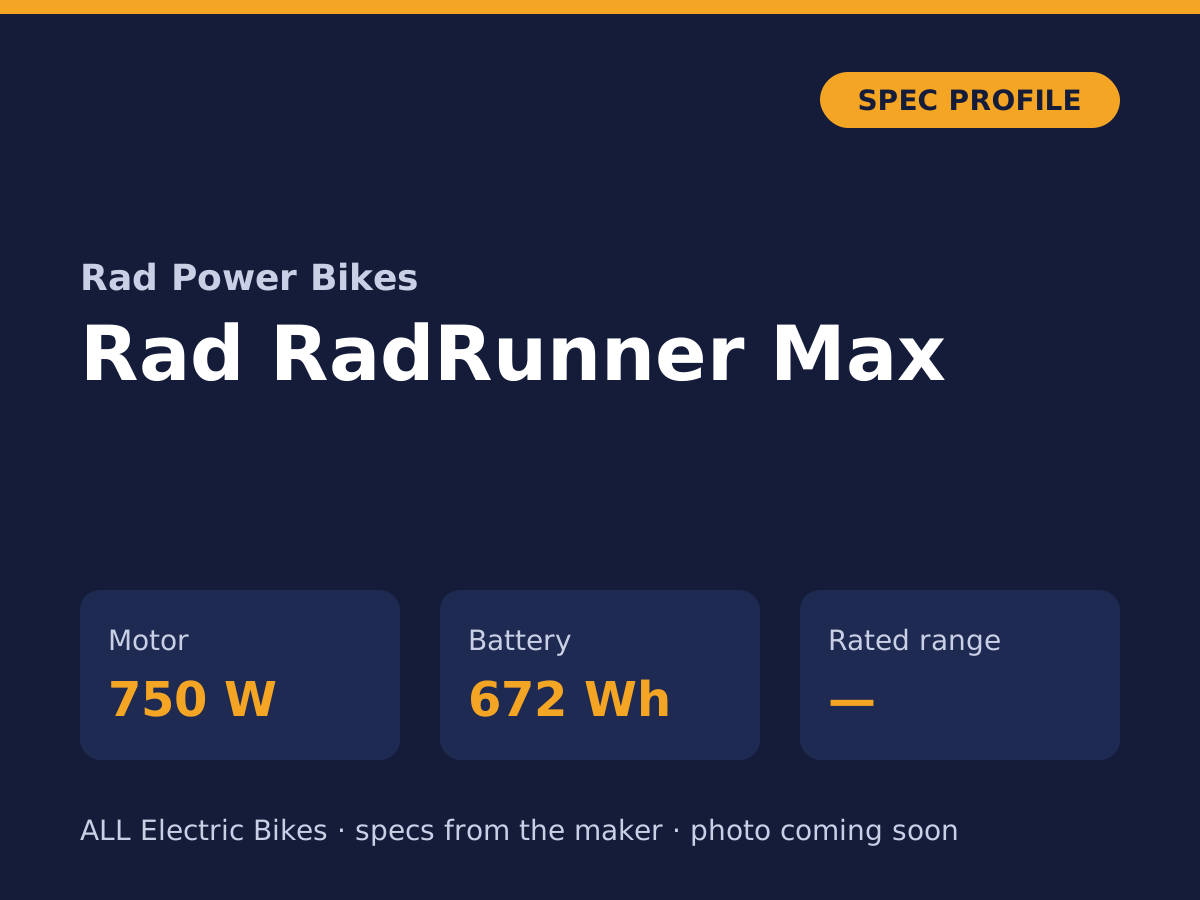
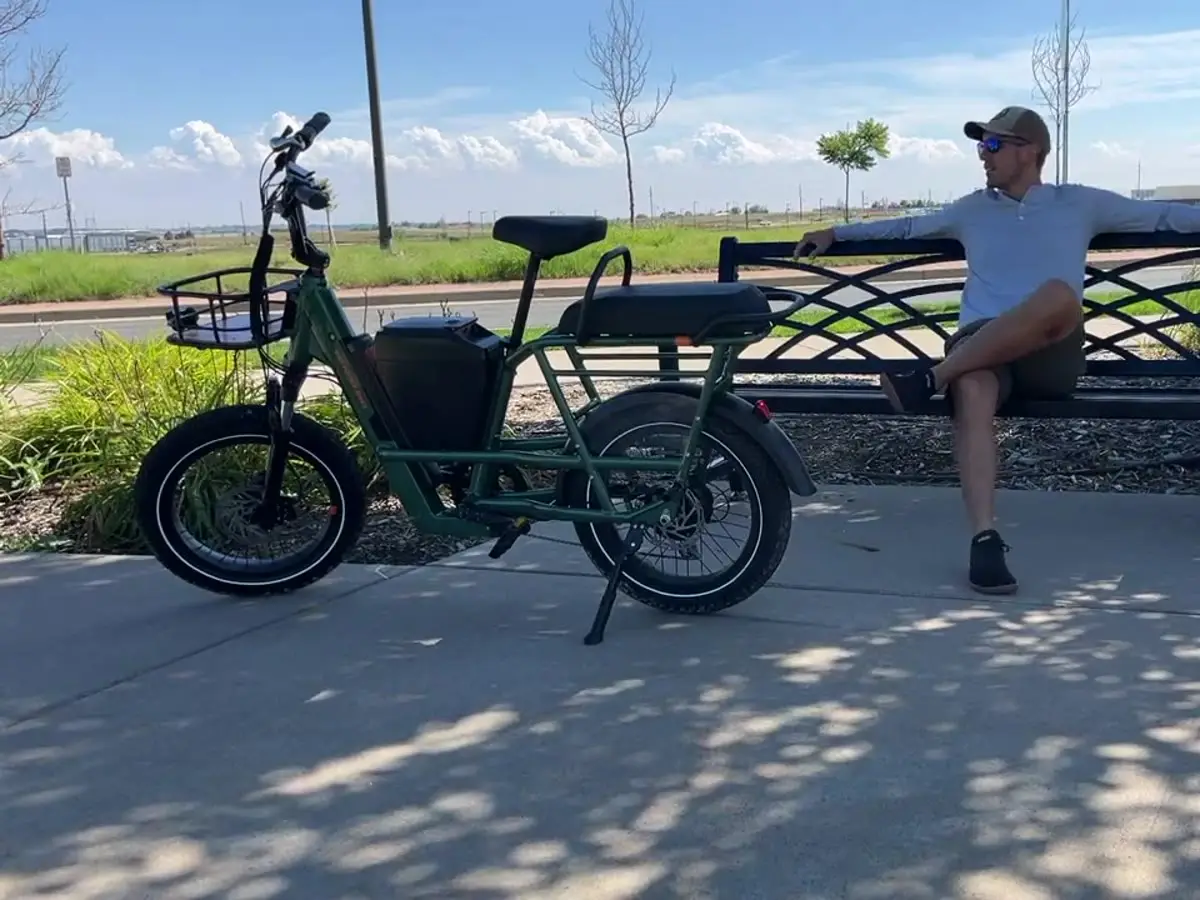
The RadRunner 3 Plus I tested is shorter, with a passenger seat instead of a long deck, a cadence sensor and a 672Wh battery. For one passenger, the current RadRunner Plus or the RadRunner Max is the closer match. For two kids, the RadWagon is the one to look at.
Outside Rad, the Lectric XPedition2 is the budget longtail I’d compare it with: $1,399 (as of Oct 27, 2026), a torque sensor, hydraulic brakes and a 450 lb payload, but a one-year warranty. For the rest of the field, see my best cargo e-bikes guide.
What I’d check before buying
Make sure the listing says RadWagon 5 and $2,399, not the $1,799 entry RadWagon. Add up your weight and your kids’ weight against the 265 lb rider limit, the 375 lb total and the 120 lb rack. Measure where you’ll park an 86 lb, 76 in bike. Confirm the bike is new and bought on or after May 15, 2026, from Rad or an authorized seller, so the warranty applies. Decide whether a 7.5 hour charge fits your routine, check your local rules before switching to Class 3, and know the return costs before you ride it.
FAQ
Have I ridden the RadWagon 5?
No. I have ridden the RadWagon 4. This page is built from Rad’s official pages and policies, the CPSC, news coverage and independent reviews, all linked in the sources.
How fast does it go?
The throttle goes to 20 mph. Pedal assist goes to 20 mph in Class 1 and 2, 25 mph in Class 3 Limited and 28 mph in Class 3.
How far does it go?
Rad says 20 to 60 miles. Electric Bike Report got 26.8 miles at full power and 48.25 miles at the lowest level, both in Class 2.
Is the RadWagon 5 affected by the CPSC battery warning?
No. It uses a Safe Shield battery, not one of the three models in the Nov 24, 2025 warning. The warning does list the RadWagon 4.
Can I return it?
Within 30 days, for $149 return shipping. Ridden bikes must have under 20 miles and also pay a 30% restocking fee.
Pros and cons (from the specs and sources)
Pros: 90 Nm with a torque sensor; hydraulic brakes that out-stopped Electric Bike Report’s average; suspension fork with lockout; turn signals and a brake light; two-leg center stand; 21 in standover and a 4’11” minimum rider height; two-year warranty when bought new.
Cons: 86 lb; 265 lb rider limit; slow 2A charger; conflicting headlight figures; return fees; a brand that just came out of bankruptcy under new owners.
Who it’s for
The RadWagon 5 makes sense for families carrying one or two kids who want hydraulic brakes and a center stand, and for car replacers doing school runs and grocery trips of under about 20 miles round trip at full assist. Shorter riders get a longtail that starts at 4’11”. Look elsewhere if you weigh more than 265 lb, have to carry the bike up stairs, or want Rad’s lowest price.
Sources, all accessed Oct 26, 2026 unless noted: Rad RadWagon 5 product page (specs, geometry, limits, class settings; price and stock rechecked Oct 27, 2026); Rad store listing (current models, entry RadWagon); Rad warranty (Rad Life Mobility, updated May 14, 2026); Rad refund policy; CPSC warning on Rad batteries, Nov 24, 2025; CPSC recall, RadWagon 4 tires; TechCrunch; GeekWire; Engadget; Electric Bike Report review (range, hill, brakes, weight, charge time, cables); GearJunkie review (Class 3 throttle limit); ElectricBikeReview review (Class 3 speed); The Inertia review (display range estimates); OutdoorGearLab review (throttle range test).
“Behold, children are a heritage from the LORD, the fruit of the womb a reward.” Psalm 127:3 (ESV)