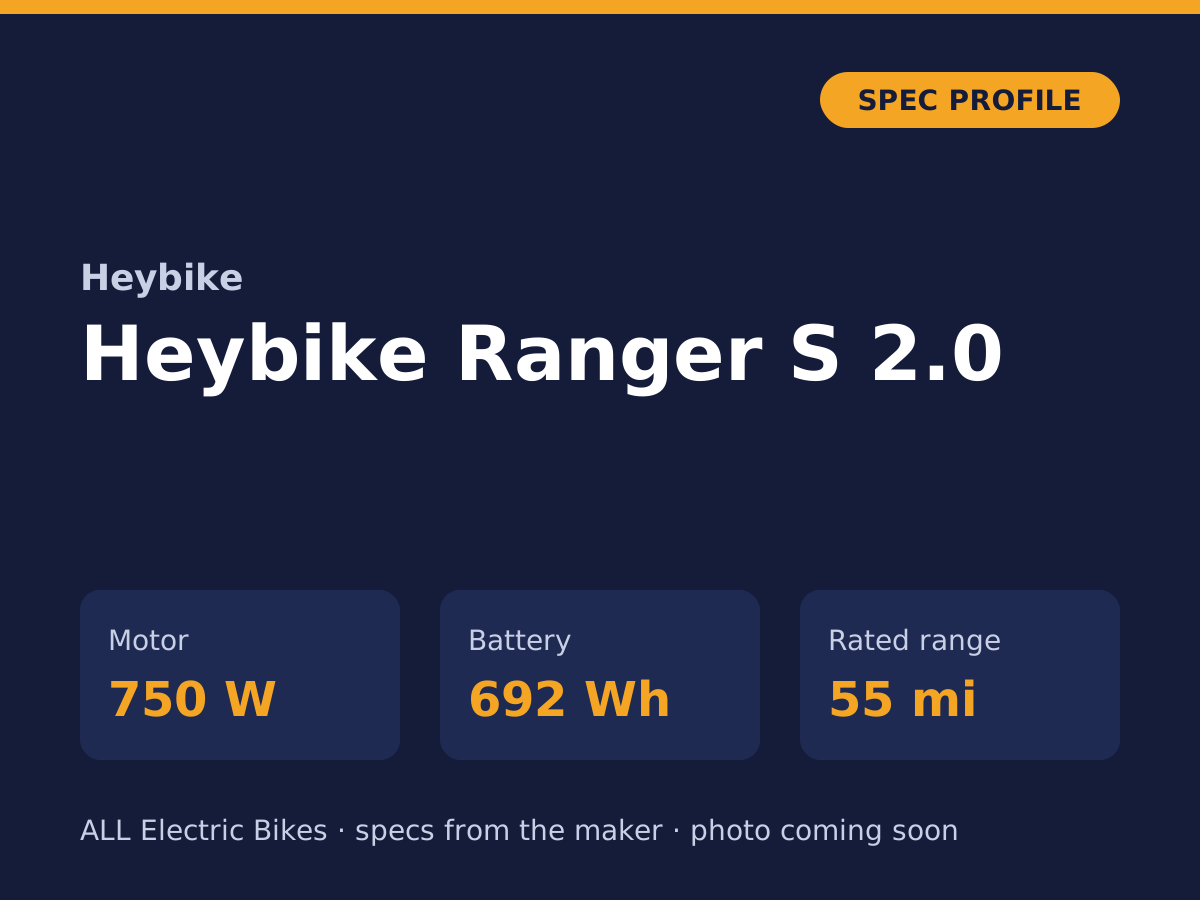
On paper, the Heybike Ranger S 2.0 is a step through folder with a 750W motor, a 692Wh battery, hydraulic disc brakes and 20 x 4 in tires for $999. I haven’t ridden it. Everything here comes from Heybike’s official product page and return policy, checked on Oct 27, 2026, and from the folding bikes I have filmed. Where I do my own math, I say so.
Should you buy one?
The Ranger S 2.0 costs $999 (as of Oct 27, 2026), against a regular price of $1,199 on Heybike’s page. It was in stock in Black, with Heybike quoting shipping in one to two business days and delivery in five to seven. Heybike was also including a free front basket with the bike on that date.
For the money, Heybike lists a 750W rear hub motor with 1400W peak and 80 Nm, a 48V 14.4Ah (692Wh) removable battery, hydraulic disc brakes, front suspension, a step through frame that folds, a color LCD with app support, and a 28 mph top speed as a Class 3 bike. The electrical system is certified to UL 2849, and the bike is rated IPX4.
The trade-offs are mostly about what Heybike doesn’t tell you. Its page doesn’t list the weight, the payload, the pedal sensor type, the gearing or the fork travel. On a folding bike, weight decides whether you’ll lift it into a car, and payload decides whether it carries you and your groceries.
The motor and the class
Heybike rates the rear hub at 750W, with 1400W peak and 80 Nm of torque. For comparison, the Kingbull Literider I filmed is listed at 80 Nm by Kingbull, so the Ranger S 2.0 matches it on paper. The Engwe Engine Pro I filmed is listed at 55 Nm. More torque mostly shows up as quicker starts and easier hills, especially with fat tires, which take more effort to get rolling.
Heybike lists five pedal assist levels and calls this a Class 3 bike with a 28 mph top speed. Heybike’s page doesn’t say whether the bike ships set to 20 mph, or how to change classes, so check the display settings when it arrives. Class 3 bikes are limited to pedal assist above 20 mph under the common three class system, and some paths and trails don’t allow them. Our e-bike laws hub covers the rules state by state.
The pedal sensor type isn’t listed. Most budget folders I’ve filmed used cadence sensors, including the Literider and the Engine Pro, which means the motor adds a set amount of help once the cranks turn rather than responding to how hard you push. Don’t assume the Ranger S 2.0 is different until Heybike confirms it.
Battery, range and charging
The battery is 48V 14.4Ah, which is 692Wh, and it comes out of the bike for charging. Heybike rates it for up to 55 miles and says charging takes about 7 hours.
For context, my own math: 692Wh is just under the 720Wh Kingbull lists for the Literider, and close to the 672Wh battery in the original Aventon Sinch, on which I went 42 miles in my test. That doesn’t predict what the Heybike will do, because motor, tires and settings differ, but it puts the battery in the normal range for a fat tire folder.
Frame, fold and fit
The frame is a step through, which makes it easier to get on and off than a bike with a top tube. The Engine Pro I filmed has a cross beam, and I flagged that for anyone who has trouble swinging a leg over. The Literider, like the Ranger S 2.0, is a step through.
The Ranger S 2.0 folds, but Heybike doesn’t list the folded size or the weight. On the folders I’ve filmed, weight was the real limit. Kingbull lists the Literider at 71 lb, and I put the original Aventon Sinch, at a listed 68 lb, in my Tesla Model 3 trunk, but it was a tight fit. Until Heybike publishes a number, don’t assume the Ranger S 2.0 is any lighter.
Heybike doesn’t publish rider height ranges or geometry on the product page either, so if you’re very short or very tall, ask before ordering.
Brakes, suspension and tires
Hydraulic disc brakes at $999 are the standout spec. Heybike’s page doesn’t list rotor sizes. For comparison, the Engwe EP-2 Pro I filmed had 160mm mechanical brakes, and the original Sinch had mechanical discs too. The Literider and the Engine Pro both had hydraulics.
Up front there’s a suspension fork. Heybike doesn’t give the travel. The tires are 20 x 4 in fat tires, which add cushion and grip on gravel, sand and broken pavement, and the small wheels keep the fold compact. There’s no rear suspension, so the padded saddle and tire pressure are what soften the back end. If you want full suspension on a folder, the Engine Pro I filmed has a fork and a rear shock.
Display, lights and the app
Heybike lists a color LCD with a 7 button control panel, showing speed, battery and distance, plus app compatibility. There are front and rear lights. Heybike doesn’t say what the app does beyond connecting to the bike.
The IPX4 rating means splash resistance. Light rain should be fine, but I wouldn’t read IPX4 as permission to ride through deep puddles or hose the bike down.
In the box and assembly
Heybike says the bike arrives mostly assembled, with basic assembly needed before the first ride. The box includes the charger, user manual, a toolkit and keys. Heybike’s page also offers a “3 for $99” accessory deal with an e-bike purchase.
Warranty and returns
Heybike lists a two year warranty. Its page also advertises a “14-day Free Trial,” but the return policy is the part to read. For a brand new, unused bike returned within 14 days for a non quality reason, Heybike gives a full refund minus a $200 return shipping fee. From day 15 to day 30, there’s also a 20% restocking fee. If the bike has been used, a return within 30 days costs the $200 shipping plus a 50% restocking fee, and after 30 days you can’t return it. For quality issues within 14 days, Heybike says the return is free.
So in practice, the “free trial” isn’t free if you ride the bike and decide it isn’t for you. My math: on a $999 bike, a used return within 30 days would cost $200 plus about $500.
How it compares with folders I’ve filmed
Against the Kingbull Literider: both are step through folding fat tire bikes with hydraulic brakes and 80 Nm on paper. Kingbull lists the Literider 2.0 at $979 as of Oct 23, 2026, with a 720Wh battery, a published 71 lb weight and a 400 lb total limit. The Literider’s published weight and limit are the advantage there. When I filmed the Literider, I called it an excellent e-bike for the price, but I also found the display hard to read in sun and the grips cheap. Those notes are about the Literider, not the Heybike.
Against the Engwe Engine Pro: the Engine Pro adds a rear shock and Engwe’s optional second battery, but it has a cross beam and was unavailable on Engwe’s US store at $1,599 as of Oct 27, 2026. The Ranger S 2.0 is the cheaper step through option on paper.
Against the original Aventon Sinch: that bike is long discontinued, but it’s useful as a baseline. It had a cadence sensor and mechanical discs, and fit my Model 3 trunk only just. The Ranger S 2.0 lists hydraulics and a bigger battery at a lower price than the Sinch launched at.
What I’d ask Heybike before buying
The weight and the payload come first, because they decide whether the bike works for you at all. Then the sensor type, the gearing, the fork travel and whether it ships at 20 or 28 mph. Finally, read the return policy closely, since a ridden bike costs half its price to return.
FAQ
Have I ridden the Ranger S 2.0?
No. This page is built from Heybike’s official product page and return policy, checked on Oct 27, 2026, and from folding bikes I have filmed.
How far does it go?
Heybike says up to 55 miles. Fat tires, hills, wind, cold and higher assist levels will cut that.
How much does it weigh?
Heybike’s page doesn’t list the weight. Other folding fat tire bikes I’ve filmed are listed at 66 to 71 lb.
Is it street legal?
Heybike calls it a Class 3 bike with a 28 mph top speed. Class 3 is allowed on roads in most states, but some paths ban it. Check your state on our e-bike laws hub.
Pros and cons (from the specs)
Pros: 80 Nm and 692Wh at $999; hydraulic disc brakes; a step through frame that folds; 20 x 4 in fat tires with front suspension; UL 2849 certified; in stock as of Oct 27, 2026.
Cons: no published weight, payload, sensor type, gearing or fork travel; IPX4 is splash resistance only; costly returns once ridden; no rear suspension.
Price
$999 on Heybike’s site as of Oct 27, 2026. The page listed a regular price of $1,199.
“I can do all things through him who strengthens me.” Philippians 4:13 (ESV)