Should you buy one?
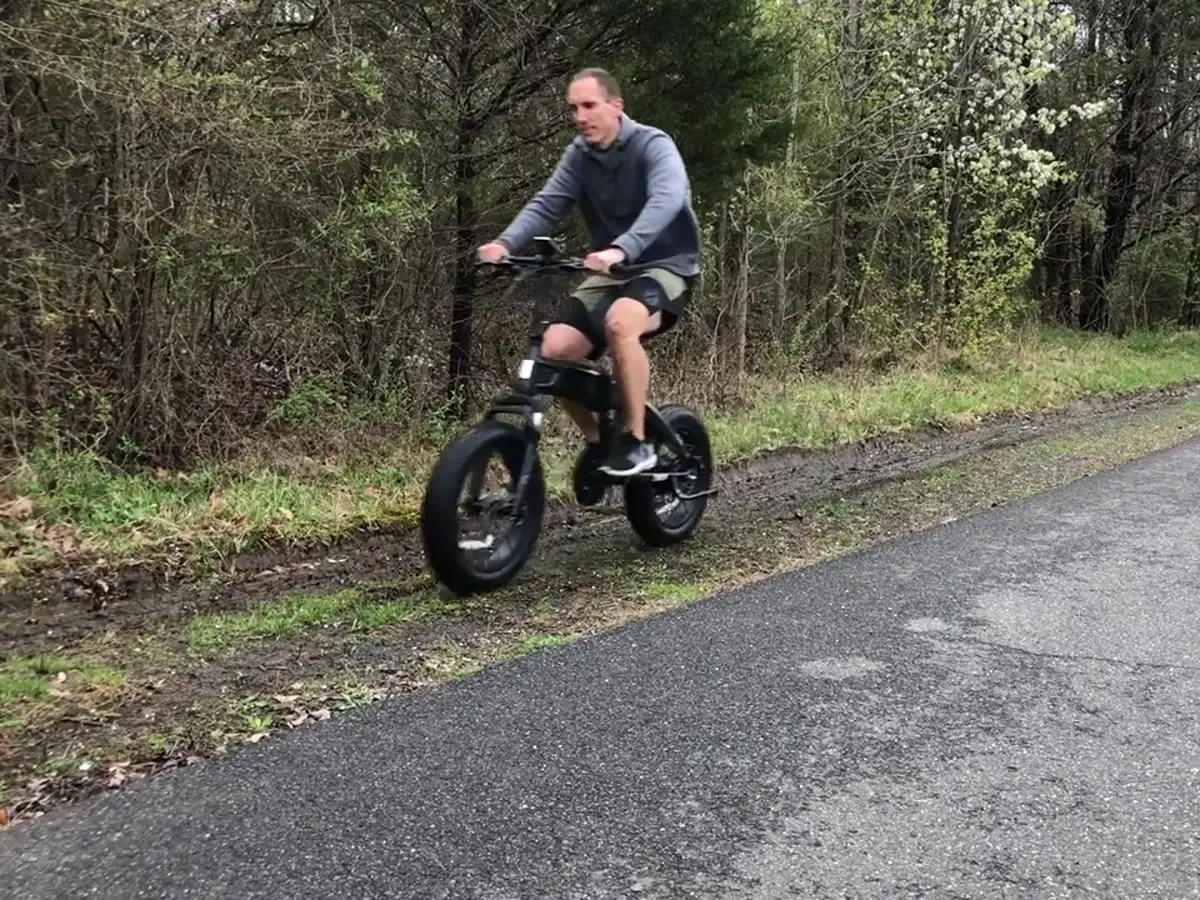
Buy the Literider if you want a fat tire e-bike that folds small enough to go in the trunk of a sedan, you like a step-through frame, and you want a rack, fenders and hydraulic brakes included. I rode it for several weeks, and my overall verdict in the video was that it’s an excellent e-bike and you get a lot for the price (5:00).
Skip it if you want a torque sensor, a display you can read in bright sun, or nicer contact points. The grips feel cheap (1:44), the color display is hard to see in sunlight (2:24), and the folding pedals flipped out on me a few times when they weren’t fully locked (2:53 to 3:21).
The deciding factor: whether folding matters to you. A folding fat tire bike is heavy, and Kingbull lists the Literider at 71 lbs. What you get for carrying that weight is not needing a hitch rack or an e-bike trailer to take it somewhere (5:04 to 5:13).
Check the current Literider at Kingbull (Kingbull now sells the Literider 2.0; this is not an affiliate link)
Who it’s for
- Riders who want a fat tire bike that fits in a car trunk. It folds down and fits in the trunk of a sedan (3:30).
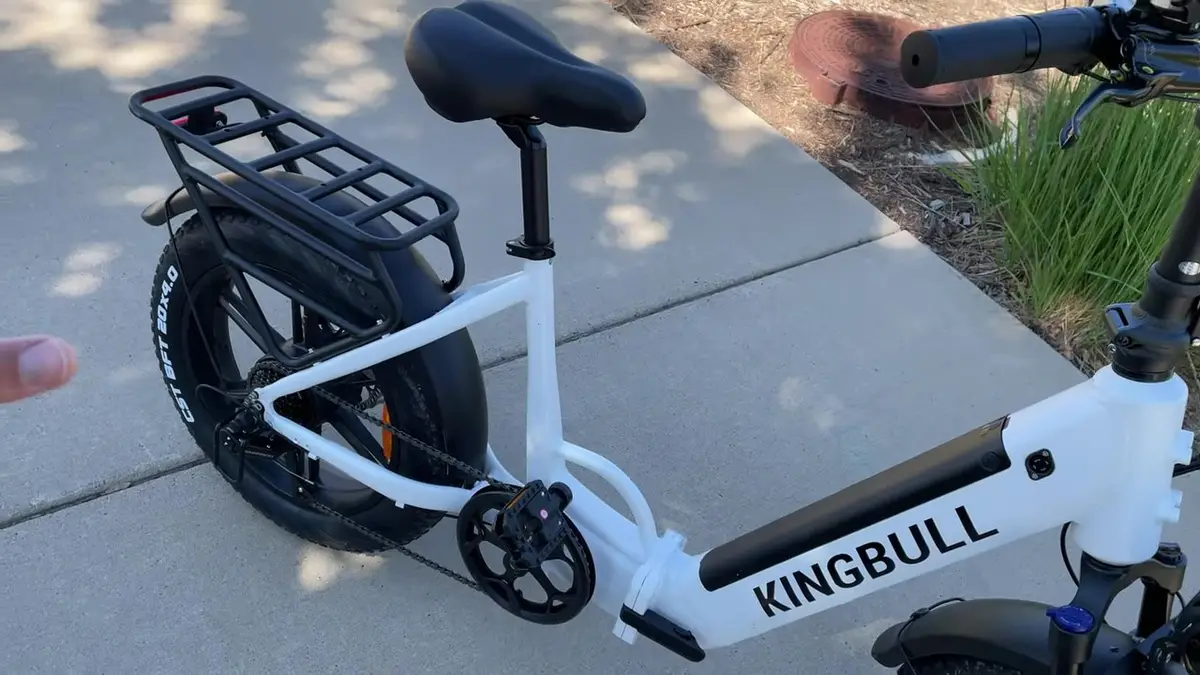
- Anyone who prefers a step-through frame, especially older riders or anyone who doesn’t like a crossbar (0:24).
- Throttle cruisers. The twist throttle works from zero, and it’s nice to just hop on and cruise (5:28).
- Riders who want a rack, fenders and lights without buying accessories.
- Taller riders who like a higher handlebar. The bar height adjusts (4:18).
Who should look elsewhere
- Riders who want a torque sensor. This is a simple cadence sensor (5:21).
- Anyone who needs a display that’s easy to read in bright sun (2:24).
- Riders who will carry the bike up stairs. Kingbull lists 71 lbs.
- Anyone who wants rear suspension. There isn’t any (3:47).
- Riders who want the bike to follow US e-bike class speeds out of the box. Mine reached 30.9 mph on pedal assist (2:02).
Design and folding
It’s a folding e-bike similar to the Aventon Sinch step-through (0:19). The step-through part of the frame doubles as a handle when the bike is folded, which I thought was a great design element (0:24 to 0:42).
The Literider is a beefy fat tire bike, and it still folds down and fits in the trunk of a sedan (3:30). That’s the real selling point. A good hitch rack for a 70 lb e-bike, or an e-bike trailer, is an extra purchase and an extra thing to store. If the bike fits in the trunk, you skip that.
Kingbull lists the battery as removable and internal to the frame. Taking the battery out before you lift the bike is the easiest way to make a 71 lb bike more manageable.
Controls and display
On the left side you get the front brake, a power button and a bell (1:44). Kingbull calls the grips ergonomic comfort grips, but on my bike they felt cheap. Grips are an easy swap if they bother you.
The power button runs the center display, and the plus and minus buttons move you through five levels of pedal assist (1:59). Holding the plus button turns on the front headlight, a really big, bright LED (2:15).
The display is pretty basic. It’s color, but it’s a little hard to see in the sunlight (2:24). Kingbull lists a color LCD with a USB charging port, so you can top up a phone from it.
On the right side there’s a standard shifter with seven gears in the rear and a single ring up front, a twist throttle that works from zero, and the rear brake (2:27 to 2:37).
Motor and speed
The rear hub motor is very powerful (0:47). On pedal assist level 5, I got up to 30.9 mph (2:02). I said in the video I don’t believe that’s rated correctly for the US, and I still think so. Kingbull’s spec page lists it as Class 2 or Class 3 with an adjustable top speed up to 28 mph, and Class 3 tops out at 28 mph on pedal assist. If yours goes faster than that, set it back down in the display settings, and check your local rules. My e-bike laws by state page and Class 2 vs Class 3 guide cover the details.
What I measured on camera: about 30.9 mph in pedal assist 5 (video, 2:02).
Kingbull lists 750W sustained and 1,300W peak.
Pedal assist and the cadence sensor
Pedal assist uses a simple cadence sensor, nothing fancy, and there’s no torque sensor on this model (5:21). A cadence sensor turns the motor on when the cranks are turning and gives you a set level of help for each assist level. It doesn’t care how hard you push. That makes it easy, because you can spin lightly and still move fast, but it feels less like a normal bike than a torque sensor does.
You also have the throttle, and on a bike like this I used it a lot. It’s really nice to just hop on and cruise along (5:28 to 5:32).
The folding pedals
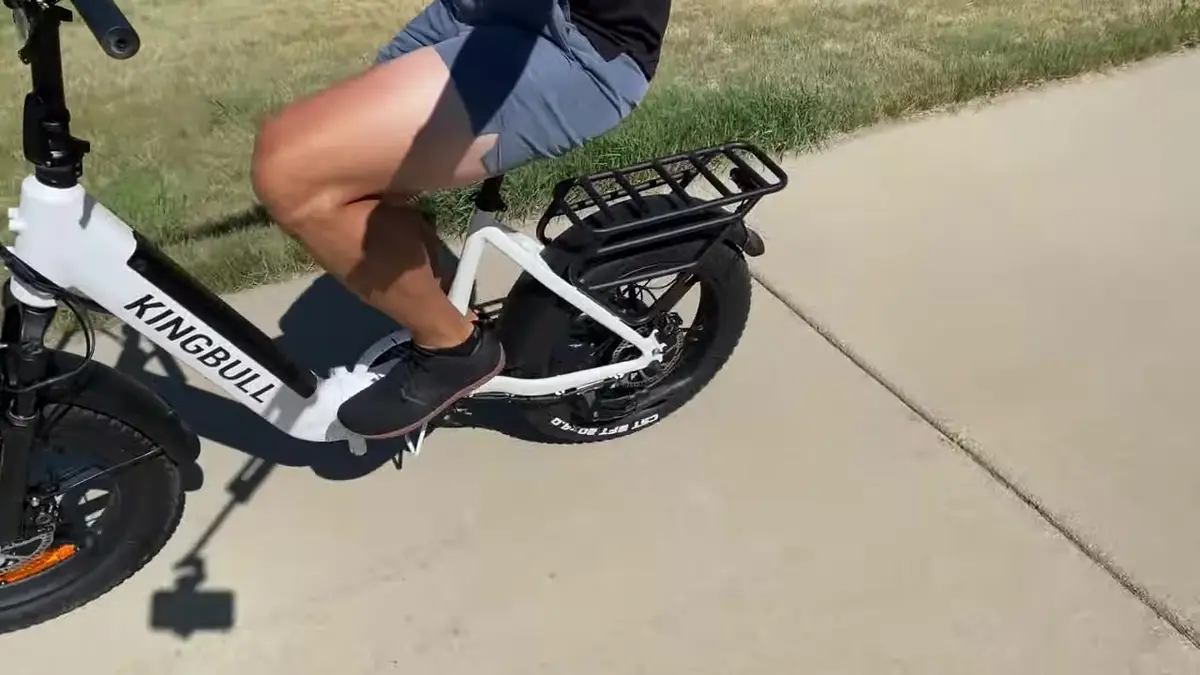
I’m not crazy about how it feels while pedaling, because the pedals collapse for folding (2:53). A few times a pedal wasn’t fully locked, and when I went to pedal it flipped out on me (3:21). It’s inconvenient, and if your foot slips off at speed, it’s a safety issue. Every time you fold and unfold the bike, check that both pedals click fully into place before you ride.
Comfort
There’s a front suspension fork and no suspension in the rear (3:47). Kingbull lists a hydraulic fork with 80 mm of travel. With the thick 4 inch tires, I think it’s pretty comfortable (3:53). The tires do most of the work at the back of the bike.
The seat is very standard, and I believe it provides plenty of cushion (3:56).
The adjustable handlebar was really helpful (4:18). You open the clamp and set the height. If you’re taller, you can tailor it to the way you like to ride. I prefer a higher bar when I’m just cruising (4:31). Kingbull lists a rider height range of 5’1” to 6’5”. Check your height against that range before you buy.
Brakes
The brakes are hydraulic discs, and they’re really nice and easy to pull (2:37). That matters on a bike that went past 30 mph for me. Hydraulic brakes need less hand force than cable brakes, and they stay consistent as the pads wear.
Rear rack, fenders and lights
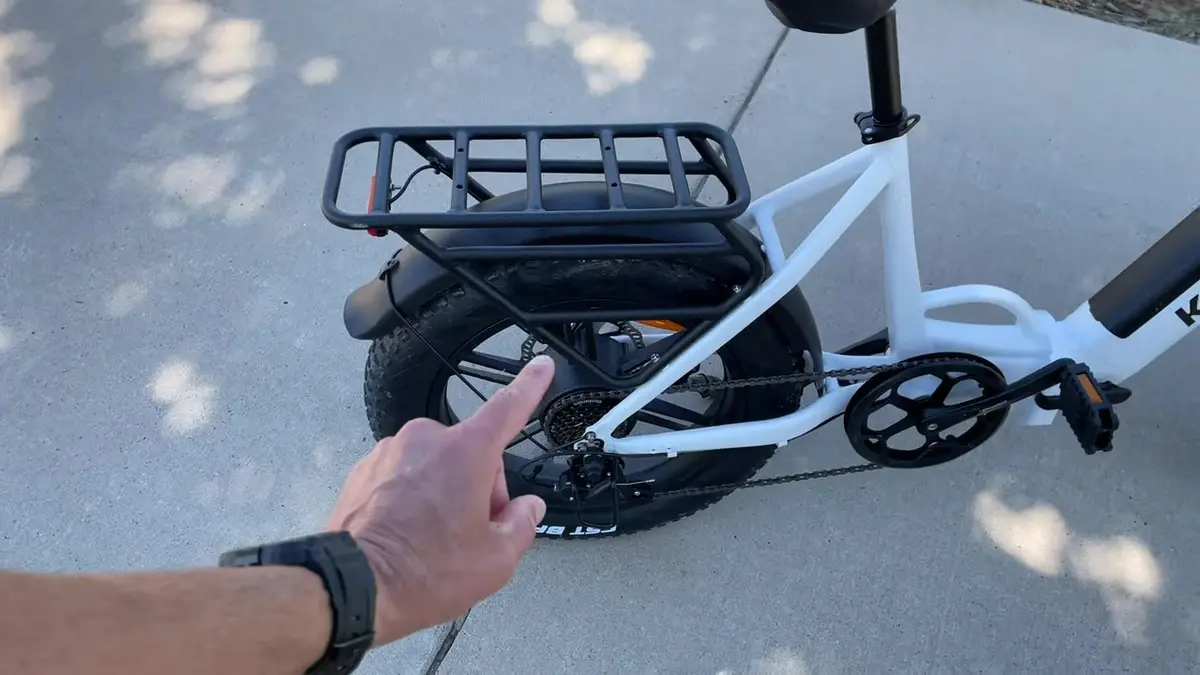
The rear rack comes standard (0:42). It’s very strong and mounts directly to the frame (3:35). I tested riding on the back at about 200 lbs (3:40). I don’t know if it’s rated for that, and Kingbull’s spec page doesn’t list a rack rating for this model, so don’t take my test as a rating. Kingbull lists a 400 lb total weight limit for rider and cargo.
Front and rear fenders come standard (5:02), and so do the lights.
What the specs mean on the road
750W sustained, 1,300W peak. That’s plenty for throttle starts and for a rider my size on hills.
48V 15Ah (720 Wh), up to 50 miles. Kingbull’s range is a best case. With a cadence sensor and a lot of throttle use, you’ll see less.
71 lbs. Heavy for a folding bike. Folding saves you a rack or trailer; it doesn’t make the bike light.
Class 2 or 3, up to 28 mph. Set it to the class your area allows. Mine went faster out of the box (2:02).
How it compares
| Kingbull Literider | Velotric Fold 1 | Original Aventon Sinch | |
|---|---|---|---|
| Motor, sustained / peak (W) | 750 / 1,300 | 750 / 1,050 | 500 / 750 |
| Battery | 48V, 720 Wh | 48V, 608 Wh | 48V, not listed |
| Rated range (mi) | 50 | 55 | 40 |
| Tires (in) | 20 x 4.0 | 20 x 3.0 | not listed |
| Weight (lbs) | 71 | 63 | not listed |
| Max load (lbs) | 400 | 440 | not listed |
| Price (USD) | 979 (Literider 2.0, Oct 23, 2026) | 1,299 (Oct 23, 2026) | 1,799 for the Sinch 2.5 (Oct 22, 2026) |
Sources: Kingbull’s spec and product pages (Oct 23, 2026); my Velotric Fold 1 page (Velotric’s specs; I haven’t ridden it); my Aventon Sinch review. “Not listed” means that page doesn’t give the number.
On paper the Literider gives you the most motor and battery here for the least money. The Fold 1 is lighter and rated for more load, with narrower 3-inch tires. The Sinch is the bike I compared it to in the video (0:19), and the current Sinch 2.5 costs more.
Pros and cons
Pros
- Folds to fit in a sedan trunk, even as a fat tire bike (3:30)
- Step-through frame that works as a carry handle when folded (0:24)
- Strong rear rack mounted to the frame; it held me at about 200 lbs (3:40)
- Hydraulic disc brakes that are easy to pull (2:37)
- Big, bright LED headlight (2:15)
- Adjustable handlebar height (4:18)
- Twist throttle that works from zero (2:32)
- Fenders front and rear included (5:02)
- A lot of bike for the price (5:00)
Cons
- Cheap-feeling grips (1:44)
- Basic color display that’s hard to see in sunlight (2:24)
- Folding pedals can flip out if not fully locked (3:21)
- Cadence sensor only, no torque sensor (5:21)
- Mine reached 30.9 mph, above US class limits (2:02)
- No rear suspension (3:47)
- 71 lbs on Kingbull’s spec
FAQ
How fast does the Kingbull Literider go?
I hit 30.9 mph on pedal assist level 5 (2:02). Kingbull lists an adjustable top speed up to 28 mph. Set it to your local limit.
Does it fit in a car trunk?
Yes. It folds down and fits in the trunk of a sedan (3:30).
Does the throttle work from a stop?
Yes. It’s a twist throttle and it works from zero (2:32).
Does it have a torque sensor?
No. It uses a simple cadence sensor (5:21).
Can it carry a passenger?
I rode on the rack at about 200 lbs and it held me, but I don’t know if it’s rated for that (3:40). Kingbull lists a 400 lb total weight limit.
Is the battery removable?
Kingbull lists a removable 48V 15Ah battery inside the frame.
Is the Literider still sold?
Kingbull now sells the Literider 2.0 at $979 as of Oct 23, 2026. Kingbull lists it with a 750W Bafang motor and a 720 Wh battery, and rates it for up to 55 miles, versus 50 miles for the original I tested. I haven’t ridden the 2.0.
Price
I didn’t give a price in my video. As of Oct 23, 2026, Kingbull lists the Literider 2.0 at $979. I don’t have an affiliate link for Kingbull.
Related reviews and guides
- Aventon Sinch step-through vs Cyrusher XF900 vs Wallke F1
- Aventon Sinch review
- Velotric Fold 1
- Best folding e-bikes
- Class 2 vs Class 3 e-bikes
“Let the favor of the Lord our God be upon us, and establish the work of our hands upon us; yes, establish the work of our hands!” Psalm 90:17 (ESV)