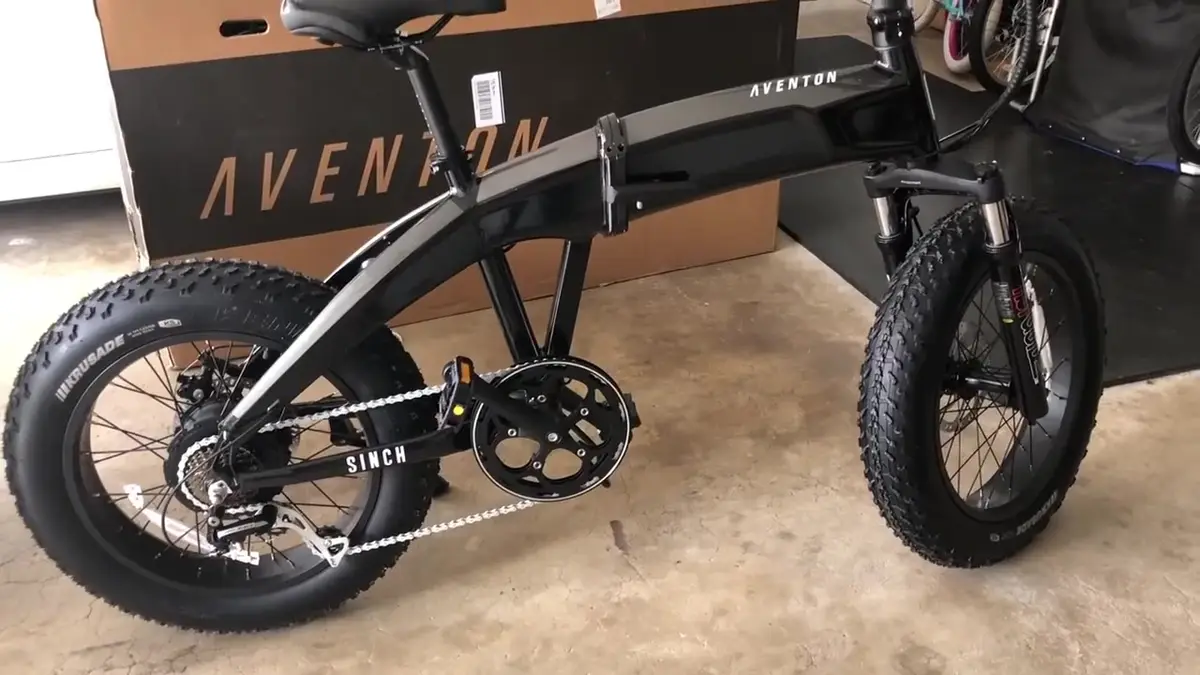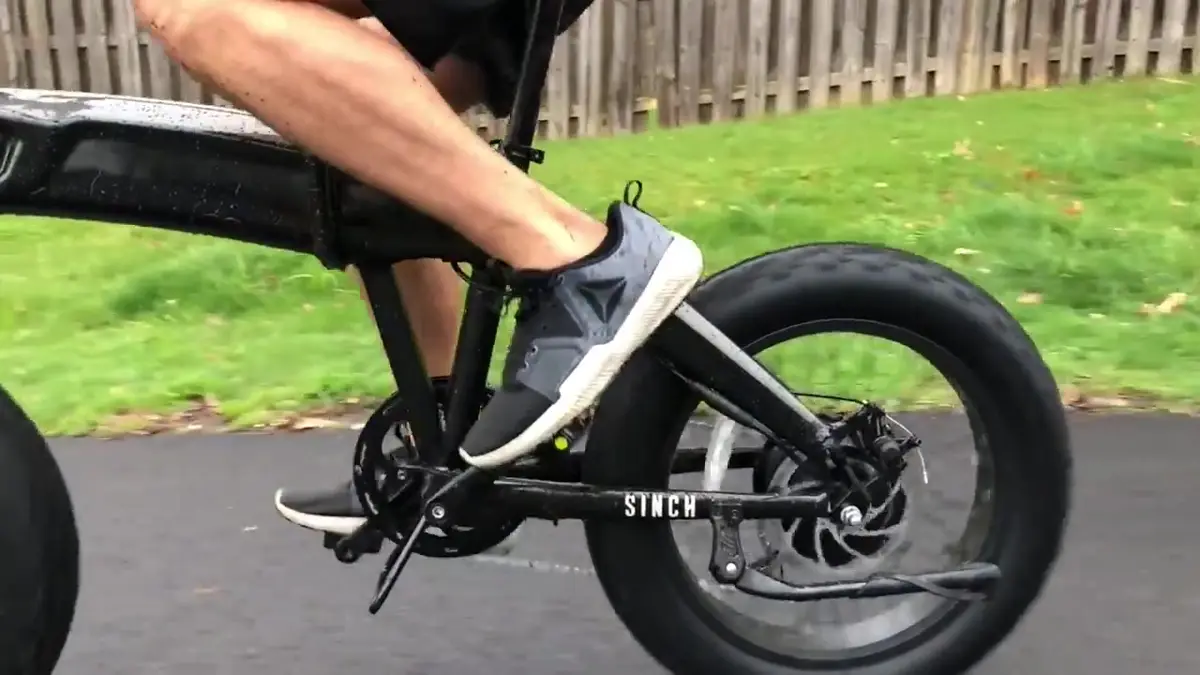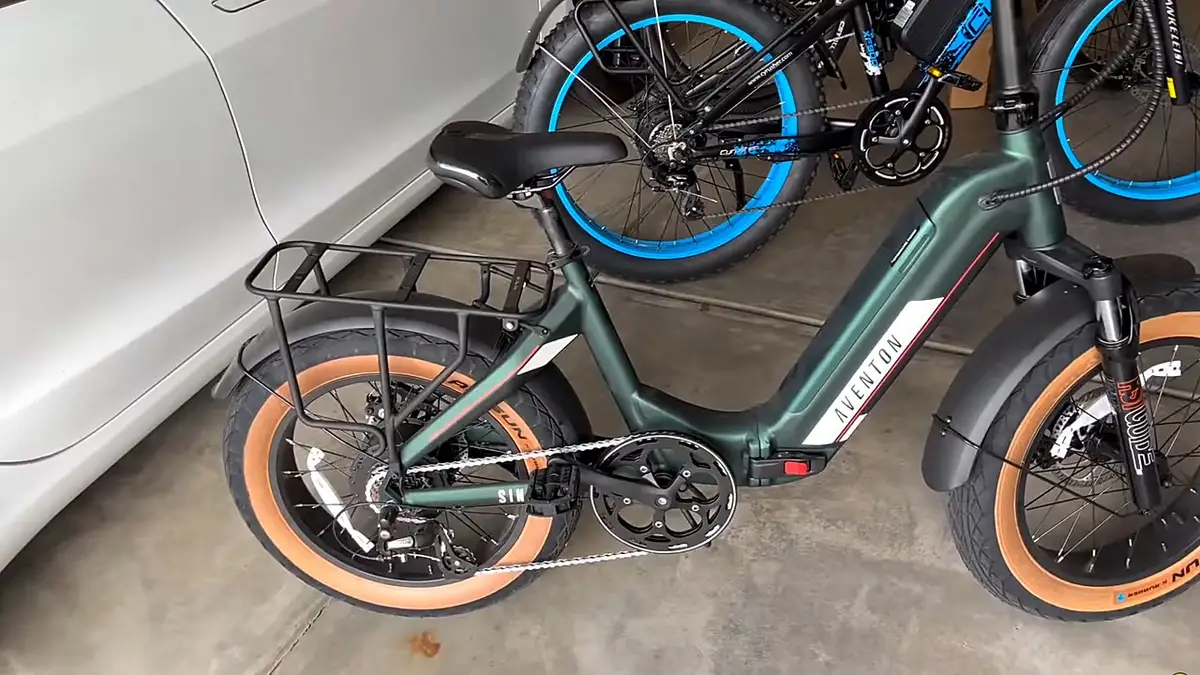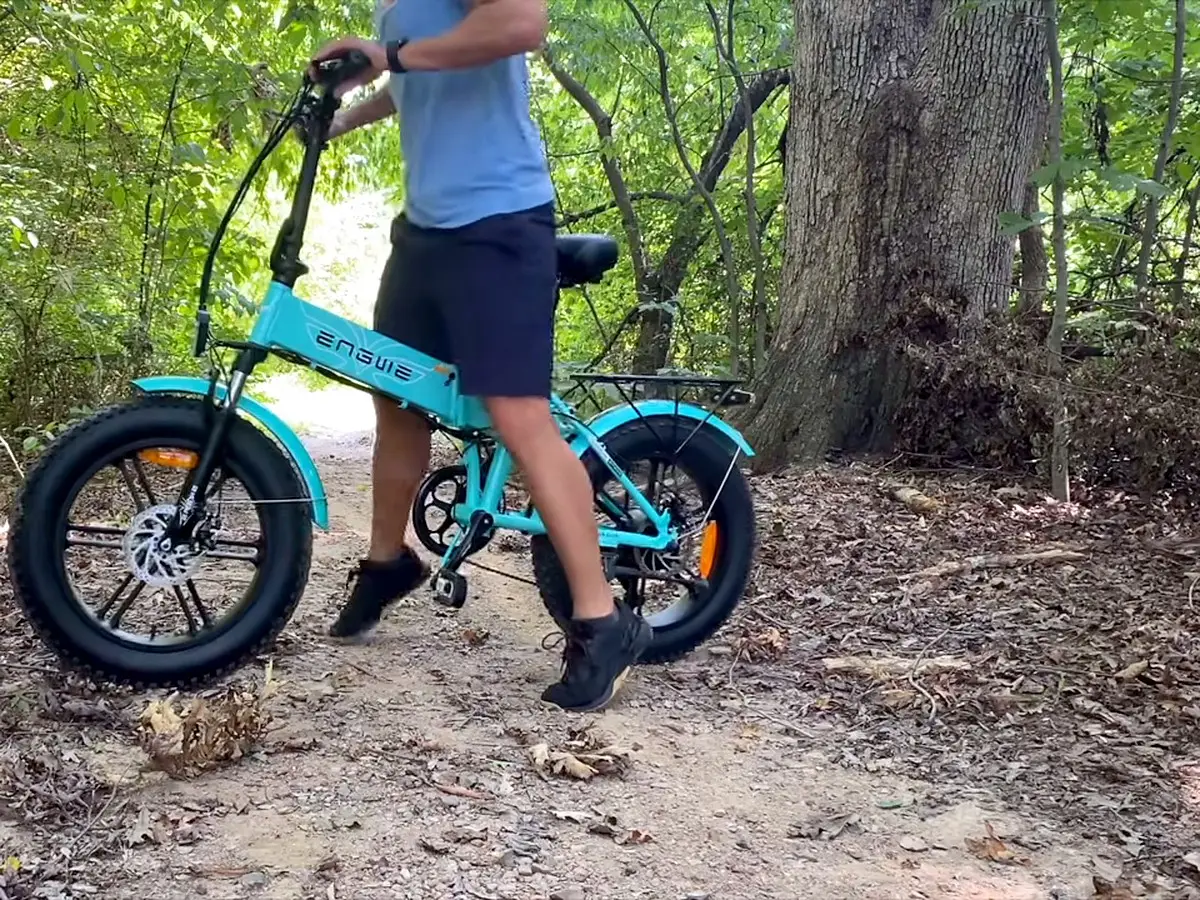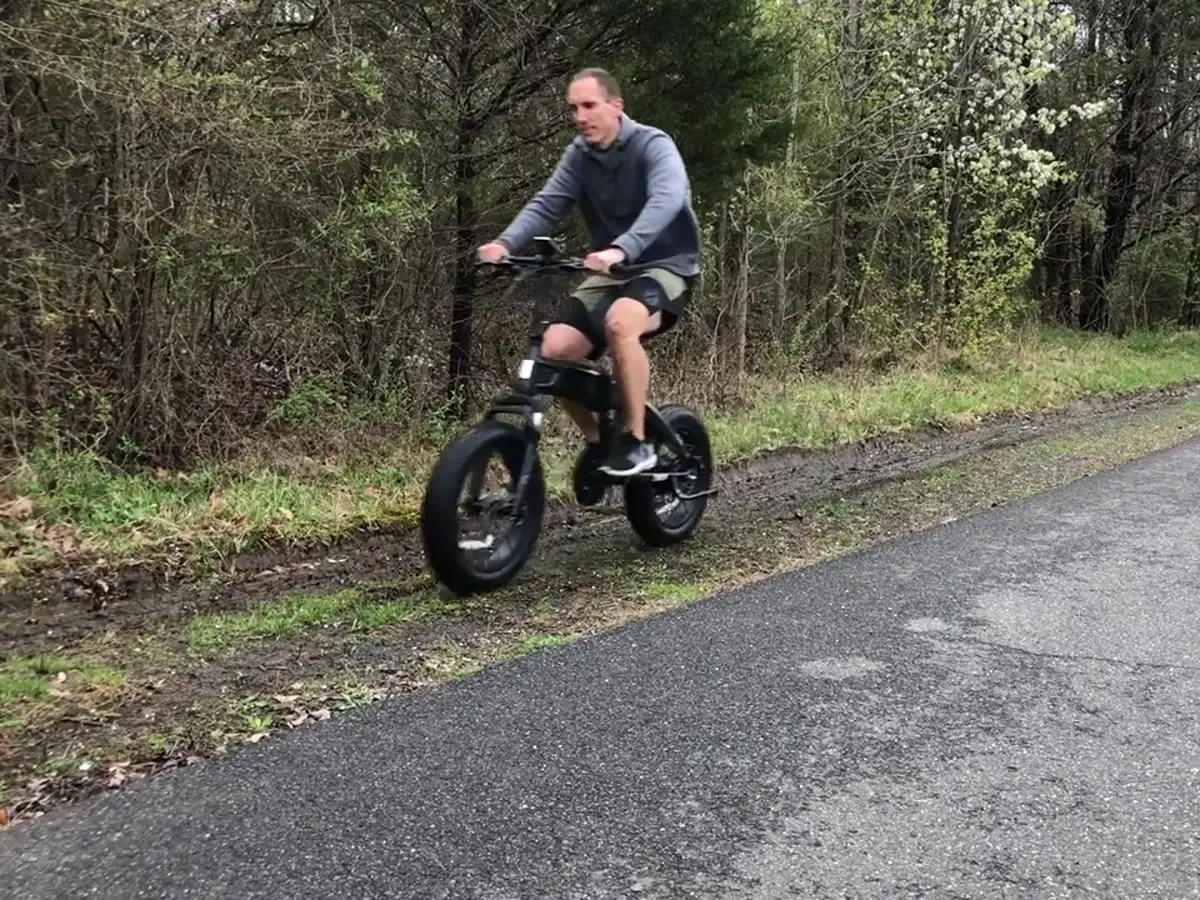
Should you buy one?
Only used, and only if it checks out. The original Aventon Sinch is no longer sold new, but it’s a blast to ride, and I’d still point anyone shopping for a fat tire folder toward a good used one (6:31 to 6:45). It had more power than a lot of the e-bikes I tested around the same time (4:16 to 4:23), it beat its rated range on my test (5:27 to 5:39), and it folds relatively small while giving a full-size adult a comfortable ride (6:39 to 6:45).
I filmed this review in April 2020. Aventon’s original Sinch page is gone. The current version, the Sinch 2.5, was $1,799 and listed as sold out on aventon.com when I last checked prices (Oct 22, 2026), so I can’t name a folder you can buy new from Aventon today. Everything below the spec tables is about the original bike I tested.
Check Aventon (affiliate link)
Who it’s for
- Riders who want a fun, powerful folding e-bike. At about 200 lbs, I had plenty of power (4:38 to 4:41).
- Commuters who charge at the office. The battery comes out and goes inside with you (2:52 to 3:24).
- People with occasional car trips. It fits in a sedan trunk, just barely (3:27 to 3:46).
- Used buyers who can check a bike in person. See the checklist below.
Who should look elsewhere
- Daily car-to-bike commuters. Folding it in and out of a trunk several times a day would be too much for me (3:49 to 4:01).
- Riders who want a quiet bike. The fat tires are loud (5:49 to 5:55).
- Anyone who wants a new one. The original is discontinued, and the 2.5 was sold out when I checked.
- Riders over 250 lbs. Aventon’s launch spec capped the rider at 250 lbs, plus 50 lbs of cargo.
Quick specs: the original Sinch
| Spec | Original Sinch (2020) |
|---|---|
| Launch price (USD) | 1,499 |
| Motor | 48V rear hub, 500W sustained, 750W peak |
| Battery | 48V 14Ah (672Wh), Samsung cells, removable, key lock |
| Rated range (mi) | 40 |
| My range, one charge (mi) | 42 |
| Listed top speed (mph) | 20, pedal assist or throttle |
| Class | Class 2 |
| Top speed I reached (mph) | above 30 |
| Pedal assist | 5 levels, cadence sensor |
| Throttle | Yes, throttle on demand |
| Weight (lbs) | 68 |
| Rider weight limit (lbs) | 250, plus 50 cargo |
| Rider height | not listed |
| Tires | Kenda Krusade 20 x 4 in, K-Shield puncture resistance |
| Brakes | Tektro MD-M810 mechanical disc, 180mm rotors |
| Fork | RST suspension, 45mm travel, lockout |
| Gears | Shimano Acera 7-speed, 52T chainring |
| Folded size | not listed |
| Lights | not listed |
| Charger | 48V 3A, about 4 hours |
| Sinch 2.5 price as of Oct 22, 2026 (USD) | 1,799, sold out |
Sources: Aventon’s Feb 6, 2020 Sinch launch press release, reprinted on biketoday.news; Bicycle Retailer, Jan 10, 2020 (price and Class 2). Both fetched Oct 24, 2026. Wayback Machine snapshots of the original aventon.com page didn’t load after several retries. My range and top speed come from my video (5:25 to 5:33). Aventon’s spec sheet doesn’t list lights; Electric Bike Review’s 2020 review of the Sinch says lights weren’t included and fenders were a $74 add-on (electricbikereview.com/aventon/sinch, fetched Oct 24, 2026).
Unboxing
This is one of the few e-bikes you get out of the box completely put together. There’s no front wheel to put on (0:44 to 0:54). It comes with the charger and a multi-tool for adjusting the bike (0:56 to 1:04). Once the packing material is off, you unfold it and hop right on (1:06 to 1:19). That’s the whole point of a folding bike.
Build quality
Construction wise, this is a really sturdy bike. I was very impressed with the build quality compared to the other e-bikes I’d been testing (1:30 to 1:39). Aventon’s launch spec backs up part of that: a double-butted 6061 aluminum folding frame, Shimano Acera shifting, a KMC chain, double-wall rims and a sealed VP headset.
Charging and the battery
Charging is very simple. There’s a little waterproof flap over the port that came in handy during my testing (2:09 to 2:13). The charger light turns from green to red while it’s charging, then back to green when the battery is full (2:15 to 2:26). Aventon listed about 4 hours to charge with the 3A charger. I didn’t time a charge in my video.
To get the battery out, you have to fold the bike. Folding is pretty effortless, handlebars included (2:30 to 2:42). Then you use the provided key and slide the battery out (2:44 to 2:52).
The battery comes out in a solid case you could throw in a bag. If you keep a charger at work, you can leave the bike outside, bring just the battery in, and charge it at your desk (2:52 to 3:24).
Folding and the car test
I put the Sinch in the trunk of my Tesla Model 3, a regular sedan trunk, and got it fully inside. It was pretty tight (3:27 to 3:46). If my commute meant driving to a parking garage and folding it in and out multiple times a day, that would be too much (3:49 to 4:01). Aventon never published a folded size for the original, so measure your trunk opening against a used bike before you count on it.
The ride
This bike is a blast to ride (4:11 to 4:16). At about 200 lbs, this thing takes off (4:38 to 4:41). With pretty decent pedaling in top gear at the full assist level, I got it above 30 mph (5:15 to 5:27). Aventon listed a 20 mph max on pedal assist or throttle, so treat my speed as what I saw on that bike, not a rating. Electric Bike Review’s 2020 review says the motor can be configured above 20 mph through Aventon support or a dealer. Where you can legally ride faster than 20 mph depends on your state. See my e-bike laws by state and Class 2 vs Class 3 pages.
The big tires give a really comfortable ride, but they are way noisier than regular e-bike tires (5:45 to 5:55). Aventon’s 45mm RST fork also takes some of the edge off, per its spec. The display shows all the information I need (6:05 to 6:12).
What my video doesn’t cover: hill climbs, braking, and throttle-only riding. I can’t give you results for those.
Range
Aventon rated the original for 40 miles. On a full charge, I went 42 miles (5:27 to 5:39). My video doesn’t give the route, assist level or temperature for that test, only that I’m about 200 lbs. In my view, the Samsung cells were part of why the range was good (4:44 to 4:50). Range depends on rider weight, terrain, temperature, tire pressure and throttle use, so treat 42 as one result.
What I measured on camera: 42 miles on a full charge (video, 5:27); above 30 mph in the top gear at full assist, pedaling (video, 5:22).
The one real complaint
The clip on the center frame that folds the bike in half got in my way. My leg hit it a few times while riding (6:14 to 6:29). It’s the only real complaint I had.
Buying a used original Sinch: checklist
I haven’t found a reliable source for used prices, so I won’t quote one. Here’s what I’d check:
- Confirm it’s the original, not a Sinch.2 or 2.5. The original has a cadence sensor, a 7-speed Shimano Acera drivetrain, mechanical Tektro discs and an RST fork, per Aventon’s launch spec. The Sinch.2 was recalled in January 2024 (below), so if the seller has a Sinch.2, ask for proof the recall repair was done.
- Battery health. Ask for a full charge before you arrive, then check the display’s battery bars and voltage readout. Ask how many miles are on it (the display has an odometer, per Electric Bike Review). A 2020 battery may hold noticeably less than 672Wh. A swollen, cracked or rattling case is a pass.
- The key. Without the battery key you can’t remove the battery for charging indoors or replacement. Make sure it comes with the bike.
- Charger. It should be a 48V Aventon charger. Don’t take a bike with a mismatched charger.
- Folding latch and hinge. Fold and unfold it twice. The clip should close firmly with no play in the frame when you push and pull on the bars. Wear here is the first thing I’d look at on a used folder, and it’s the same clip my leg kept hitting.
- Brakes and tires. Squeeze the levers and check the rotors. Look for cracked sidewalls on the Kenda tires.
- Test ride. Check that the assist and throttle both cut in and that the motor is quiet under load.
Pros and cons
Pros
- Came completely put together, with a charger and multi-tool
- Sturdy construction compared to other bikes I tested then
- Strong 750W peak motor, even at my 200 lbs
- 42 miles on a full charge in my test, beating the 40 mile rating
- Removable, key-locked battery you can carry inside
- Waterproof flap over the charge port
- Fits in a Model 3 trunk, barely
Cons
- My leg hit the folding clip a few times
- Fat tires are loud
- You have to fold the bike to get the battery out
- No lights listed on the original
- Discontinued, and the Sinch 2.5 was sold out when I checked
How it compares
| Aventon Sinch (2020) | Engwe EP-2 Pro | Ziprs F1 | |
|---|---|---|---|
| Motor (W, sustained) | 500 | 750 | 350 |
| Motor (W, peak) | 750 | 960 | not listed |
| Battery (Wh) | 672 | 624 | 345 |
| Rated range (mi) | 40 | 75 (pedal assist) | 45 |
| Fat tires | Yes, 20 x 4 in | Yes, 20 x 4.0 in | No |
| Price, USD | 1,499 (2020 launch) | 1,399 (sold out, Oct 22, 2026) | 1,499 (2021) |
None of these three is sold new as far as I can confirm: the Sinch is discontinued, the Engwe was sold out on Oct 22, 2026, and the Ziprs price is from 2021. Engwe and Ziprs figures are from my Engwe EP-2 Pro review and Ziprs F1 review. For current options, see my fat tire e-bike guide and best e-bikes under $2,000.
The current Sinch 2.5 spec sheet
I haven’t tested the Sinch 2.5. Everything in this section is Aventon’s listing, not my results. Aventon’s own product page loaded geometry and features for me but not the full spec table, so the component rows come from authorized Aventon dealers that reprint Aventon’s spec sheet.
| Spec | Sinch 2.5 (listed) |
|---|---|
| Motor | 48V, 500W sustained, 1,056W peak, rear hub |
| Torque (Nm) | 60 |
| Sensor | Double-sided bottom bracket torque sensor |
| Battery | 48.8V, 14Ah (636.4Wh), removable internal |
| Battery weight (lb) | 7.6 |
| Charger | 48V, 3A |
| Charge time (hours) | 4 to 5 |
| Claimed range (miles) | Up to 55 |
| Top speed (mph) | 20, adjustable to 25 |
| Class | Class 2, throttle can be unplugged |
| Pedal assist levels | 4 |
| Weight (lb) | 68 |
| Total weight limit (lb) | 300 |
| Folded size (in) | 41 x 24 x 29 |
| Tires | Innova 20 x 4.0 in |
| Brakes | Hydraulic disc, 180mm rotors |
| Drivetrain | Shimano Altus 8-speed, 12-32T cassette, 48T chainring |
| Fork | Coil suspension with lockout |
| Seatpost | Aventon suspension seatpost |
| Handlebar | 580mm wide |
| Rear rack limit (lb) | 55 |
| Fenders | Included |
| Display | Aventon BC147 |
| Warranty (years) | 2 |
Sources: aventon.com/products/sinch-2-5-ebike (geometry, features, warranty, price and stock), accessed Oct 24, 2026. Component rows from Sutton’s Bay Bikes and Oregon E-Bikes, which reprint Aventon’s spec sheet, both accessed Oct 24, 2026.
Geometry
Aventon sells the Sinch 2.5 in one size.
| Measurement | Sinch 2.5 |
|---|---|
| Rider height | 4’11” to 6’3” |
| Seat tube (mm) | 400 |
| Top tube (mm) | 675 |
| Reach (mm) | 491 |
| Stack (mm) | 534 |
| Standover (mm) | 390 |
| Head tube angle | 72° |
| Seat tube angle | 71° |
| Chainstay (mm) | 420 |
| Wheelbase (mm) | 1,137 |
| Wheel size (in) | 20 x 4.0 |
A 390mm standover is about 15 inches, which is easy to step over.
Where the sources disagree
- Rider height. Aventon’s page lists 4’11” to 6’3”. The dealer spec sheets list 4’11” to 6’2”. I’d go by Aventon.
- Water rating. Aventon’s page lists IPX5. Some dealer copies still say IPX4. IPX5 covers low-pressure water jets and IPX4 covers splashes. Neither means you can submerge it or pressure wash it.
- Range. Most listings say up to 55 miles, based on a light rider in Eco on flat ground. One dealer page says 60. Aventon bases its figure on a 165 lb rider in Eco. I’m 200 lbs, so I’d plan on less.
- Battery cells. Aventon’s 2020 launch spec lists Samsung cells for the original. Dealer copy for the 2.5 says LG cells. Don’t assume batteries carry over between models.
What changed from the Sinch I tested
My 2020 Sinch was rated 500W sustained and 750W peak with a 48V battery and a 40 mile rating. Based on Aventon’s listing, here’s what’s different on the 2.5:
Hydraulic brakes. My original Sinch had Tektro MD-M810 mechanical discs, per Aventon’s launch spec. Aventon’s 2.5 page says hydraulic brakes were one of the most requested upgrades over the Sinch.2. Hydraulic brakes need less hand force than cable brakes, which matters on a 68 lb bike.
Torque sensor. My original used a cadence sensor, per Aventon’s launch spec. The 2.5 lists a torque sensor. A torque sensor adds assist in proportion to how hard you pedal, so it reacts less abruptly than assist that only waits for the cranks to turn.
Suspension seatpost. Fat tires carried most of the comfort on my Sinch. The 2.5 adds a suspension seatpost on top of the coil fork.
Separate throttle. The 2.5 has a left-hand throttle you can unplug. Aventon says the bike still works without it, for places where throttles aren’t allowed.
Turn signals and a new display. Aventon lists turn signals and the BC147 display.
More peak power. 1,056W peak versus the 750W peak I quoted for my Sinch. I haven’t ridden the 2.5, so I can’t tell you how that feels.
One thing I can’t tell you is whether Aventon fixed the folding clip that my leg kept hitting. The listing doesn’t say, and I haven’t ridden one.
Recall check: the Sinch.2, not the Sinch I tested
On Jan 4, 2024, the CPSC and Aventon recalled about 2,300 Class 2 Sinch.2 folding e-bikes, plus about 30 sold in Canada. The hazard was unexpected acceleration. Aventon had six reports and no injuries. The fix is a free repair at an Aventon dealer, including a controller software update. The recalled bikes sold from April to August 2023 for about $1,800.
That recall doesn’t cover the original Sinch I reviewed in April 2020, and I found no recall for the original as of Oct 24, 2026. If you’re shopping used, confirm which model you’re looking at. If it’s a Sinch.2, ask whether the recall repair was done. Aventon’s recall details are at aventonhub.com/pages/recall-information.
Sources: CPSC recall 24-075, cpsc.gov, and the eridehero.com recall list (updated Mar 23, 2026), both accessed Oct 24, 2026.
Warranty
Aventon’s current warranty, for bikes bought on or after Jan 1, 2026, gives two years on the frame, drivetrain, electrical system, wheels and installed accessories. The frame goes to lifetime coverage for the original owner if you register within 90 days. The battery is covered for two years or 300 cycles. Other parts get one year. Wear items and labor aren’t covered, and you have to report shipping damage within seven days. Bikes bought before 2026 keep the warranty they shipped with, so a used original Sinch is long past any coverage.
Source: aventon.com/pages/warranty, accessed Oct 24, 2026.
FAQ
Is the original Aventon Sinch still sold?
No. The original product page is gone, and the Sinch 2.5 was sold out on aventon.com when I checked on Oct 22, 2026.
How far did it go on one charge?
42 miles in my test, against a 40 mile rating.
How heavy is the original Sinch?
68 lbs, per Aventon’s 2020 launch spec.
Does it come assembled?
Yes. Mine came out of the box completely put together.
Is the battery removable?
Yes. Fold the bike, use the key and slide it out.
How fast does it go?
Aventon listed 20 mph. I got it above 30 mph with pretty decent pedaling in top gear at full assist.
Was the Aventon Sinch recalled?
The Sinch.2 was, in January 2024. I found no recall for the original Sinch.
What’s the difference between the Sinch and the Sinch 2.5?
Per Aventon, the 2.5 has hydraulic brakes, a torque sensor, a suspension seatpost, turn signals, a separate left-hand throttle and 1,056W peak power. The original had mechanical discs and a cadence sensor.
What size rider fits the Sinch 2.5?
Aventon lists 4’11” to 6’3” in one size. It doesn’t list a height range for the original.
Price
The original launched at $1,499 in January 2020, per Bicycle Retailer. I didn’t give a price in my video. As of Oct 22, 2026, the Sinch 2.5 was $1,799 on aventon.com and sold out.
Check Aventon (affiliate link; it doesn’t cost you any more)
Related reviews and guides
“Commit your work to the LORD, and your plans will be established.” Proverbs 16:3 (ESV)