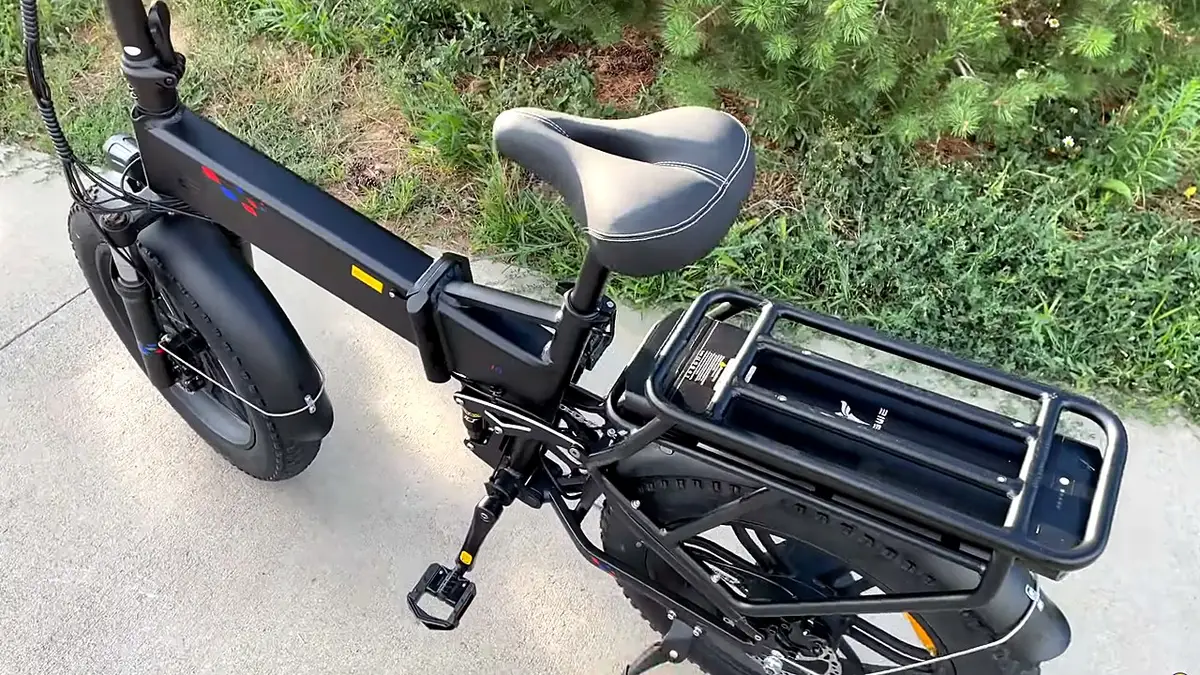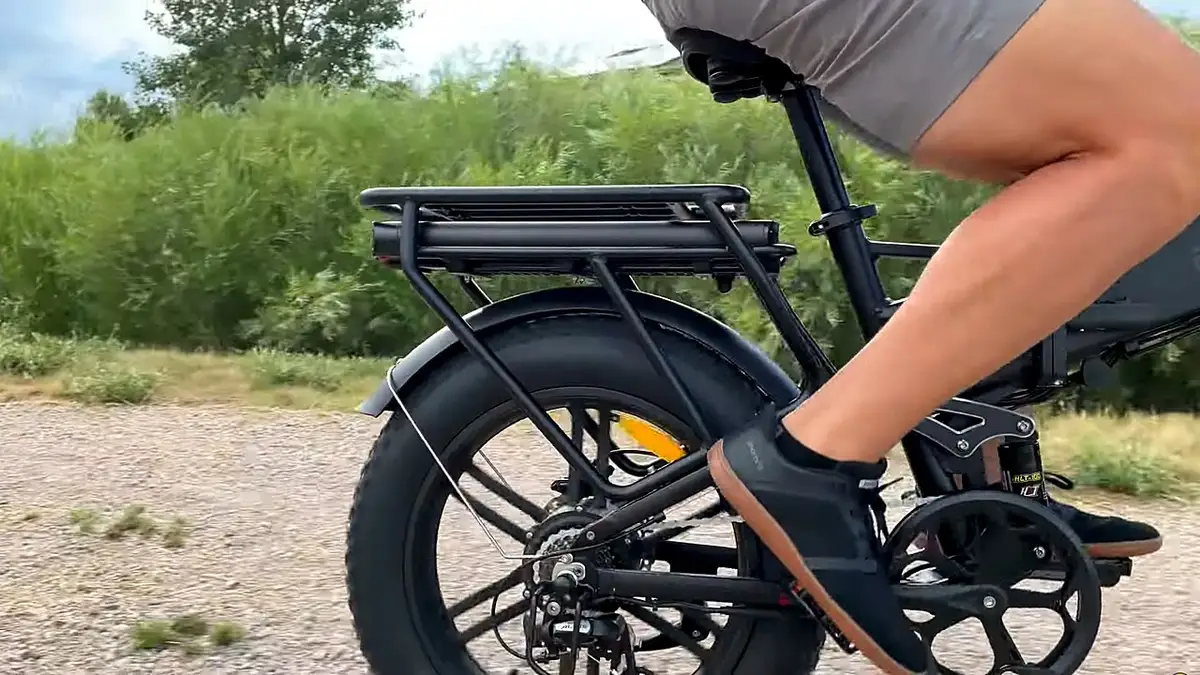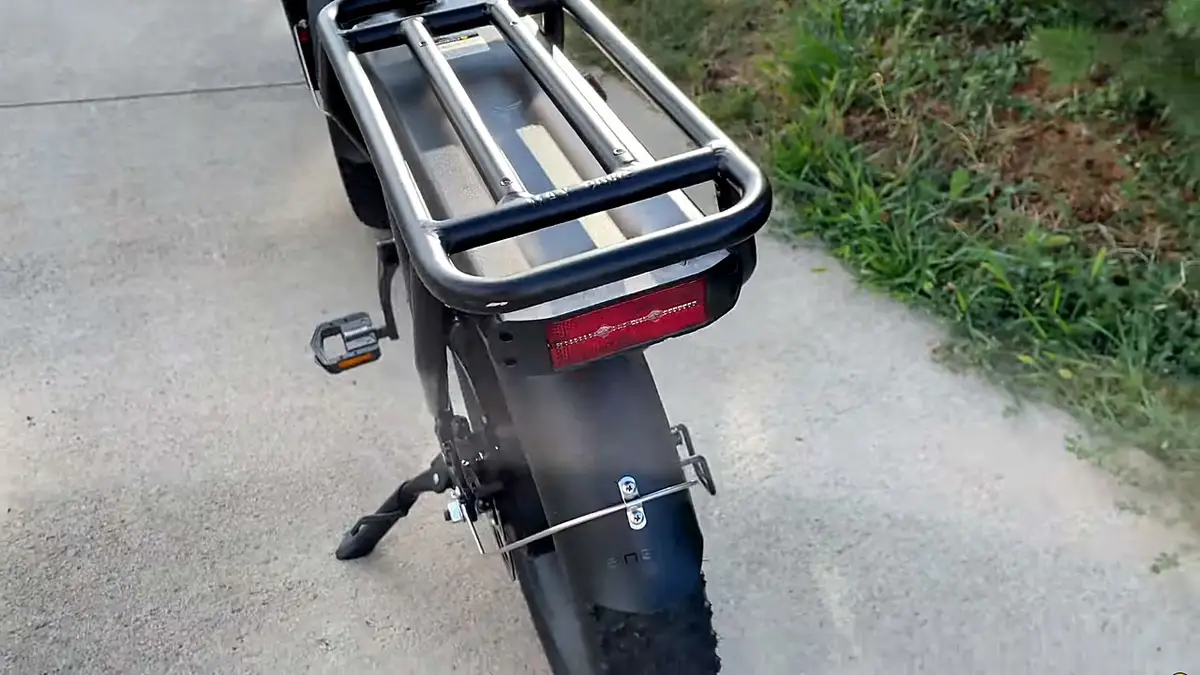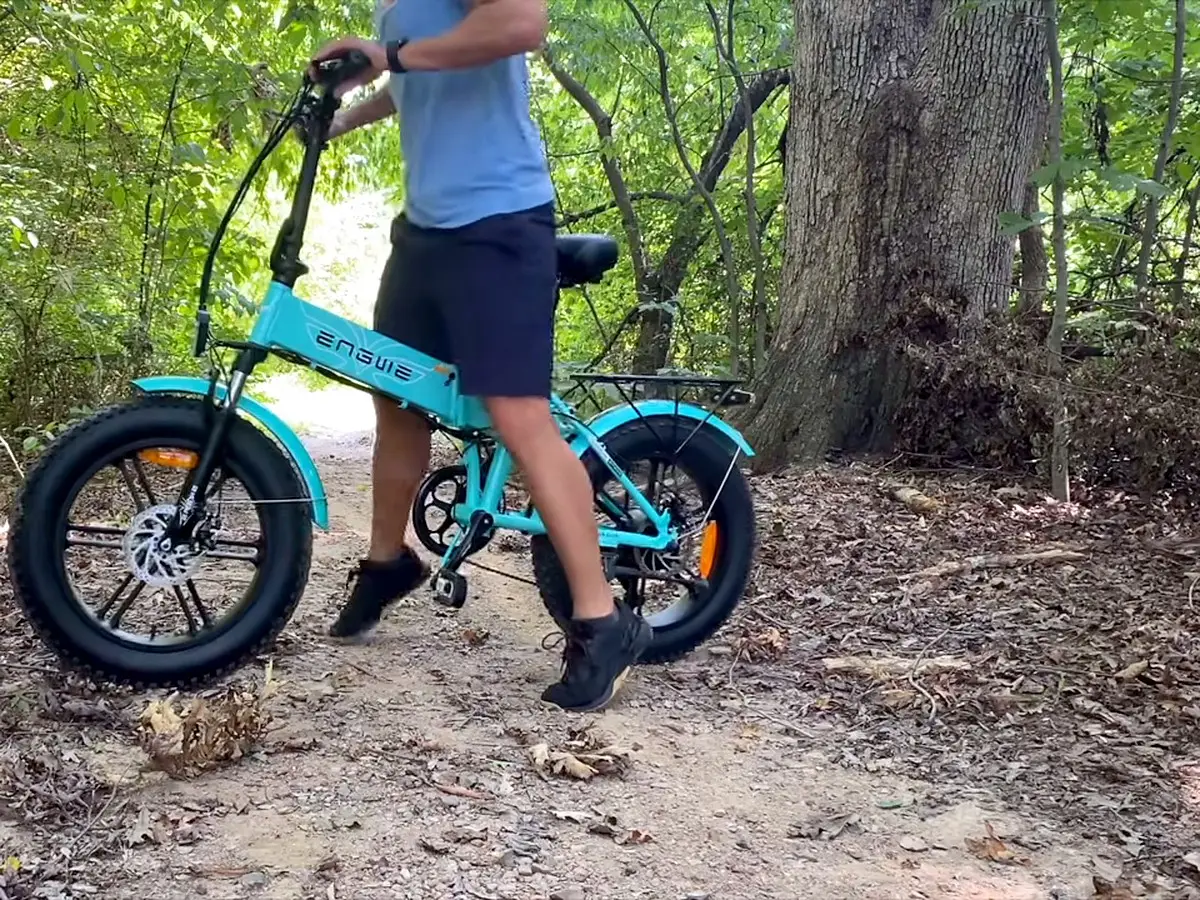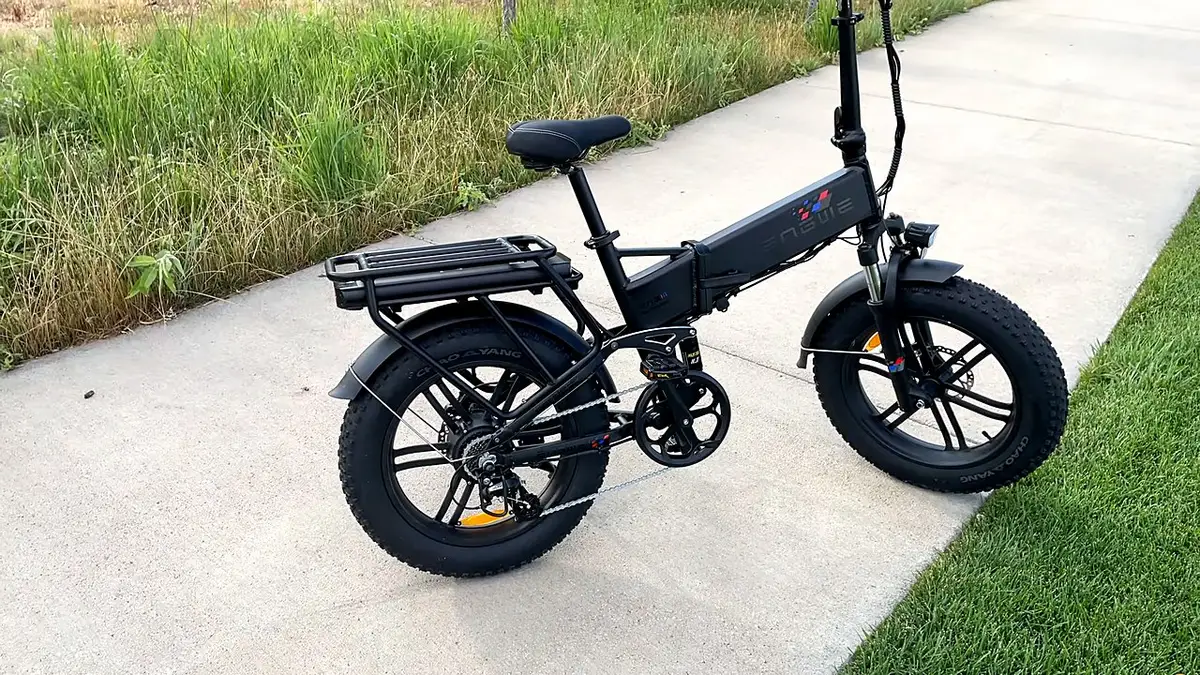
The Engwe Engine Pro is a folding fat tire bike with a front fork and a rear shock, hydraulic brakes and room for a second battery on the back. I rode it for several weeks for my video review (0:06 to 0:09), with Engwe’s optional rear rack battery fitted, and this is what I found.
Everything I say about the ride comes from that video, and I give the time stamps so you can watch the moment yourself. Specs I didn’t measure, like weight, torque and rated range, come from Engwe’s own US listing, which I checked on Oct 23, 2026, with price and stock rechecked on Oct 27, 2026.
Should you buy one?
My overall take in the video was that this is a lot of e-bike for the money, and that Engwe did a good job building a dual suspension fat tire bike that a lot of people will like (7:32 to 7:43). I also pointed out that a couple of years earlier, you couldn’t get this many bells and whistles at that price (8:29 to 8:37).
The problem is buying one. As of Oct 27, 2026, Engwe’s US store lists the Engine Pro at $1,599 with every color (Black, Gray and Blue) unavailable, and the newer Engine Pro 2.0 ($1,699) is unavailable in all three colors too. You can’t buy either new from Engwe. Its Amazon listing is gone too (it returned a not-found page on Oct 27, 2026), so what’s left is a used bike.
The folding fat tire bikes you can order today are in my best folding fat tire e-bike guide. As of Oct 27, 2026, all three were available at their brands’ US stores:
- Kingbull Literider 2.0, from $979, a step through. I rode the earlier Literider.
- Engwe EP-2 3.0, $1,499. I rode the earlier EP-2 Pro.
- Rattan LF Ultra, from $1,399. I rode the earlier LF 750 Pro.
None of them has the Engine Pro’s rear shock, and I haven’t ridden these newer versions.
If you do find an Engine Pro, buy it if you need a bike that folds into a sedan or SUV without a rack (7:43 to 7:51) but still want real suspension for rough paths. Skip it if messy external cables bother you, if you want a torque sensor, or if you’d rather not leave a key in the bike while you ride.
Two batteries, and why that’s the headline
The first thing I showed in the video was the optional rear rack battery (0:15 to 0:34). The Engine Pro already carries its main battery inside the folding center tube. The rack pack adds a second one behind you. When I recorded, it was about a $400 option (0:18 to 0:25). On Oct 27, 2026, Engwe’s US store lists the Engine Pro Rear Rack Battery at $349 and in stock, described as a 48V 13Ah pack.
Here’s my honest caveat. In the video I said that, from what I could see on Engwe’s website, a second battery like this doubles the range (7:01 to 7:08). That was Engwe’s claim, not something I measured. I didn’t run a range test. Engwe’s current accessory page goes further and says the rack pack adds “up to 124 miles (200km)” of range. That’s Engwe’s claim, and it’s worth reading next to the pack size: a 13Ah pack is smaller than the 16Ah main battery, so it holds less energy than the battery you already have.
Where the second battery makes sense is the commute. I said that if you have a longer commute, or you can’t plug in all the time, the extra pack is a great option (7:51 to 8:04). I also said what I believe about commuting in general, which is that if you’re able to, you should get out of the car and ride to work (7:08 to 7:20).
There’s one thing I didn’t like about the dual battery setup. The display updates its battery percentage, but it doesn’t tell you when the second battery is in use (6:35 to 6:55). I wished it did. The rear pack does have its own level indicator on the battery itself, which helps (6:53 to 6:59), but you have to look back at the rack to read it.
When you add the rack battery, you take off the original tail light that’s fixed to the stock rear rack, and you get a new integrated red tail light built into the battery (3:55 to 4:09).
Folding, and fitting it in a car
The Engine Pro folds the way most folding e-bikes do, in the middle of the frame, and the handlebar folds down too (0:37 to 0:44). It also comes with folding pedals to save space (4:41 to 4:48). The payoff, as I said near the end of the video, is that you can get it into the back of a sedan or SUV without needing a bike rack (7:43 to 7:51).
Engwe lists the bike at 69.88 lb. I didn’t weigh it, and that’s Engwe’s figure, likely without the rack battery. Folding makes a bike smaller, not lighter, so that number is the one to check if you’ll be lifting it into a trunk.
One more fit note. This is not a step through. There’s a cross beam you have to swing a leg over (3:46 to 3:53). The handlebar raises and lowers, so it works for a lot of different rider heights (3:37 to 3:46), but if stepping over a bar is hard for you, look at a step through model.
Full suspension, and how it rides
This is what sets the Engine Pro apart from most folders I’ve filmed. It has a front fork and a rear shock (4:31 to 4:36), and I found it very comfortable, especially over rough terrain (4:36 to 4:41). The 20 x 4.0 in fat tires, per Engwe, add to that cushion.
Engwe describes the frame as a 3 step alloy folding frame. Of the other folders I’ve filmed, none has a rear shock.
Motor, pedal assist and the throttle
Engwe lists a 750W rear hub motor with 1,000W peak and 55 Nm of torque. In the video I said the motor gives you a lot of power but is “nothing to write home about,” pretty standard (6:07 to 6:12). I did like how it’s integrated into the design of the wheel, which makes the bike look a little nicer (6:12 to 6:19).
The pedal assist uses a cadence sensor, which measures the turning of your cranks (4:48 to 4:58). That means the motor adds power once the pedals move, at a level set by the assist mode, rather than responding to how hard you push. A lot of newer high end bikes use torque sensors (4:48 to 4:51), and the Engine Pro 2.0 is one of them, according to Engwe. If you want assist that follows your effort, that’s a point for the 2.0 or a different bike.
There are five levels of pedal assist, and you can drop all the way to zero (1:12 to 1:23). The throttle works from a standstill (1:00 to 1:04).
The throttle also has cruise control. There’s a cruise control icon by the throttle, and if you hold the throttle at a speed for about 5 to 7 seconds, the bike stays there (2:51 to 3:08). I said that’s a nice feature, especially on a longer ride.
I didn’t run a top speed test, so I won’t give you a number from the video.
Brakes and gears
The Engine Pro has hydraulic disc brakes front and rear (0:56 to 1:00, 3:17 to 3:20). I didn’t run a stopping distance test.
The gearing is eight speeds in the rear and one chainring up front, which I called very standard for e-bikes you buy today (5:58 to 6:05). Engwe’s listing calls it a Shimano 8 speed system. The shifter is where this bike surprised me. It uses your thumb and index finger to go up or down, and I said in the video that I liked it more than any other shifter I’d tried, and that it’s really nice and easy to use (3:20 to 3:31). Out of the box it was a hair loose, but that was easily fixed by tightening a small ball on the shifter (3:31 to 3:37).
Controls, display and comfort touches
The grips are a synthetic leatherette with a palm rest, and they’re really comfortable when you rest your hands on them (0:46 to 0:56, 3:09 to 3:17). Hidden under the throttle is a horn, which is very convenient (1:04 to 1:08).
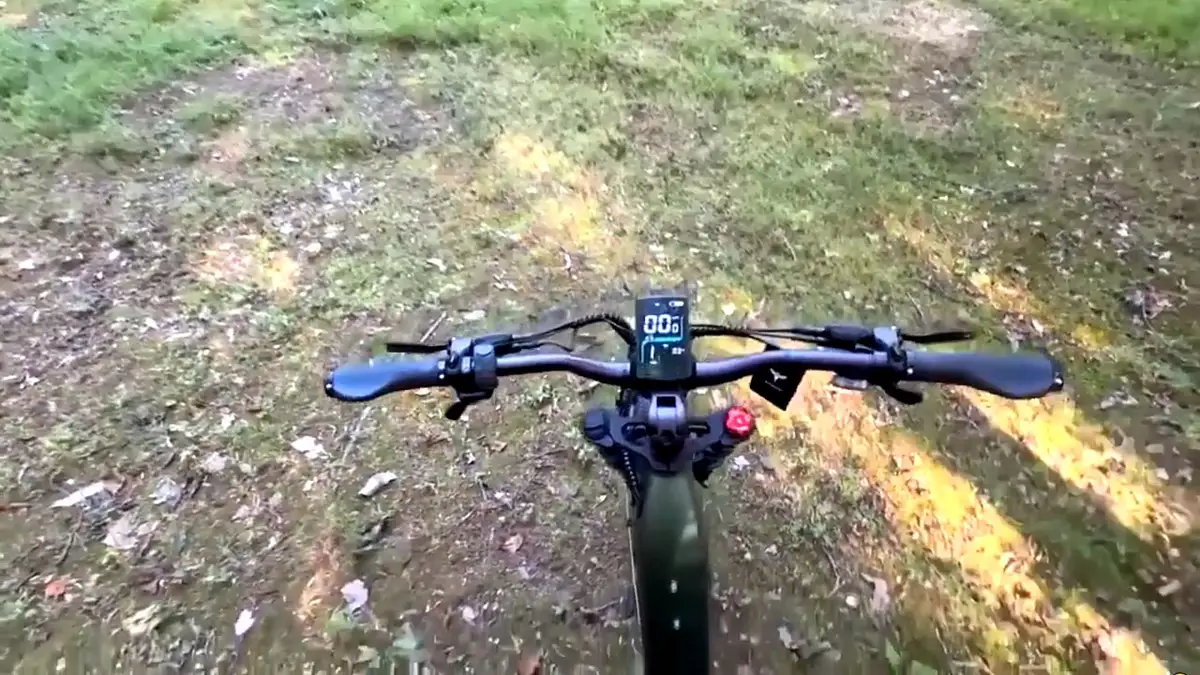
The display is full color, sitting in the center of the bar (1:10 to 1:15). It has a light sensor. When I turned the headlight on in daylight, it switched itself back off, because the sensor knew the sun was still up (1:20 to 1:31). There are plenty of other settings, but I didn’t dig into all of them for the review (1:31 to 1:35).
The headlight and tail light are integrated (3:53 to 3:57), and fenders come standard (4:09 to 4:12). The saddle feels premium, a leather material, and I liked the vent in it, which lets heat escape on a longer ride (6:19 to 6:31). If you have the extended battery, you’re going to want to ride far, so that matters (6:31 to 6:35).
What I didn’t like
Two things stood out, and I said so plainly.
The first is the cabling. Because it’s a folding bike, there aren’t many places to route cables, so near the front fork you’ll see a lot of wiring running outside the frame and zip tied underneath (5:14 to 5:34). Engwe did a decent job with what it had, but I called the external cabling my least liked part of the design (5:34 to 5:39).
The second is the key. You have to leave a key in the “ignition” for the bike to be on and rideable (5:42 to 5:55). It never fell out on me, but I found it a little annoying (5:55 to 5:58).
A smaller complaint: the rear fender likes to rattle a little over some bumps (4:09 to 4:24). I think it comes from the rivets where the fender attaches (4:24 to 4:28). It’s something to keep in mind, not a deal breaker.
What I didn’t test
I didn’t run a range test, a top speed test or a braking test, and I didn’t weigh the bike. The 69.88 lb weight, 55 Nm torque, 330 lb max load and range ratings are Engwe’s numbers. Engwe’s listing gives 62 miles as its headline range, with 37 miles on electric only and 75 miles on pedal assist. As with every rated range, those assume ideal conditions. Fat tires, hills, wind, cold and a heavier rider all cut it.
How it compares with other folders I’ve filmed
The closest bike I’ve filmed is the Engwe EP-2 Pro, Engwe’s earlier folding fat tire bike. On the specs listed on my review pages, the EP-2 Pro has no suspension and uses 160mm mechanical brakes, with a 48V 13Ah battery and a listed 66 lb. The Engine Pro adds a rear shock, hydraulic brakes and a bigger 16Ah main battery, for about 4 lb more. Engwe lists the EP-2 Pro at $1,399, sold out, as of Oct 22, 2026.
The Rattan LF 750 Pro I filmed has a fork plus a suspension seatpost rather than a rear shock, with a 48V 13Ah battery and a 300 lb max load. It cost $1,249 when I reviewed it and has since been replaced.
The Luckeep X1 Pro goes the other direction: dual batteries at 960Wh total and a 440 lb max load, but it’s listed at 81 lb. It’s a different answer to the same question, built around range rather than suspension.
If you want something with a step through frame instead of the Engine Pro’s cross beam, the Kingbull Literider is a folding step through with fat tires and hydraulic brakes that I filmed.
Of these, the Engine Pro is the only one with both a rear shock and hydraulic brakes on its spec sheet.
Engine Pro or Engine Pro 2.0?
I haven’t ridden the 2.0, so this is spec only, from Engwe’s US listing on Oct 27, 2026. Engwe describes a 1,200W motor with 75 Nm, a torque sensor, a 52V 16Ah battery rated up to 68 miles on pedal assist, a 6061 aluminum folding frame, full suspension, hydraulic disc brakes and a Shimano 8 speed. The biggest changes from the bike I rode are the torque sensor and more torque, which address one of my complaints. It’s listed at $1,699, but it was unavailable in every color on Oct 27, 2026.
Who it’s for
The Engine Pro fits riders who need a fat tire bike that folds into a car, want full suspension for rough paths, and like having the option of a second battery for a long commute. It suits people who don’t mind a cadence sensor and a cross beam frame. Look elsewhere if you need a step through, hate external wiring, want a torque sensor, or need to lift the bike often.
FAQ
Have I ridden the Engine Pro?
Yes. I tested it for several weeks with the optional rear rack battery fitted (0:06 to 0:09, 0:15 to 0:25).
Does it fold?
Yes. The frame folds in the middle and the handlebar folds down (0:37 to 0:44), and it comes with folding pedals (4:41 to 4:48).
Does it have cruise control?
Yes. Hold the throttle at a speed for about 5 to 7 seconds and it holds that speed (2:51 to 3:08).
Is the second battery worth it?
If you commute far or can’t always charge, I think it’s a great option (7:51 to 8:04). It was about $400 when I recorded (0:18 to 0:25), and Engwe lists it at $349 as of Oct 27, 2026. I didn’t measure how much range it adds.
Does it have a torque sensor?
No. It uses a cadence sensor (4:48 to 4:58). Engwe says the Engine Pro 2.0 has a torque sensor.
Pros and cons
Pros: folds, with a folding handlebar and pedals; full suspension that’s very comfortable on rough ground; hydraulic disc brakes; cruise control; an easy thumb and index shifter; an optional second battery; integrated lights, fenders and a horn; a vented saddle.
Cons: a lot of external cabling; the key must stay in while you ride; a cadence sensor, not torque; the rear fender rattles over some bumps; the display doesn’t show when the second battery is in use; unavailable on Engwe’s US store as of Oct 27, 2026.
Price
Engwe’s US site lists the Engine Pro at $1,599 but unavailable in all colors as of Oct 27, 2026, so you can’t buy it new from Engwe. For bikes you can buy now, see Engwe’s current bikes (affiliate link) or the in stock picks in my folding fat tire guide.
“Blessed are those whose strength is in you, in whose heart are the highways to Zion.” Psalm 84:5 (ESV)