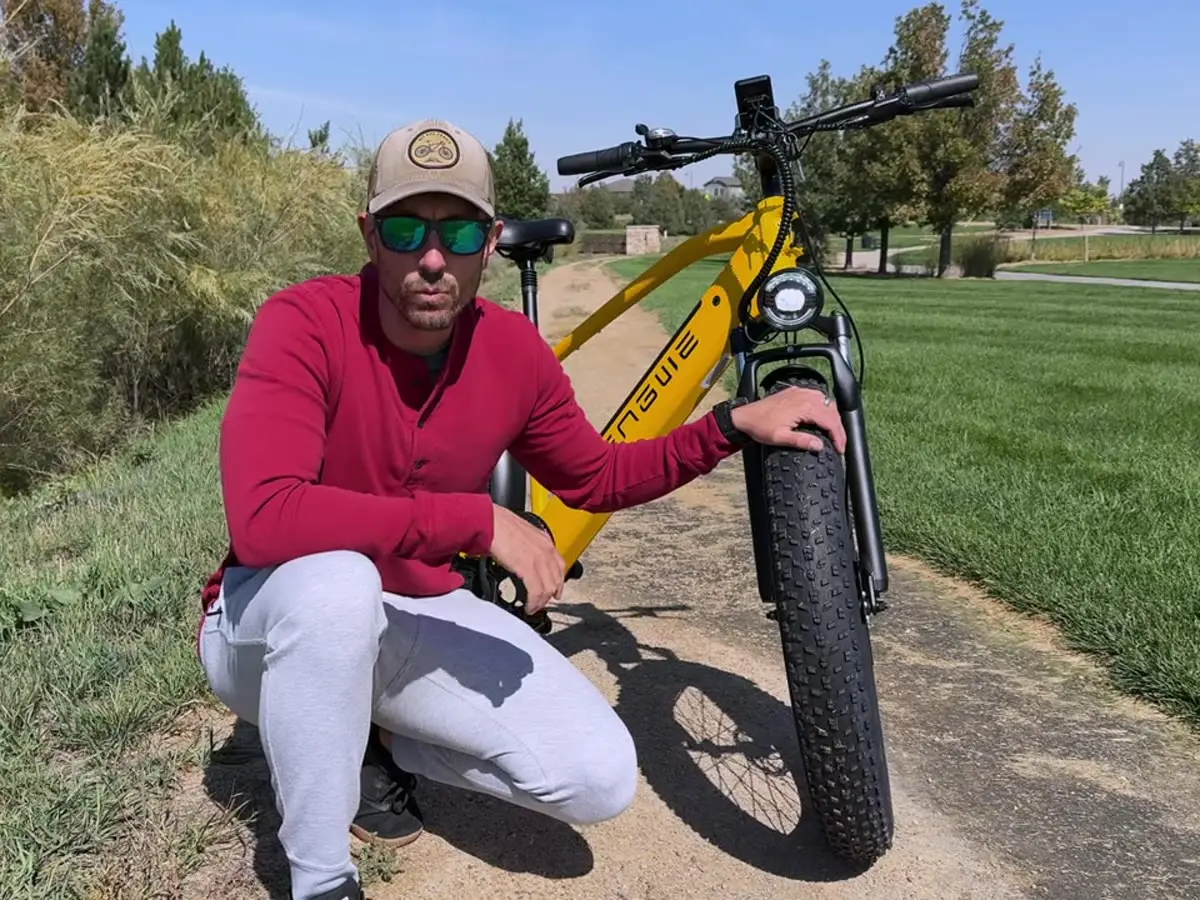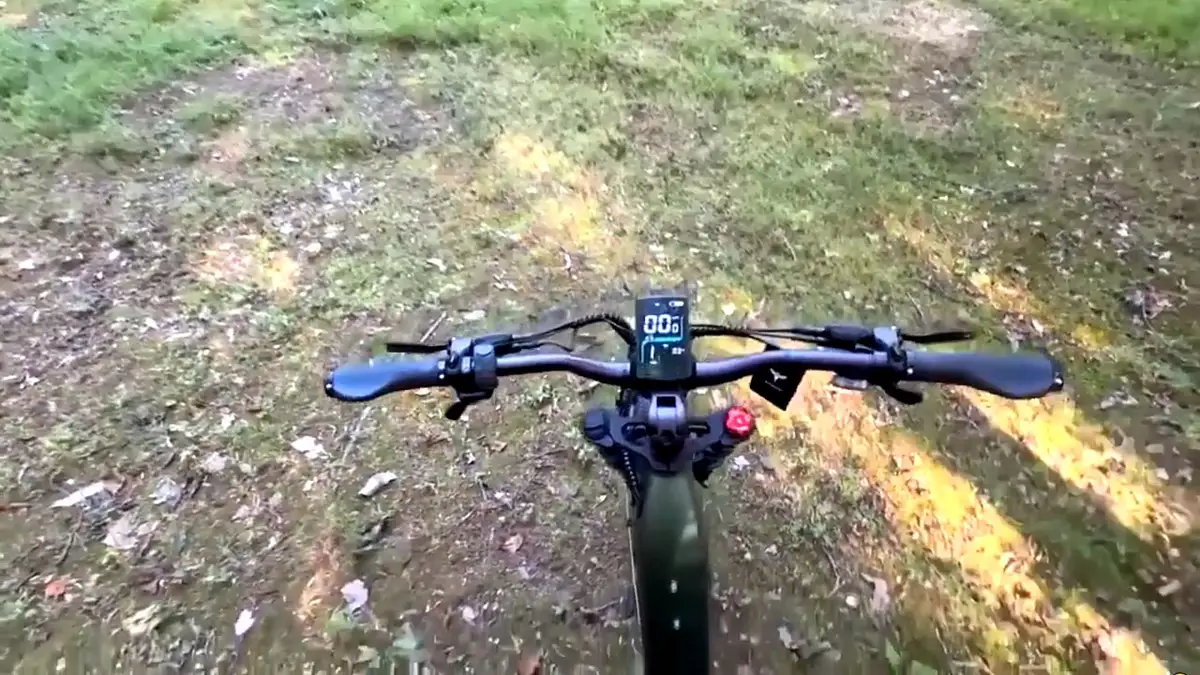
At the end of my video review, I pointed the Engwe E26 3.0 Dual Motor at the steepest gravel peak on my property. No pedaling, just throttle, with me at about 200 lb on board. The speed dropped from 10 to 9, then 8, then 7, then all the way to 5 mph, and then I was at the top (12:32 to 13:28). I said a single motor bike like the Aventon Aventure wouldn’t have made that climb without pedaling (13:28 to 13:41).
That climb is the whole story of this bike. It has a motor in the front wheel and another in the rear, and the second motor changes everything. I tested it for several weeks (0:22 to 0:27). Times in parentheses point to that video, and specs I didn’t measure come from Engwe’s US product page.
As of Oct 27, 2026, us.engwe.com lists it at $1,799, down from $2,399, in Army Green and Graphite Grey, both in stock. I don’t have an affiliate link for it.
Two motors, and you need both
In the video I called it a beast of a bike, and a heavy one (0:36 to 0:44). With just the rear motor on, I said it lacks a lot of power for a 200 lb rider like me. Turn on both motors and you get an incredible amount of power for hills or for towing a kid carrier or luggage (0:49 to 1:15). Engwe lists 2,000W peak combined and 160 Nm of torque.
I showed the difference on a steep slope. In dual motor mode at full throttle, I was only doing about 9 mph and the motor bogged down a bit, but it never stopped (7:13 to 8:22). On a gentler stretch of the same hill I hit 13 to 14 mph (8:28 to 8:37).
Then I switched to the rear motor alone on the steep part. Even in sport mode, it maxed out, and at full throttle I came to a complete standstill (8:46 to 9:27). It couldn’t make the climb (9:33 to 9:41). Back in dual mode, from a standstill on the same incline, I could feel the front tire pulling me right up past the hill (9:43 to 9:58).
The one annoyance: it always starts in rear only
Here’s what I wished Engwe had changed. Every time you power the bike on, it starts with only the rear motor running, and I wished there were a way to make dual motor the default (2:41 to 2:57). That matters because I ride it with both motors on every time.
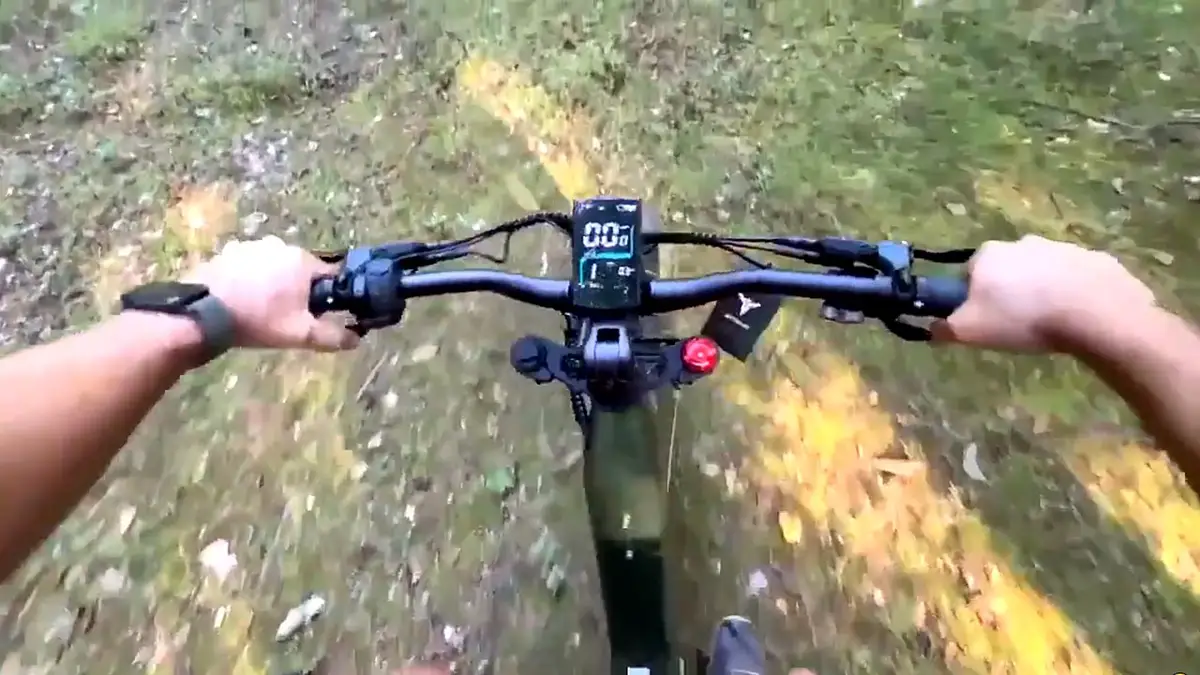
Switching is easy once you know how. Hold both turn signal buttons together, the display flashes P3, and both motors light up on the little bike icon on the screen (3:03 to 3:27). P2 means single motor (8:52 to 8:57).
Controls that feel good
The left grip has a palm rest area that makes it a little wider where your palm sits, and I called them the most comfortable grips out there (1:24 to 1:33). That side also has the front hydraulic disc brake and the throttle (1:33 to 1:40). The right side has the rear hydraulic brake and an eight speed shifter you work with your pointer and thumb. I called it the best shifter, because it’s so comfortable to use (1:56 to 2:13).
There are five levels of pedal assist plus zero. The throttle works from a stop, but only when you’re in a pedal assist level. At zero, the throttle gives you no power (2:18 to 2:36). The display also has trip and odometer screens, a horn button, and a dual LED headlight you turn on by holding plus, plus an integrated tail light (3:27 to 3:59). You can check today's price at Engwe.
Suspension and the ride
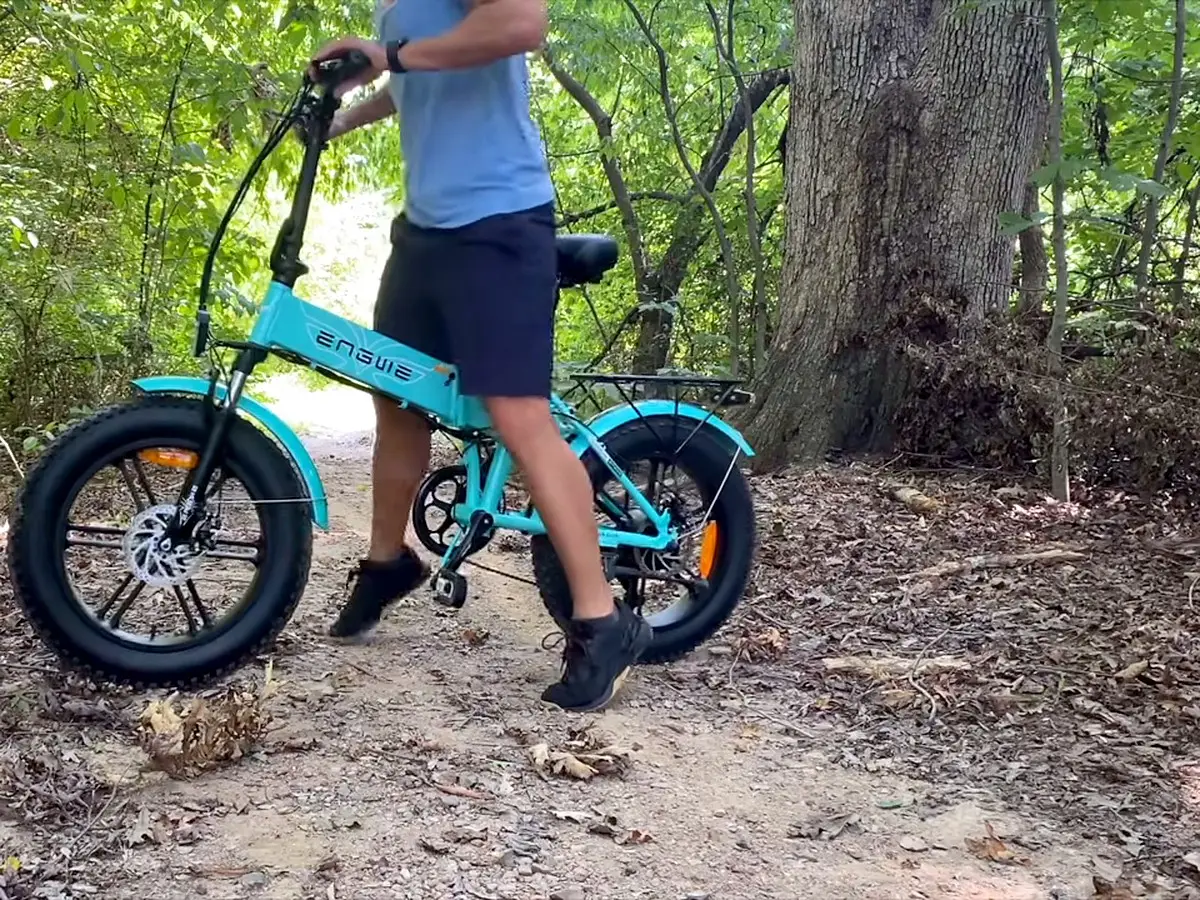
The front fork is huge, with 4 inch fat tires under it. I’d taken it on some pretty aggressive terrain and still hadn’t bottomed out the fork (4:28 to 4:55). Under the seat, which I called pretty comfortable and easy to upgrade, there’s a rear shock that gives a ton of cushion off road (5:21 to 5:36). On rough ground during the climb test, I said the dual suspension was doing an excellent job and felt super comfortable (7:51 to 7:58). Engwe lists a 120mm fork and an 80mm air shock.
What I measured on camera: 13 to 14 mph up a steep slope on both motors, throttle only, at about 200 lb (video, 8:31); rear motor alone stalled on that same slope at full throttle (video, 9:18); both motors made a steeper gravel climb with no pedaling, slowing to 5 mph at the top (video, 13:25).
What surprised me most was how it rides. I ride a lot of mountain bikes without a motor, and even though this one is so heavy, it felt like a very nimble regular mountain bike (10:29 to 10:52). Engwe lists it at 85.9 lb. I didn’t weigh it.
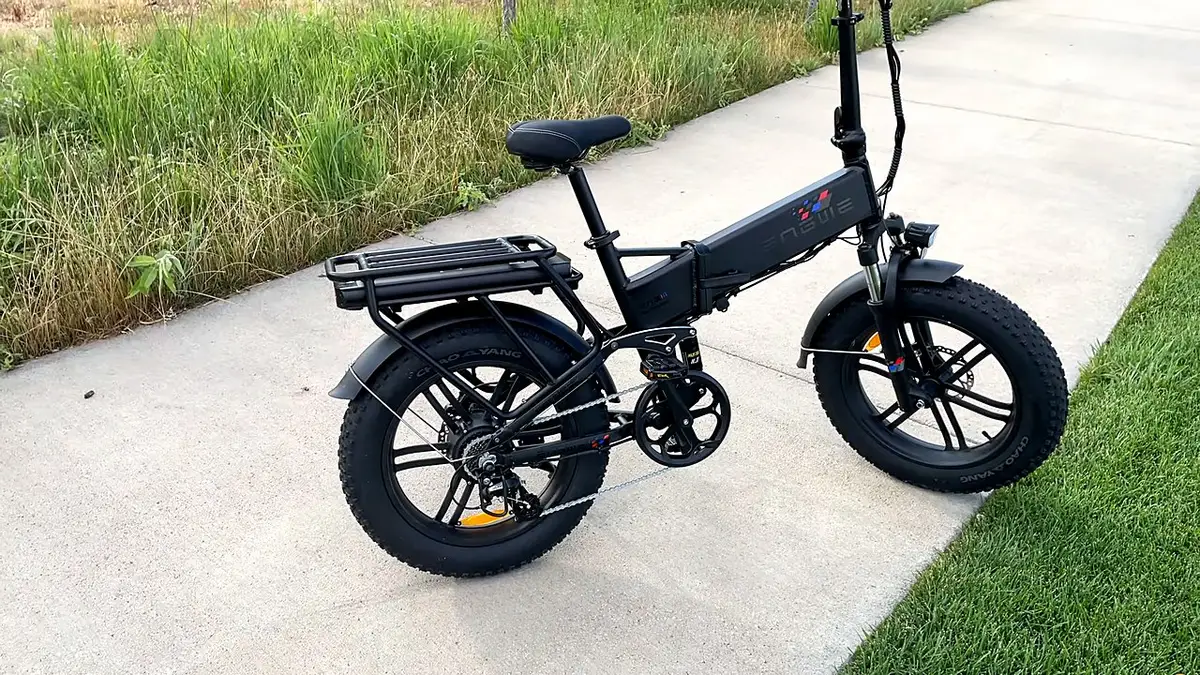
The frame is a step-through, and the battery pops out with a key (5:13 to 5:23). There’s a cover over the crank that makes it look like a mid-drive, but it isn’t. Both motors are hubs (5:36 to 5:46). The handlebars adjust, so a taller rider can set them where they like (6:25 to 6:49).
Built for hauling gear
A rear rack came with it, though I hadn’t installed it yet when I filmed (3:59 to 4:07). Front and rear fenders come standard too (6:07 to 6:11). I said it’s really designed for loading up with gear for hunting or camping (4:07 to 4:20, 6:11 to 6:25). Engwe lists a 400 lb max load.
What I didn’t test
I didn’t run a range test or a top speed test, and I didn’t weigh it. Engwe rates the range at 37 to 46 miles in dual mode and 50 to 76 miles on the rear motor alone, measured on flat concrete with a 165 lb rider.
There’s also a conflict to know about. I called it a Class 2 bike in the video (0:44 to 0:47), but Engwe lists 28 mph on throttle and 31 mph on pedal assist. Both are above the Class 2 limit, and 31 mph is above Class 3. Check the bike’s settings and your local rules on my e-bike laws hub.
How it compares with bikes I’ve filmed
The original Engwe E26 I reviewed is a different bike, with one motor, a smaller battery and no rear shock. It listed at $1,699, sold out, on Oct 22, 2026. If you mostly ride flat ground and you’re lighter than me, the Bee Cool Adventurer was $1,099 on Oct 22, 2026, with one 750W motor. The Mokwheel Scoria is another single motor fat tire bike I filmed.
How it compares
| Engwe E26 3.0 Dual Motor | Engwe E26 | Mokwheel Scoria | Bee Cool Adventurer | |
|---|---|---|---|---|
| Motors | Dual, 2,000W peak | Single, 1,000W peak | Single, 750W | Single, 750W |
| Battery | 48V 20Ah | 48V 16Ah | 48V 19.6Ah | 48V 21Ah |
| Weight | 85.9 lb | 73.8 to 76 lb | 79 lb | 78 lb |
| Max load | 400 lb | 330 lb | 350 lb | 350 lb |
| Price | $1,799 (Oct 27, 2026) | $1,699, sold out (Oct 22, 2026) | Scoria 2.0, $1,799.99 (Oct 22, 2026) | $1,099 (Oct 22, 2026) |
Rival specs are from the brands, as listed on my review pages for those bikes.
Pros and cons
Pros: climbed a steep gravel peak on throttle alone; pulled me up from a standstill in dual mode; full suspension and hydraulic brakes; turn signals, a horn, a dual headlight, a rack and fenders; adjustable bars and comfortable palm rest grips; rides like a nimble mountain bike.
Cons: starts in rear only mode every time; the rear motor alone stalled on the steep climb; no throttle at pedal assist 0; heavy at 85.9 lb; listed speeds above Class 2.
FAQ
How do you turn on both motors?
Hold both turn signal buttons. The display flashes P3 and dual mode comes on. You have to do it every time you power on the bike (2:41 to 3:27).
Is this the same bike as the Engwe E26?
No. The E26 I reviewed earlier has one motor, and this one has two. See my Engwe E26 review.
Is it good for heavier riders?
At about 200 lb, I said that if you’re a heavier rider worried about hills, you can worry no longer in dual mode (10:00 to 10:20).
For more options, see my best e-bike for hills guide and my best fat tire e-bike guide.
“The LORD is my light and my salvation; whom shall I fear? The LORD is the stronghold of my life; of whom shall I be afraid?” Psalm 27:1 (ESV)