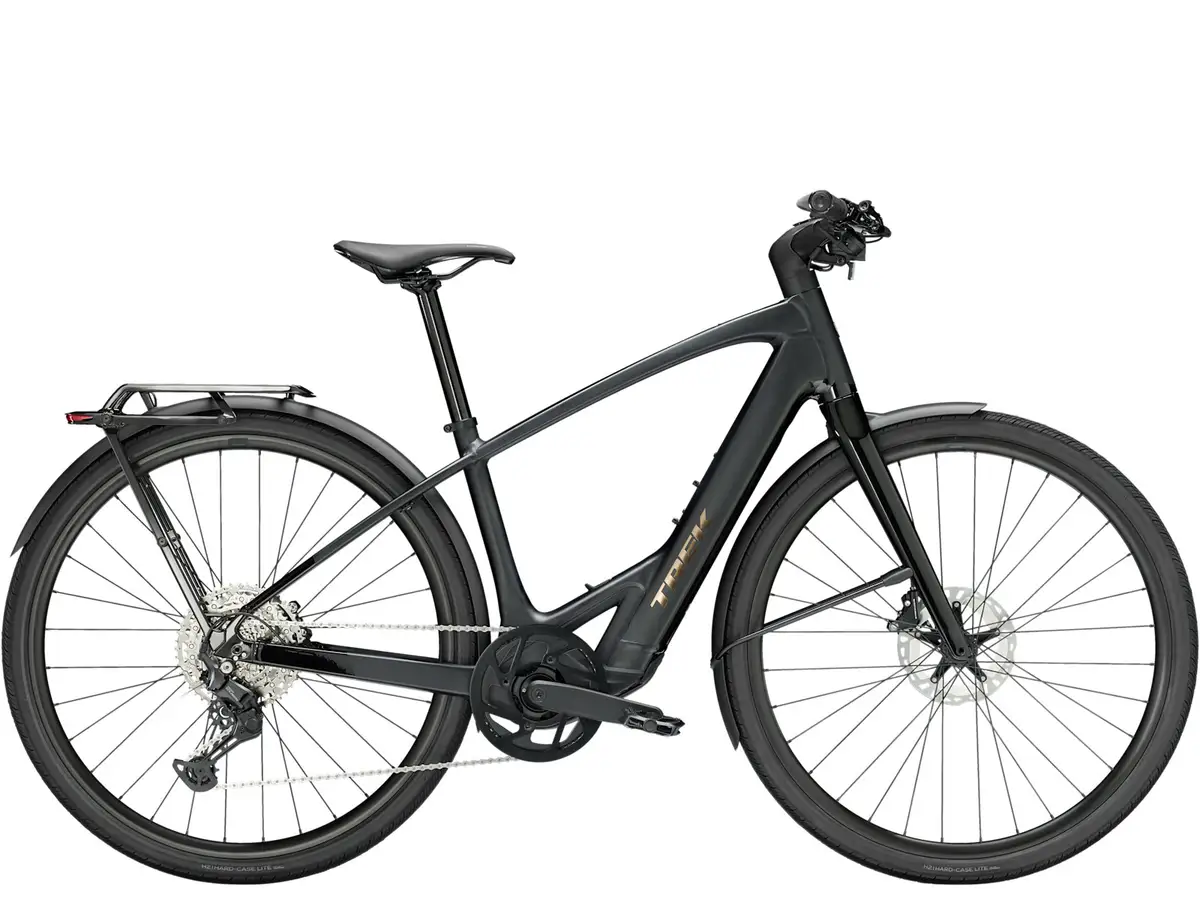
Most e-bikes I film weigh 60 lb or more. The Trek FX+ 7S weighs about 41, assists to 28 mph and uses a small TQ motor in the cranks instead of a big hub motor. I haven’t ridden it. The lightest e-bike I’ve filmed is the 36 lb Velotric T1 ST, so that’s the closest comparison I have. This page uses Trek’s product pages, checked on Oct 28, 2026 and linked at the bottom.
Two frames, closeout pricing
The FX+ 7S comes with a standard frame in S through XL, or as the Midstep, with a lower top tube, in XS through L. Both were $3,199.93 on trekbikes.com as of Oct 28, 2026, marked as closeouts. Trek shows $3,999.99 as the regular price. Closeouts usually mean limited sizes and colors, so check your size before you plan around this price.
A different kind of motor
The TQ-HPR50 is a mid drive rated at 50 Nm, 250W continuous and 300W peak. Those numbers are low next to the 500W and 750W hub motors on most bikes I review. The trade is weight and noise: Trek describes the bike as “light, quiet, and fast,” not powerful.
It’s a Class 3 bike: pedal assist goes to 28 mph. Trek doesn’t list a throttle. If you ride on paths that are closed to Class 3 bikes, check the rules first. Our e-bike laws hub and the Class 2 vs Class 3 guide explain where each class is allowed.
Battery and range
The 360Wh battery sits inside the frame, and Trek’s parts list calls it “dealer removable,” so plan on charging it on the bike. Trek rates it for up to 50 miles. An optional 160Wh Range Extender, sold separately, raises Trek’s figure to 75 miles in Eco. Range ratings are best-case numbers, and holding speeds near 28 mph uses more energy, so a small battery like this one leaves less margin. The charger is 4A.
Weight and what it carries
Trek lists 41.23 lb for the Midstep and 41.12 lb for the standard frame, both in size M. That’s about 20 lb less than most commuters I film, which matters if you lift it onto a car rack or carry it up stairs.
It doesn’t skip the commuter gear. An alloy rear rack, a rear fender and a kickstand come on the bike. The rack works with MIK bags and baskets, and Trek’s feature text rates it for 55 lb. The total weight limit is 300 lb, including the bike, which leaves about 259 lb for rider and cargo.
Brakes, gears and ride
The brakes are Shimano hydraulic discs with one 180mm and one 160mm rotor (Trek lists both sizes without saying which end gets which). The drivetrain is a Shimano CUES 10 speed with an 11 to 48 cassette, which gives low gears for climbing. The tires are 700 x 40mm Bontrager H2 Hard Case Lite.
There’s no suspension. The fork has carbon legs and a 100 x 12mm thru axle. Trek also says the frame accepts a dropper seatpost, which lets you lower the saddle on the fly or share the bike between riders of different heights.
Lights, display and phone mount
Lights are built in front and rear. The display is a small TQ LED screen in the top tube with Bluetooth and ANT+, and the bike works with the Trek Central app. The stem has a Quad Lock phone mount that charges your phone wirelessly. You’ll need a Quad Lock case for your phone.
How it compares
Against the Velotric T1 ST, which I filmed: the T1 ST weighs 36 lb, uses a 350W rear hub and a 353Wh battery, and is Class 1 at 20 mph. On my test ride, the T1 ST went over 100 miles and used only two of four battery bars. The FX+ 7S has a similar battery size, a mid drive, 28 mph assist, a carbon fork and a rack. It costs about $1,800 more than the T1 ST Plus at $1,399 (Velotric, Oct 22, 2026).
Against the Trek FX+ 1: the FX+ 1 is about $1,200 less at $1,999.99, has a throttle, a 500W hub motor and a 520Wh battery, and weighs about 7.5 lb more. The FX+ 7S trades the throttle and some battery for a lighter, quieter mid drive and the included rack.
If you want the same light-assist idea on drop bars, Trek’s Checkpoint+ SL pairs a 360Wh battery with the stronger 60 Nm TQ-HPR60 and gravel tires, from $5,599.99 at about 30.5 lb.
FAQ
Have I ridden the FX+ 7S?
No. This page is based on Trek’s product pages, checked Oct 28, 2026.
Does it have a throttle?
Trek doesn’t list one. It’s a Class 3 pedal assist bike that helps you up to 28 mph.
Can I take the battery out to charge it?
Trek’s parts list says “dealer removable,” so plan on charging it on the bike.
What’s the difference between the FX+ 7S and the Midstep?
The Midstep has a lower top tube and comes in XS through L. The standard frame comes in S through XL. Everything else, including price, matches.
How far does it go?
Trek says up to 50 miles, or up to 75 miles in Eco with the optional 160Wh Range Extender.
Pros and cons (from the specs and sources)
Pros: about 41 lb; quiet TQ mid drive; 28 mph assist; rack, rear fender and kickstand included; carbon fork with thru axle; wide 11 to 48 gearing; Quad Lock wireless charging mount; $800 off as a closeout.
Cons: small 360Wh battery; no throttle listed; no suspension; battery is dealer removable only; rear fender only; Class 3 limits some paths; closeout sizes may run out.
Who it’s for
On paper, the FX+ 7S fits riders who want an e-bike that rides and lifts more like a regular bike, commute or exercise on pavement, and want to keep up with 28 mph traffic. If you want a throttle or a bigger battery for the money, look at hub-drive bikes like the FX+ 1 instead.
Price
$3,199.93 on trekbikes.com as of Oct 28, 2026, for both the FX+ 7S and FX+ 7S Midstep (closeout; Trek shows $3,999.99 as the regular price).
“Commit your way to the LORD; trust in him, and he will act.” Psalm 37:5 (ESV)