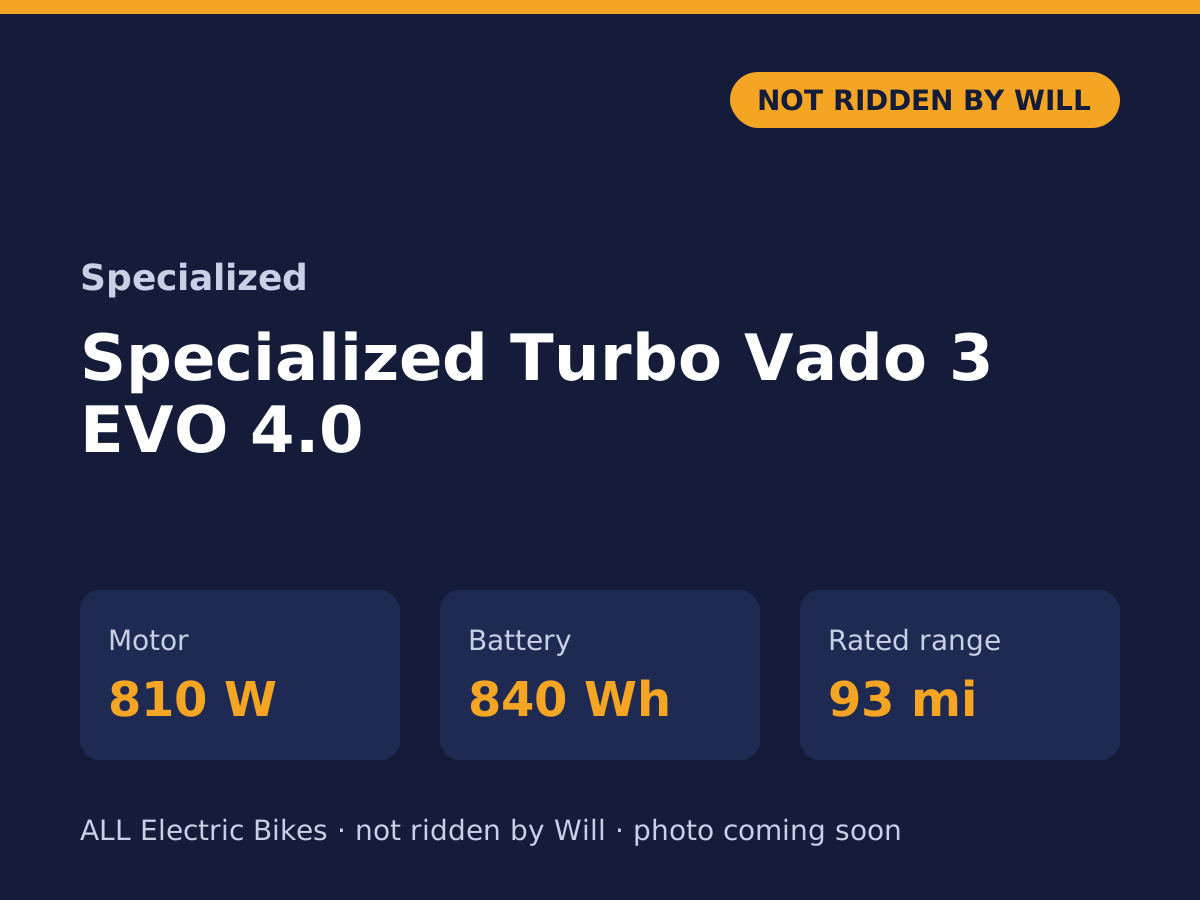
Specialized did something unusual with the Turbo Vado 3 EVO 4.0. It took the motor and battery from its Levo 4 electric mountain bike and put them in a commuter, and it put them in the cheaper 4.0 trim, not just the top models. I haven’t ridden it, or any Vado. This page is a research profile, not a review. Everything below comes from Specialized’s product pages, its Vado 3 user manual and policies, the CPSC, and two independent reviews I summarize and link at the bottom. Prices and stock were checked on Oct 27, 2026.
As of Oct 27, 2026, specialized.com lists the EVO 4.0 at $4,499.99, with sizes M through XL in stock and some colors of S and M running low. That’s a lot of money for a commuter, so the real question is whether you need this much bike.
Which Vado 4.0 this is
Search for “Turbo Vado 4.0” and you’ll find two generations on Specialized’s site. This page covers the newest one, the Vado 3 EVO 4.0. Specialized also lists a full suspension Vado 3 X 4.0 at $5,499.99, and the older Vado 2 4.0, which was on sale on Oct 27, 2026 at $2,499.99, down from $4,099.99, with most sizes out of stock. I haven’t ridden either of those.
That sale changes the math. The Vado 2 4.0 lists a 70 Nm motor and a 710Wh battery, so the Vado 3 EVO costs $2,000 more for the bigger motor and battery, a longer fork and wider tires, while the sale stock lasts.
The motor is the headline
Specialized lists its 3.1 mid-drive at 105 Nm of torque and 810W peak. A mid-drive sits at the cranks and works through the bike’s gears, which is why it’s the usual choice for steep hills. Specialized calls it “SuperNatural” power.
BIKE magazine, a German publication that tested the regular, non-EVO Vado 3 4.0, called the 4.0 “a U-turn” for Specialized. Its cheaper Vados used to get smaller motors and batteries. Now the 4.0 gets the top motor and the big battery, and what you give up is in the rest of the parts. The same review said that in everyday riding “the enormous motor power is almost never needed.” On paper, 105 Nm matters most if you’re a heavier rider, carry cargo or face long, steep climbs.
There’s no throttle. Like every Vado, it’s pedal assist only, with a walk assist mode up to 3.1 mph for pushing it up a ramp, per Specialized’s manual.
Class 1 or Class 3
The product page doesn’t list a class or top speed. The Vado 3 user manual, which covers the whole family, says the bike can be set to Class 1, with assist to 16 or 20 mph depending on your region, or Class 3, with assist to 28 mph, where the law allows. The manual also says the class may reset to comply with local laws. Class 3 bikes face more rules in many states, so check yours on my e-bike laws hub.
Battery and range
The Turbo X2 battery holds 840Wh, sits in the down tube and comes out with a key. Specialized rates the range at up to 150 km, about 93 miles, and includes a 4A charger. Its support documents list a Full Power Range Extender, a second battery sold separately, but the page doesn’t give its capacity.
I haven’t found an independent U.S. range test of the EVO 4.0, so I can’t give you a real world number. Riding in the top mode up hills will land you well short of the rating.
Where the parts don’t match the price
Here the independent reviews push back. The brakes are Shimano MT200 two piston hydraulics with 180mm rotors, and BIKE magazine called them “simple.” It singled out the SR Suntour fork as the part most likely to draw criticism and found it “a bit stiff.” That review was of the regular Vado 3 4.0, so the EVO’s 120mm fork (100mm on size S) may differ.
The rest is commuter friendly: a 40mm suspension seatpost, 27.5 by 2.6 inch flat resistant tires with reflective sidewalls, and a Shimano CUES 9-speed with an 11-41T cassette. One oddity in Specialized’s spec table: it lists a 9-speed cassette with a chain labeled for 11-speed CUES. Ask the dealer to confirm.
Weight, fit and carrying
Specialized lists 63 lb 4.4 oz, which is heavy if you carry it up stairs. It comes in S, M, L and XL. The product page links a size guide instead of listing rider heights, so get fitted at the shop. Specialized’s page shows ship to home as not available, so you’ll pick it up at a dealer, which also means a shop builds it.
The integrated MIK HD rack is rated to 27 kg, about 60 lb, with a brake light built into its tail light. The manual lists a 136 kg, or 300 lb, limit for rider plus cargo. At 250 lb, you’d have about 50 lb left for bags. Up front there’s a 500 lumen Lezyne headlight.
Security and tech
The color display sits in the stem and has a USB-C port for your phone. The touchscreen is saved for higher trims, which both BIKE magazine and Cycling Electric noted. Specialized’s U.S. page lists a Turbo System Lock that disables the motor through the app, a keyed battery lock, and Apple Find My built in, so it’s tracking for iPhone users only. BIKE magazine said the lock was missing on the European bike it tested, so confirm the U.S. bike you buy has it. Specialized rates the system IP67.
Warranty, returns and recalls
Specialized gives a lifetime frame warranty to the original owner if you register within 90 days, or 2 years if you don’t. The motor and drive system get 2 years, and the battery gets 2 years or 300 cycles, whichever comes first. Online orders can be returned within 30 days of delivery if new and unused in the original packaging. Dealer purchases follow the dealer’s policy.
I searched the CPSC database on Oct 26, 2026 and found no recall for the Vado 3 or Vado 3 EVO. An older recall from March 2025 covered Vado and Como IGH bikes with chain or belt guards, including models named “VADO 3.0 IGH.” That’s the earlier generation, not the new Vado 3.
How it compares with a bike I’ve filmed
The closest bike I’ve filmed is the Aventon Ramblas, another mid-drive. Aventon lists 100 Nm, and the battery works out to about 691Wh by my math. On paper, the Vado lists a little more torque, a bigger battery, and the dealer network and lifetime frame warranty. This comparison uses published numbers only. It isn’t a ride impression of the Vado.
Who it fits, on paper
The Vado 3 EVO 4.0 fits long distance commuters, riders in hilly cities, heavier riders who’ll use 105 Nm, and iPhone users who want built in tracking and a shop to go back to. It fits less well if you’re on a budget, need a throttle, have to carry the bike often, or ride mostly flat pavement, where the discounted Vado 2 4.0 covers a lot of the same ground.
FAQ
Have I ridden the Turbo Vado 3 EVO 4.0?
No. I haven’t ridden any Vado. This page uses Specialized’s published specs, manual and policies, the CPSC and independent reviews.
Does it have a throttle?
No. It’s pedal assist only.
How fast does it go?
The product page doesn’t say. The Vado 3 manual lists assist to 28 mph in Class 3, or 16 or 20 mph in Class 1, by region.
Is the Vado 2 4.0 a better deal?
On price, it was $2,000 cheaper on Oct 27, 2026, at $2,499.99 on sale, but most sizes were out of stock, and it lists a smaller 70 Nm motor and 710Wh battery.
Sources
Accessed Oct 26, 2026; prices and stock rechecked Oct 27, 2026.
- Specialized Turbo Vado 3 EVO 4.0 product page (price, stock, specs, weight)
- Specialized Turbo Vado 3 X 4.0 product page
- Specialized Turbo Vado 2 4.0 product page
- Specialized Vado 3 user manual (PDF)
- Specialized warranty
- Specialized returns policy
- BIKE magazine, Vado 3 4.0 review
- Cycling Electric, Turbo Vado 3 EVO 5.0 first ride
- CPSC recall 25200 details
- CPSC recall search
For more options, see my best commuter e-bike guide.
“If I take the wings of the morning and dwell in the uttermost parts of the sea, even there your hand shall lead me, and your right hand shall hold me.” Psalm 139:9–10 (ESV)