Scroll sideways on a phone. Rated range is the maker's claim. A dash means I couldn't verify that number. Video = when my review went up on YouTube.
How I picked
Every bike on this page is one I rode and filmed myself (8 bikes, videos from 2020 to 2026). Bikes I haven't ridden are left out.
The top pick for each use is the bike with the highest AEB Score in that group that you can still buy. The score comes from the specs (range, motor, brakes and build, practicality) plus the current maker price, so it's the same yardstick for every bike.
Specs come from the maker's listing, checked against what I saw on the ride. Prices are from my review data; tap through for the current price.
More detail on how I test.
Who should skip each one
Straight from the downsides I hit in each review. If one of these is a dealbreaker for you, look at the next bike.
Aventon Level 3: skip it if this bothers you: Cheaper hand grips without the elongated shape I like Also: Same cheap kickstand as the last Level
Velotric T1 ST: skip it if this bothers you: No shocks, so it's not for rugged off-road trails Also: Battery isn't removable; it's housed inside the frame
Aventon Soltera 3 ADV: skip it if this bothers you: Only 250W, so hills on gravel take real effort Also: No throttle
Ridel EKO: skip it if this bothers you: No throttle Also: Battery is fixed in the frame, so no charging it at the office
Velotric Discover 1 Step-Through: skip it if this bothers you: I had to install the rear kickstand myself, a small extra step Also: Plastic pedals
Aventon Pace 500.3: skip it if this bothers you: No suspension; you feel the bumps off pavement Also: Fenders aren't standard
Aventon Soltera (1st gen): skip it if this bothers you: Rim brakes, not disc brakes Also: No front fork and no shock absorbers
Aventon Level.2: skip it if this bothers you: Pretty heavy, especially next to the Soltera Also: No bell on the handlebars
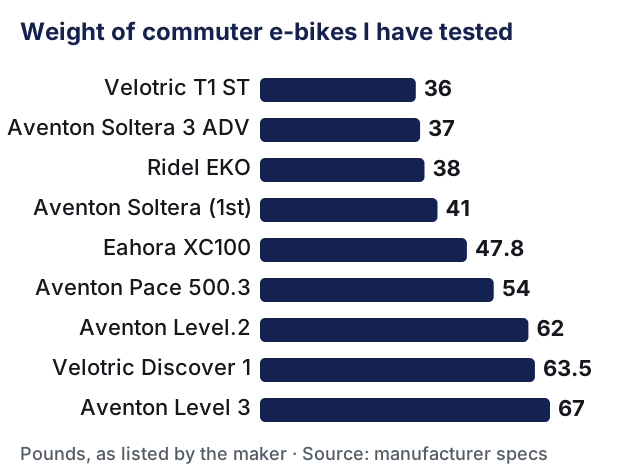
A commuter e-bike has one job: get you to work and back every day without drama. That sounds simple, but “commuter” covers everything from a 36 lb bike that feels like a regular road bike to a 67 lb bike with a rack, fenders, suspension and a throttle. I’ve tested a lot of both. The right one depends on your route, your storage and whether you can charge at work.
Commuter bikes split into two groups, and the weight chart shows the gap clearly.
Light bikes (36 to 41 lb) like the T1 ST, Soltera 3 ADV and Ridel EKO feel like a regular bike. You can carry them up stairs and ride them with the power off. In exchange you get a smaller battery, a smaller motor, usually no throttle and no suspension. They’re pavement bikes. On the T1 ST it felt so light that I only turned on pedal assist going uphill. On the Soltera 3 ADV, gravel up a slight incline took real effort even in turbo.
Loaded bikes (54 to 67 lb) like the Level.3, Level.2 and Discover 1 come with a rack, fenders, lights, a front fork and a throttle. They’re more comfortable on rough streets and easier on hills and in a headwind. They’re also hard to carry upstairs. I called the Level.2 pretty heavy, especially next to the Soltera.
Ask yourself two questions:
Will I ever carry it? Stairs, a train, a car rack. If yes, stay light.
What’s the worst pavement on my route? Potholes, curbs and gravel shortcuts push you toward a front fork and wider tires.
Classes: what’s allowed where
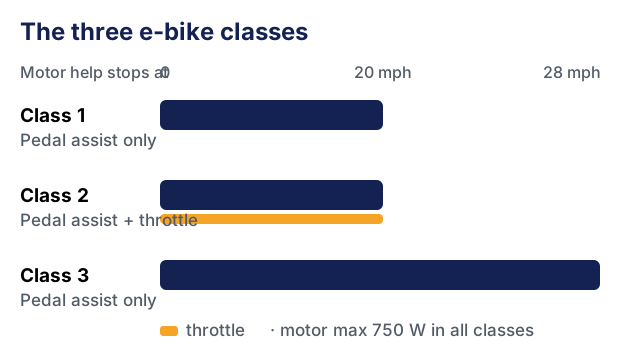
Class 1 is pedal assist to 20 mph. Class 2 adds a throttle, still 20 mph. Class 3 is pedal assist to 28 mph. Most states that use the system cap the motor at 750W. Local rules vary, so check yours.
For a commute, class matters because of where you’re allowed to ride. Many bike paths allow Class 1 and 2 but not Class 3. Class 3 bikes are often allowed in bike lanes on roads. The details depend on your state and city. My e-bike classes explainer and Class 2 vs. Class 3 guide go deeper.
Some bikes can change class. The Level.2 ships as Class 2 at 20 mph and Aventon says it can be unlocked to Class 3 with 28 mph pedal assist. The Discover 1 is listed as Class 3 but set to 20 mph by default.
What a commute costs to charge
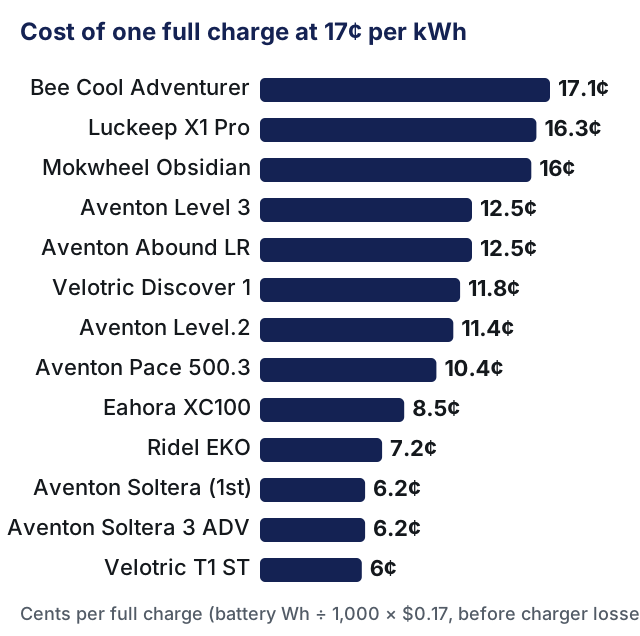
Charging is the cheapest part of owning an e-bike. Here’s the math.
A full charge costs roughly: battery Wh ÷ 1,000 × your electricity rate per kWh. Some energy is lost as heat in the charger, so the real number is a little higher.
Cost of one full charge at an example 17¢ per kWh, before charger losses. Bee Cool Adventurer 17.1¢, Luckeep X1 Pro 16.3¢, Obsidian 16¢, Level.3 and Abound LR 12.5¢, Discover 1 11.8¢, Level.2 11.4¢, Pace 500.3 10.4¢, Eahora XC100 8.5¢, Ridel EKO 7.2¢, Soltera and Soltera 3 ADV 6.2¢, T1 ST 6¢. Source: manufacturer battery specs; 17¢/kWh is only an example rate. Use your own bill.
Worked example 1: the T1 ST. Its battery is 352.8Wh. At 17¢ per kWh, a full charge is about 6¢. I rode over 100 miles on one charge, mostly pedaling on flat ground and using assist on hills. That’s about 6¢ per 100 miles in my test. Your number will be higher with more assist, but it gives you a sense of how little this costs.
Worked example 2: a year on a Level.3. Its battery is 733Wh, so a full charge is about 12.5¢ at 17¢ per kWh. Say your commute is 10 miles round trip, five days a week, 50 weeks a year: 2,500 miles. If you got 35 miles per charge (an example number, not my test result), that’s about 72 charges, or roughly $9 a year before charger losses. Even if you only got half that range, it would still be under $20.
The real cost of a commuter battery isn’t electricity. It’s the battery itself wearing out over years of charging. Keep that in mind when you compare removable and fixed batteries.
Removable vs. fixed batteries
This matters more for commuters than anyone else.
Removable (Level.2, Discover 1, first-gen Soltera): you can carry the battery into the office and charge at your desk, and store it inside in cold weather while the bike stays outside.
Fixed (T1 ST, Ridel EKO): you have to bring the whole bike to an outlet. On the EKO I noted there’s no charging it at the office. The upside is a cleaner, lighter frame.
If your bike lives outside or in a garage without power, get a removable battery.
Features I’d want for daily riding
Lights that turn on by themselves. The T1 ST’s headlight has a light sensor. The Level.3’s tail light lights up when you brake. The Ridel EKO’s lights aren’t integrated and have to be switched on by hand.
Fenders and a rack. Standard on the Level.2 and Level.3. On the Discover 1, the rack is extra. On the Pace 500.3, fenders aren’t standard.
Theft tracking. The Level.3 has built-in 4G location (free for the first year, then a paid subscription, per Aventon). The T1 ST supports Apple Find My. Neither replaces a good lock.
Torque sensor. On the Level.2, Level.3 and Pace 500.3, the harder you pedal, the more help you get. I called it the most responsive way I’ve found to ride an e-bike.
Brakes. Hydraulic discs on the Discover 1, Soltera 3 ADV and Pace 500.3. The first-gen Soltera has rim brakes, fine on dry pavement, less so in the rain.
My picks
Best all-around: Aventon Level.3
The Level.3 is the bike I recommended as an all-around commuter and a first e-bike. After several weeks it just fit me. It rides on gravel, asphalt and concrete. You get a torque sensor, a thumb throttle that works from zero in a pedal assist mode, a range estimate based on how you’ve actually been riding, an integrated rack rated about 60 lb, and front and seatpost suspension. The grips are cheaper than I’d like, the kickstand is the same cheap one as the last Level, and it showed sold out on aventon.com as of Oct 22, 2026.
Lightest: Velotric T1 ST
At 36 lb, the T1 ST feels as light as a normal bike, the motor is almost silent even in turbo, and the brakes worked fantastically. No shocks, no removable battery, and no display, just a color-coded indicator. It’s now sold as the T1 ST Plus.
Best for two riders sharing a bike: Velotric Discover 1
The Discover 1 fit me at 6’1” and my wife at 5’6” with only a seat adjustment. My wife liked it more than any other e-bike I’ve tested. The throttle and pedal assist give you lots of power instantly, and it handled curbs and light dirt. It’s now sold as the Discover 1 Plus.
Simplest: Ridel EKO
The Ridel EKO looks like a regular single speed bike; friends didn’t realize it was an e-bike. It’s light enough to carry up apartment stairs and needs very little maintenance. No throttle, fixed battery, thin tires.
Plan your commute before you buy
Before you pick a bike, ride your route once, on any bike or on a map, and answer these:
Distance, round trip. Use my tested numbers, not the rated ones, and keep a buffer. If your round trip is 20 miles and you can’t charge at work, I’d want a bike that tested at 30 or more.
Biggest hill. If there’s a long climb, look at torque and the hills guide. A 250W bike that’s lovely on flat paths can be hard work here.
Road surface. Smooth bike paths suit 36 to 41 lb bikes with thin tires. Broken pavement, curbs and gravel suit a front fork and wider tires.
Where it sleeps. Inside, garage or outside? That decides removable vs. fixed battery and how much the lock matters.
What you carry. A laptop bag fits on your back. Groceries, a gym bag or a kid need a rack, and a rack needs a rating. Do the payload math in my heavy rider guide.
Which paths you use. If part of the route is a multi-use path, check whether Class 3 or throttles are allowed there.
Common mistakes
Buying a heavy bike for a walk-up apartment. A 67 lb bike up three flights every day gets old fast.
Ignoring where you’ll charge. Fixed battery plus no outlet near the bike is a real problem.
Buying Class 3 for a bike-path commute. Check whether Class 3 is allowed on your route first.
Skipping fenders. One wet commute without them and you’ll buy them.
Trusting the rated range in winter. Cold weather reduces range on lithium batteries. Plan a buffer.
Cheap lock on an expensive bike. Tracking helps you find it, but a solid lock keeps it there.
FAQ
What’s the best e-bike for commuting?
For most people, of the bikes I’ve tested, the Aventon Level.3. It has a torque sensor, a throttle, a rack, suspension and tracking. If you need a light bike, the Velotric T1 ST is 36 lb.
How much does it cost to charge an e-bike?
At an example rate of 17¢ per kWh, a full charge costs about 6¢ for a 353Wh battery like the T1 ST’s and about 12.5¢ for a 733Wh battery like the Level.3’s, before charger losses. Use your own electricity rate.
Should a commuter e-bike have a throttle?
It’s useful for starting at lights and on hills. Class 1 bikes like the T1 ST and Soltera 3 ADV don’t have one and are allowed on more paths. Class 2 bikes like the Level.3 do.
Is a light e-bike worth it?
If you carry the bike or ride mostly paved, flat routes, yes. The T1 ST, Soltera 3 ADV and Ridel EKO are 36 to 38 lb. You give up suspension, a throttle and battery size.
Do I need suspension for commuting?
On smooth pavement, no. The T1 ST has none and was comfortable on paved paths. On rough streets, a front fork like the Level.3’s or Discover 1’s makes a real difference.
Can I charge an e-bike at work?
If it has a removable battery, yes, as long as your workplace allows it. The Level.2 and Discover 1 have removable batteries. The T1 ST and Ridel EKO don’t.
Check prices for the bikes in this guide
Prices change often, so these links go to the current listing. I only show a price where it's in my review data.