In the full review (13 sections)
- Quick specs: Toro Power Max e24 (39924, current production model)
- A prototype, in sleet, before production
- How it’s built
- Range: about 1,000 feet on three batteries
- Self-propelled, and it climbs
- The controls are spot on
- Why battery makes sense for a snow blower
- How it compares
- Pros and cons
- Who should buy it, and who should skip it
- FAQ
- Why this review stops here
- Sources
Short verdict: The Power Max e24 looks like a gas two-stage snow blower, but it runs on Toro’s 60V batteries, and that’s what makes it work. With three 6Ah batteries I cleared about 1,000 feet of heavy sleet before they ran out. It drove itself up a slope too steep for me to walk up in snow boots, and its controls are the best I’ve used on a snow blower. The unit I tested was a prototype Toro sent me early, with a battery door I had to tape shut, which Toro told me it would fix before production. As of October 26, 2026, the production e24 (model 39924) lists at $1,649 on Toro’s site with two 6.0Ah batteries, and there’s now a bigger e26.
Disclosure: Toro sent me this prototype to review. My opinions are my own.
Quick specs: Toro Power Max e24 (39924, current production model)
| Spec | Toro Power Max e24 (39924) |
|---|---|
| Type | Two-stage, self-propelled |
| Clearing width | 24 in |
| Intake height | 20 in |
| Auger / impeller | 11 in / 11 in, hardened gears, no shear pins |
| Batteries | (2) 60V Max L324, 6.0Ah, 324Wh, included; third port open |
| Claimed runtime | Up to 70 minutes |
| Claimed capacity | Up to 24 car spaces in up to 10 in of snow on 2 batteries; add a 7.5Ah battery in the third port for 4 to 15 more spaces (Toro’s numbers vary by page) |
| Charge time | 180 minutes |
| Throw distance | Up to 45 ft |
| Drive | 6 forward, 2 reverse |
| Chute | Steel, Quick Stick control |
| Lights | LED headlights |
| Weight | 172 lb |
| Chargers included | 2 |
| Warranty | 3-year limited (Toro) |
| Price as of Oct 26, 2026 | $1,649 (Toro) |
| CPSC recalls | None found for the e24. Toro’s 2021 Power Max recall covered the gas Power Max 826 OHAE (model 37802), not this battery model |
A prototype, in sleet, before production
Toro sent me a prototype while we still had winter weather, so I could film before the season ended. What we got was sleet, not snow. That turned out to be a harsh test, because sleet is basically little ice balls that pack together. The e24 still scooped most of the ice and slush off the pavement.
So keep in mind what this review is and isn’t. It’s a prototype, and the conditions were heavy sleet. I didn’t get to test it in real snow.
How it’s built
It’s huge. The layout, with an auger and impeller in front and a big housing on top, is something you almost always see on gas machines. The big block where a gas engine would go holds an electric motor here, powered by Flex-Force batteries. There’s no gasoline at all.
Even as a prototype, most of the parts felt well built. I say most because of one battery door. One of the three battery compartment lids wouldn’t stay closed, and I had to tape it shut. Toro already knew about it and told me it would be fixed in production. I haven’t been able to check a production unit, so I can’t confirm the fix myself. Toro’s manual has a related warning: if a battery lid won’t close all the way, the battery isn’t fully seated.
Range: about 1,000 feet on three batteries
My e24 took three batteries, compared with one for Toro’s smaller single-stage blower. With three 6Ah batteries I cleared about 1,000 feet before they were completely drained. I think that’s good range, especially since what it was throwing was heavy sleet, not light snow.
Two notes for buyers today:
- The production kit includes two batteries, not three. The third port is open for a battery you already own or buy separately. Toro’s manual says the installed batteries must add up to at least 6.0Ah or the machine won’t start.
- Toro’s capacity claims are in car spaces, not feet. Toro claims up to 24 car spaces in up to 10 inches of snow on the two included batteries. One Toro page claims 4 to 15 more spaces with a third 7.5Ah battery, and up to 39 spaces with three 7.5Ah batteries. I can’t convert my 1,000 feet of sleet into car spaces, so treat my number and Toro’s as separate data points.
Self-propelled, and it climbs
The self-propel goes forward and reverse, and it’s strong. It drove the machine up an incline so steep that I couldn’t walk up it in snow boots. On a 172-pound machine you need that. The production model has six forward speeds and two reverse.
The controls are spot on
For me, this is where the e24 is better than most snow blowers I’ve used:
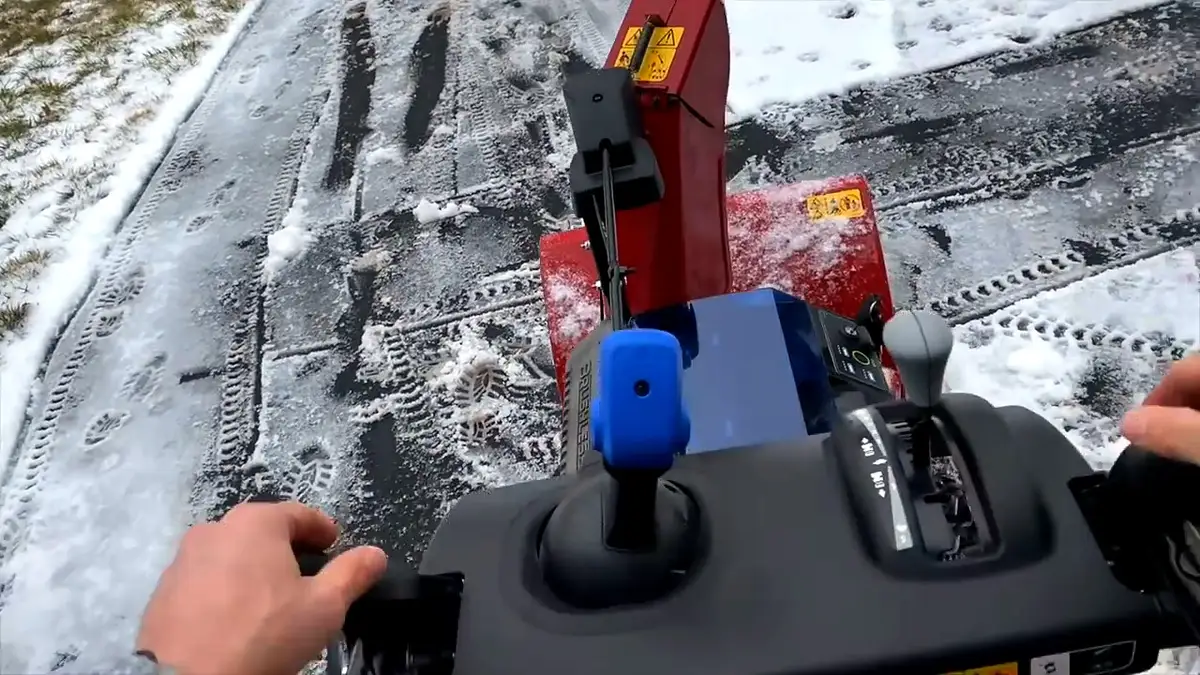
- A joystick controls the chute. It changes both the direction and the angle of the throw, and it’s easy to use while you’re moving. Toro calls it Quick Stick.
- A speed lever sets forward and reverse.
- Two separate bails. One starts the auger and impeller. The other engages the drive. So if you need to turn around or make another loop without throwing snow, you hold only the drive bail, reposition, then engage the auger again and keep going.
- A battery light for each of the three batteries. That’s a big deal, and it’s something I’ve wanted on Toro’s mower. EGO puts a charge display on its batteries, and I’m glad Toro did it here.
- A clean-out tool. Like every snow blower, mine clogged, though not badly given that sleet packs into clumps. Toro includes a small clearing tool so you never put your hand in the chute.
Why battery makes sense for a snow blower
A snow blower sits idle most of the year. With gas, you either prepare it for storage or deal with old fuel. With batteries, when winter comes back you charge them and put them in.
That’s even better if you already own Toro 60V tools. The batteries are already charged from the mower and trimmer. I mentioned in the video that this would make sense for, say, a small apartment complex that needs a machine for two or three months of the year.
How it compares
| Toro Power Max e24 (39924) | Toro Power Max e26 (39926) | EGO Power+ SNT2405 | |
|---|---|---|---|
| Clearing width | 24 in | 26 in | 24 in |
| Intake height | 20 in | 20 in | 20 in |
| Batteries included | (2) 60V 6.0Ah | (2) 60V 7.5Ah | (2) 56V 7.5Ah |
| Battery ports | 3 | 3 | 2 |
| Claimed capacity | Up to 24 car spaces, 10 in snow | Up to 30 car spaces, 10 in snow | 18-car driveway, 8 in snow |
| Throw distance | Up to 45 ft | Up to 45 ft | Up to 50 ft |
| Drive | 6 forward, 2 reverse | 6 forward, 2 reverse | Variable, forward and reverse |
| Hand warmers | not listed | Yes | not listed |
| Weight | 172 lb | 186 lb | not listed |
| Warranty | 3-year limited | 3-year tool, 3-year battery | 5-year tool (dealer listing) |
| Price as of Oct 26, 2026 | $1,649 (Toro) | $1,899 (Toro) | $1,499 sale, $1,649.99 regular (Boyd’s Outdoor Power) |
| Tested by me | Prototype | not tested | not tested |
How I’d read that:
- e24: the one I’d get if you already own Toro batteries and want a gas-style two-stage.
- e26: $250 more (October 26, 2026 prices) for two more inches of width, bigger 7.5Ah batteries and hand warmers.
- EGO: cheaper on sale, and it throws farther on paper, but it has two battery ports instead of three. It’s the obvious choice if you’re already on EGO.
Pros and cons
Pros
- It handled heavy sleet in my testing
- About 1,000 feet cleared on three 6Ah batteries in sleet
- Its self-propel climbed a slope I couldn’t walk up
- Joystick chute control works on the move
- Separate drive and auger bails make repositioning easy
- A charge light for each battery
- No fuel to manage in the off-season
- A third battery port for more runtime
Cons
- The prototype battery door needed tape; Toro said production would fix it, and I haven’t verified that
- I haven’t tested it in real snow
- Heavy, at 172 lb
- Only two batteries in the box, and a 180-minute charge time
- It still clogs in packing sleet, as any blower will
- Expensive compared with gas two-stage blowers of the same size; Toro’s recall notice says the gas Power Max 826 sold for about $1,200 in 2020-21
Who should buy it, and who should skip it
Buy it if you already own Toro 60V batteries, you want a full-size two-stage with no gas, your driveway has a hill, or you hate preparing an engine for summer storage.
Skip it if you get very heavy snow often and want throw distance above all, you don’t have Toro batteries and want the cheapest way in, or you’d rather wait for reviews of production units.
FAQ
Is this a production model? No. Mine was a prototype Toro sent early. Toro said the battery door I taped would be fixed in production.
How far did it go on a charge? About 1,000 feet on three 6Ah batteries, clearing heavy sleet until they were fully drained.
How many batteries come with it? Two 6.0Ah batteries and two chargers with the current 39924, plus an empty third port.
Can it climb hills? Mine drove up a slope I couldn’t walk up in snow boots.
Does it have shear pins? Toro says no. It uses hardened gears and bolts instead.
How do I clear a clog? Use the included clearing tool, never your hand.
Has the e24 been recalled? I found no CPSC recall for it as of October 26, 2026. Toro’s 2021 recall was for the gas Power Max 826.
What does it cost? $1,649 on Toro’s site as of October 26, 2026.
Why this review stops here
I have one video on this machine, filmed on a prototype in sleet. I don’t have real-snow footage, production-unit testing or multi-season results, and I’m not going to guess at any of them.
Sources
- My video: Toro 60V Power Max e24 full review (June 3, 2021)
- Toro 39924 page, accessed Oct 26, 2026
- Power Max e24 operator’s manual, accessed Oct 26, 2026
- Toro Power Max e26 (39926) page, accessed Oct 26, 2026
- Toro Power Max 826 recall notice, accessed Oct 26, 2026
- EGO SNT2405 at Boyd’s Outdoor Power, accessed Oct 26, 2026